
Ethan Sun, Founder & CEO, SunAura Thermal
Bedrooms are the room type where wall heating makes the clearest case, and it is a case about the overnight hours rather than the evening. A sleeping person is still, covered by bedding, and in a room that is expected to be cooler than the rest of the house. Those three facts change what a heater needs to do — and they make the noise, draught and dry-air characteristics of convection heating more objectionable at 3 a.m. than at any other time of day.
This guide is for the buyer specifying wall film for a bedroom or a child’s room. It covers the overnight setpoint, what Low actually delivers, wattage by room size, the noise and humidity question, the clearance rule for children’s rooms, and an honest running-cost arithmetic you can redo with your own tariff.
Why bedrooms suit radiant wall heat
Three properties of a wall film line up with how a bedroom is actually used.
It is silent. There is no fan, no compressor, no expanding and contracting metal. The only audible event is the thermostat relay, and on an in-line controller even that is a switch rather than a regular cycling click. In a room where the heater runs while the occupant is trying to sleep, silence is a feature rather than a nicety.
It does not move air. Convection heating works by circulating air, which is why it dries the room and why it produces the faint draught a sleeper notices at shoulder height. A radiant panel warms surfaces and bodies directly, with no air movement to create that draught.
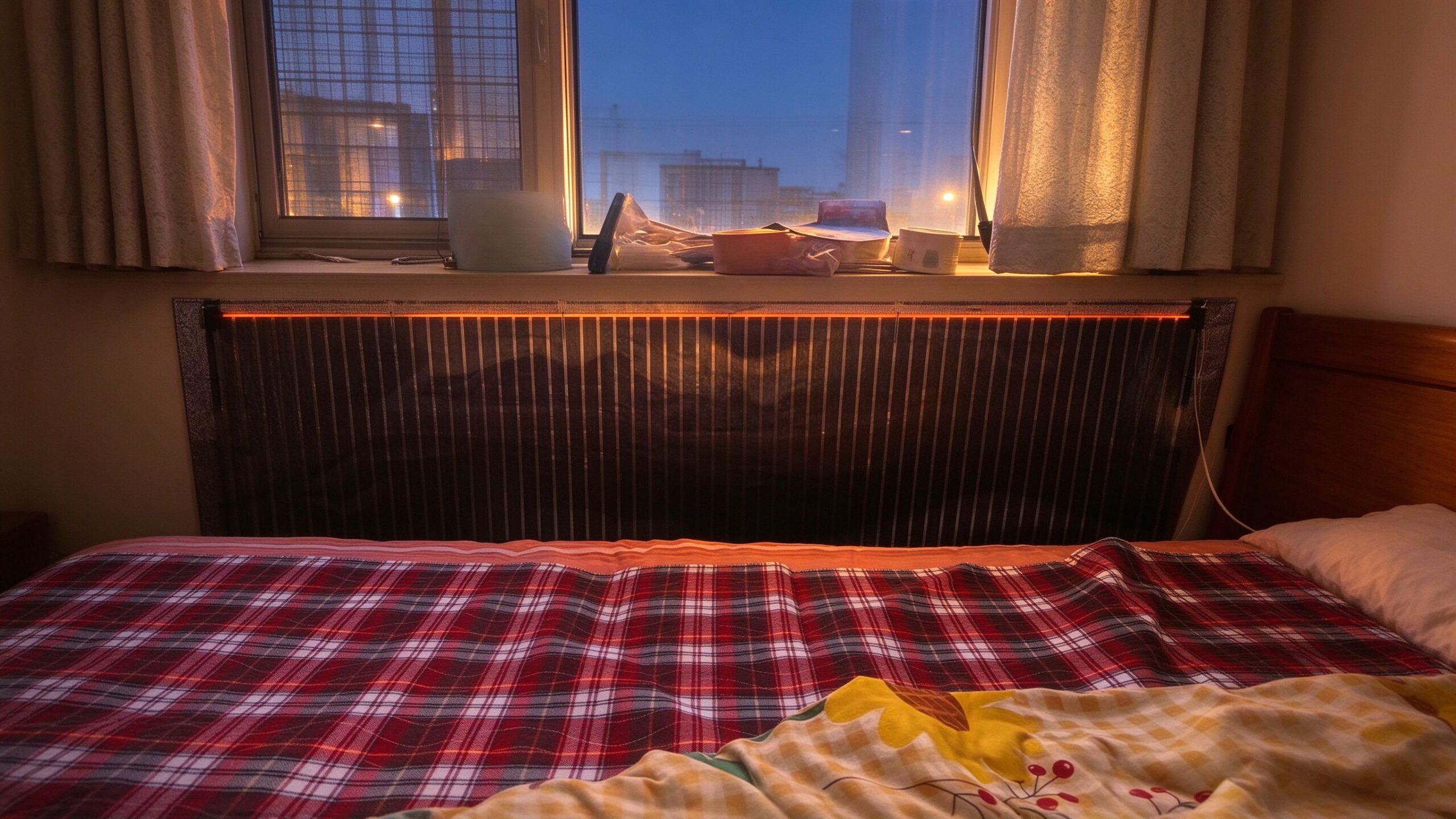
It warms the person, not the volume. A sleeping occupant under bedding is already insulated; what feels cold is the face and the air immediately around the bed. A panel above the headboard radiates onto exactly that zone, which is why a bedroom can feel comfortable on a lower air temperature with wall film than with a convection heater.
Overnight setpoints: the number that matters
Bedroom overnight temperatures sit below daytime living-room temperatures by design, and the range most households settle on is roughly 16–19 °C air temperature overnight, with the radiator or panel doing less work than it does in the evening.
The common error is to run the bedroom at the same setpoint as the living room and conclude that the room is expensive to heat. It is not the room that is expensive; it is the setpoint. Dropping two degrees overnight is the single largest and least disruptive energy decision in a bedroom, and it is a decision about the thermostat rather than the heater.
The second error is the opposite: switching the panel off entirely and relying on bedding. That works for the occupant who likes a cold room, and it does not work for a child’s room, a room with an elderly occupant, or a room where the occupant gets up in the night. A radiant panel on Low holds a stable background temperature without the on-off swings of a thermostat hunting a setpoint it cannot reach.
Low, High and duty cycle
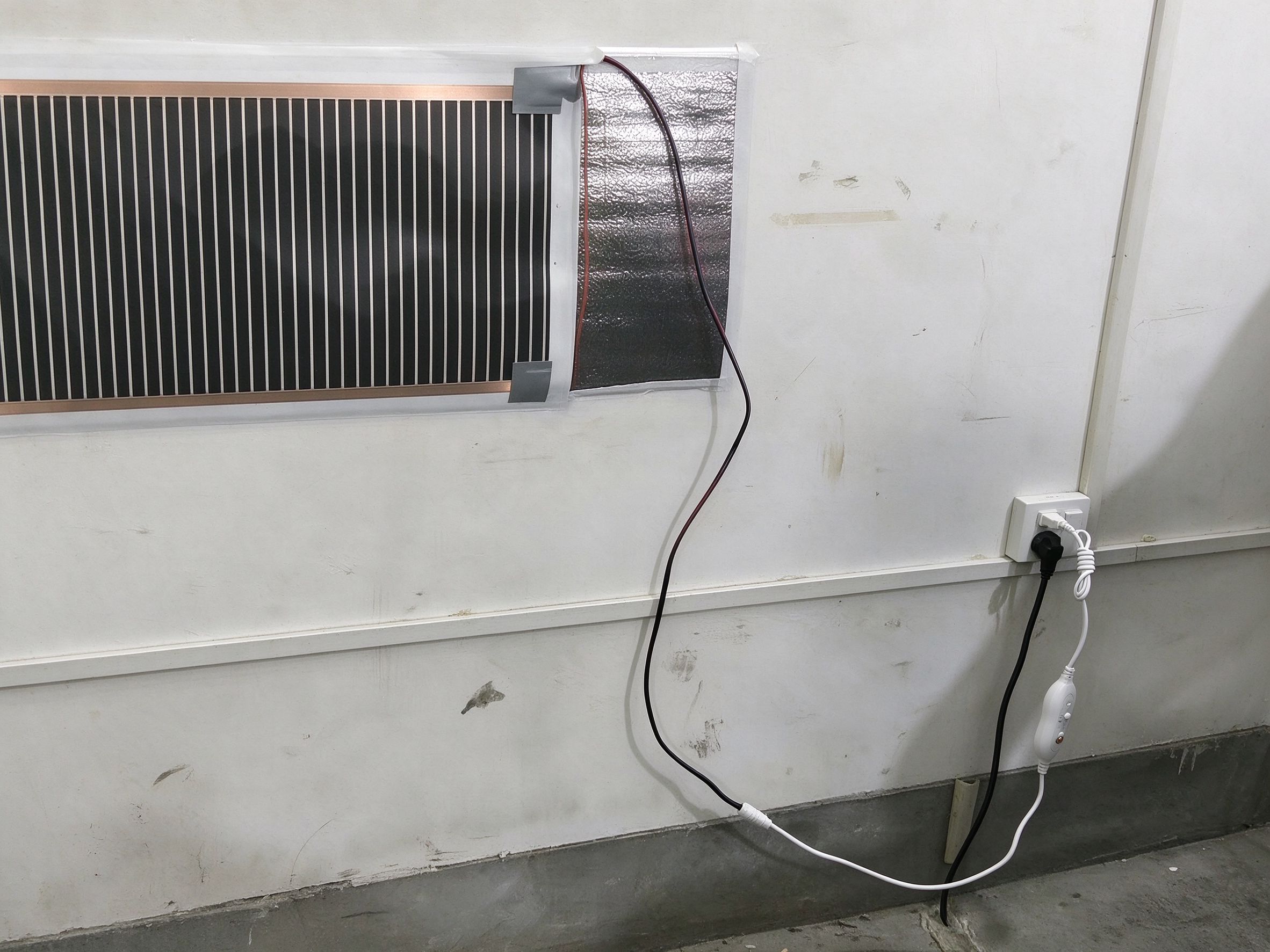
The standard wall panel ships with an in-line controller offering High, Low and Off. High is for warm-up and for the coldest evenings; Low is the overnight setting, and it is what this article is really about.
Low does not mean the panel is off. It means the panel runs at reduced output, holding the wall warm rather than driving it to full surface temperature. In practice a bedroom panel on Low will spend much of the night near its lower working band rather than cycling between full power and nothing, which is the behaviour that makes the overnight hours comfortable and quiet.
Where a programmable room thermostat replaces the in-line switch, the equivalent strategy is an overnight setpoint two degrees below the evening setpoint, with a timed transition rather than a step. The transition time matters in a bedroom: a panel that drops from evening to overnight setpoint an hour before sleep is less noticeable than one that drops at the moment the occupant gets into bed.
For rooms where the heating is supplementary rather than primary, Low may be enough for the entire night and High may never be used except on the coldest weeks.
Wattage by bedroom size
| Bedroom | Panel | Power | Position | Overnight setting | Note |
|---|---|---|---|---|---|
| Small single, 8–10 m² | 50×150 cm | 375 W | Above headboard or under window | Low | Adequate as primary in an insulated room |
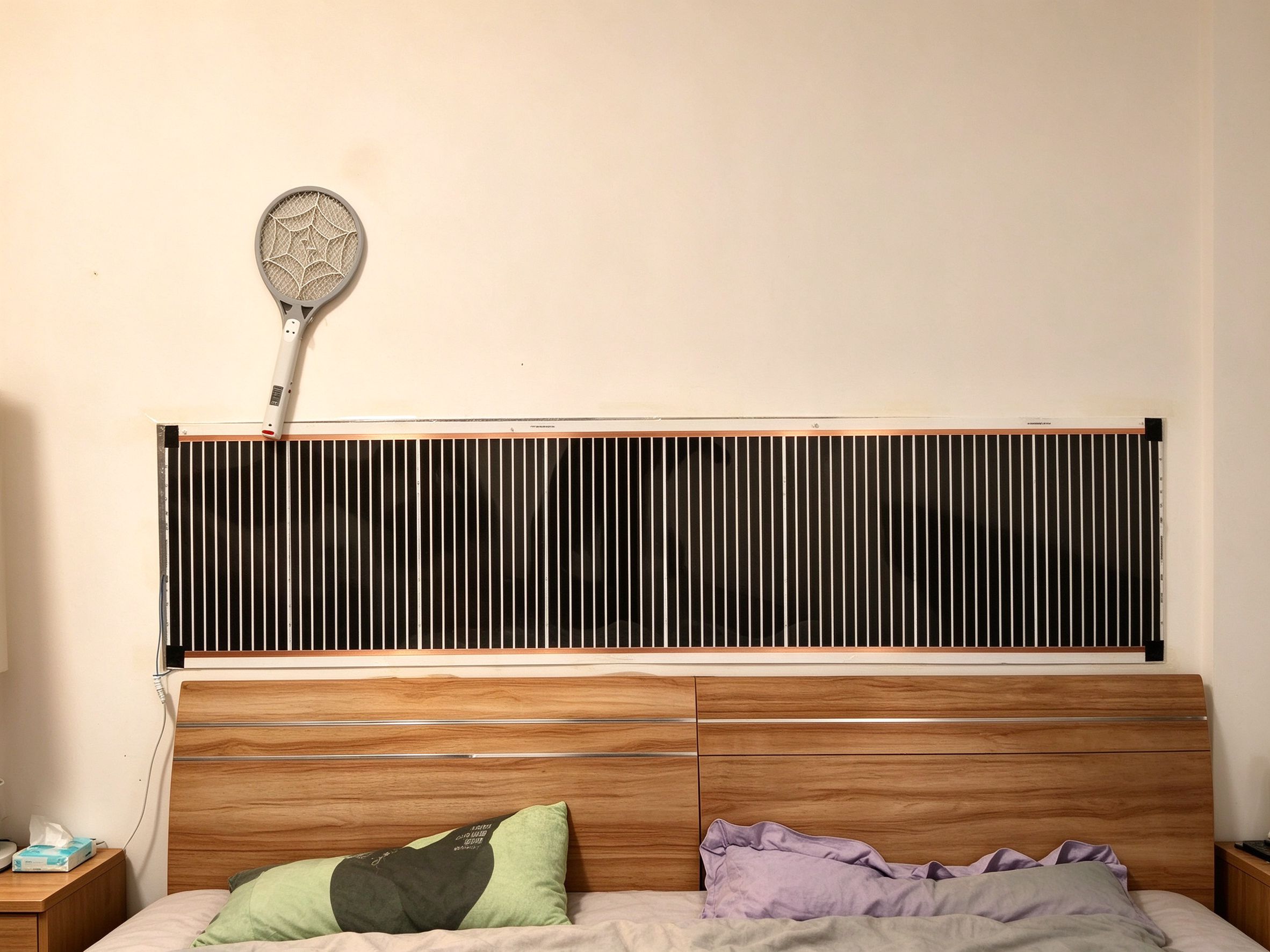
| Standard double, 12–14 m² | 50×200 cm | 500 W | Above headboard, 1000 mm | Low overnight, High pre-heat | The most common specification |
| Large double, 16–18 m² | 50×300 cm | 750 W | Headboard wall or two walls | Low | Two smaller panels distribute better than one |
| Child’s room, 10–12 m² | 50×150 cm or 50×200 cm | 375–500 W | Above cot or bed, clearance enforced | Low, with room thermostat if possible | Clearance rule is the governing constraint |
| Bedroom with ensuite | Panel plus a 50×50 cm in the ensuite | 500 W + 125 W | Headboard and beside the vanity | Bedroom Low; ensuite timed | Separate control for the ensuite |
These figures follow the factory’s indicative coverage ranges — a 500 W panel covering 5–7 m² as a primary source — and they assume a reasonably insulated room. A bedroom in an uninsulated older building, or one with single glazing and a north-facing wall, moves toward the conservative end of the range or takes a larger panel.
Noise, dry air and the complaint pattern
The complaints that reach us about bedroom heating are consistent enough to be worth listing, because they describe what people are actually reacting to.
Noise. A fan heater in a bedroom is audible at the other end of the room. An oil radiator clicks as it heats and cools. A split system’s indoor unit is quiet but not silent, and its defrost cycles are not. A wall film makes no sound at all beyond the controller switch.
Dry air. Convection heating raises air temperature and lowers relative humidity in the room, and the effect is noticeable overnight as a dry throat or dry eyes. Radiant heating raises the temperature of surfaces and bodies with far less air movement, so the humidity change is smaller for the same comfort level.
Cold feet. Radiant wall heating warms the body and the wall it faces, not the floor. A bedroom with cold floors may still feel cold underfoot; if that is the complaint, a small floor mat in the area beside the bed complements the wall panel better than a larger wall panel does.
Dust and odour. A convection heater passing room air across a hot element carries dust with it, and the smell at the start of the season is the result. A wall film at 50–70 °C does not produce that effect to the same degree, and it does not circulate dust around the room.
Children’s rooms and the clearance rule
The film is fully shielded and emits no electromagnetic radiation — the first question parents ask, and the answer is a genuine product characteristic rather than a reassurance. The safety issue that actually matters in a child’s room is different, and it is mechanical.
The printed rule is that the front face must remain clear. Covered, the panel’s surface temperature can exceed 100 °C within minutes, and a child’s room is a room where things end up draped over furniture and pushed against walls. Three measures make the specification defensible: mount the panel above the cot or bed at a height the child cannot reach, keep the wall run in front of the panel free of shelving and hanging storage, and put nothing — a curtain, a canopy, a muslin — within the panel’s footprint.
A room thermostat with a lockable range is worth the small extra cost in a child’s room, because it removes the possibility of a child turning the panel to High overnight. Where the budget does not extend to that, the in-line switch should be positioned out of reach rather than at skirting level.
Compared with the alternatives
| Wall film | Electric blanket | Oil radiator | Split system | |
|---|---|---|---|---|
| Noise | None | None | Clicking as it cycles | Low but present; defrost cycles audible |
| Air movement | None | None | Natural convection only | Fan-driven |
| Heats the room, not just the bed | Yes | No — bed only | Yes | Yes |
| Warm-up | About one minute to surface temperature | 10–20 minutes | 15–30 minutes | Several minutes, plus defrost in cold weather |
| Floor footprint | None | None | 0.3–0.5 m² | Wall unit plus outdoor unit |
| Overnight suitability | High, on Low | High for the person, no room heat | Moderate — cycling noise | Moderate — noise and dry air |
| Child safety considerations | Clearance rule, mounting height | Overheating risk if left on high | Hot surface, tip-over risk | Remote control, filter hygiene |
The comparison that matters most is with the electric blanket, because it is the cheapest way to be warm in bed and it does nothing for the room. A wall panel and an electric blanket are not alternatives; on a very cold night, the blanket warms the sleeper and the panel keeps the room from becoming a cold box, and the combination is more comfortable than either alone.
Running-cost arithmetic
Here is the arithmetic without a claim attached. A 500 W panel running at full output for eight hours consumes 4 kWh. On Low, drawing perhaps half its rated output across the night, it consumes around 2 kWh. On a thermostat cycling at 50 % duty at the evening setpoint, it consumes roughly 2 kWh over the same window.
Multiply by your own tariff. At an illustrative 0.30 per kWh, 2 kWh is 0.60 for the night. At 0.15 per kWh it is 0.30. Neither figure is a promise; both are what the panel’s rated load implies, and the difference between them is your electricity contract rather than the product.
The comparison worth making is against the alternatives at the same comfort level. An oil radiator rated at 1.5 kW does not run continuously, but it runs more of the night than a 500 W panel on Low does, and it heats a larger air volume to do the same job. A split system has a better coefficient of performance and a lower running cost per delivered kilowatt-hour in mild conditions, and it loses that advantage as outdoor temperature falls — which is exactly the period when a bedroom heater is working hardest.
What we will not do is publish a percentage saving for wall film against any of them. The number depends on tariff, climate, room insulation, occupancy and the duty cycle of the previous system, and a single headline figure would be a guess dressed as a measurement.
Insulation, pre-heat and the first hour
Two practical points close the gap between the arithmetic and the actual bill.
First, pre-heat rather than boost. Because the panel reaches working temperature in about a minute, a bedroom can be brought to the evening setpoint shortly before occupancy instead of being held warm all afternoon. A timer that switches the panel on thirty minutes before the household goes to bed uses less energy than a panel held at temperature from mid-afternoon.
Second, treat the room’s insulation as part of the heating system. A bedroom with single glazing and an uninsulated wall loses heat faster than a 500 W panel can replace it at the overnight setpoint, and the panel then runs near-continuously at full output — which is the case where the bill surprises people. Curtains, draught sealing and a floor mat cost less than a larger panel and change the arithmetic more.
Data and evidence
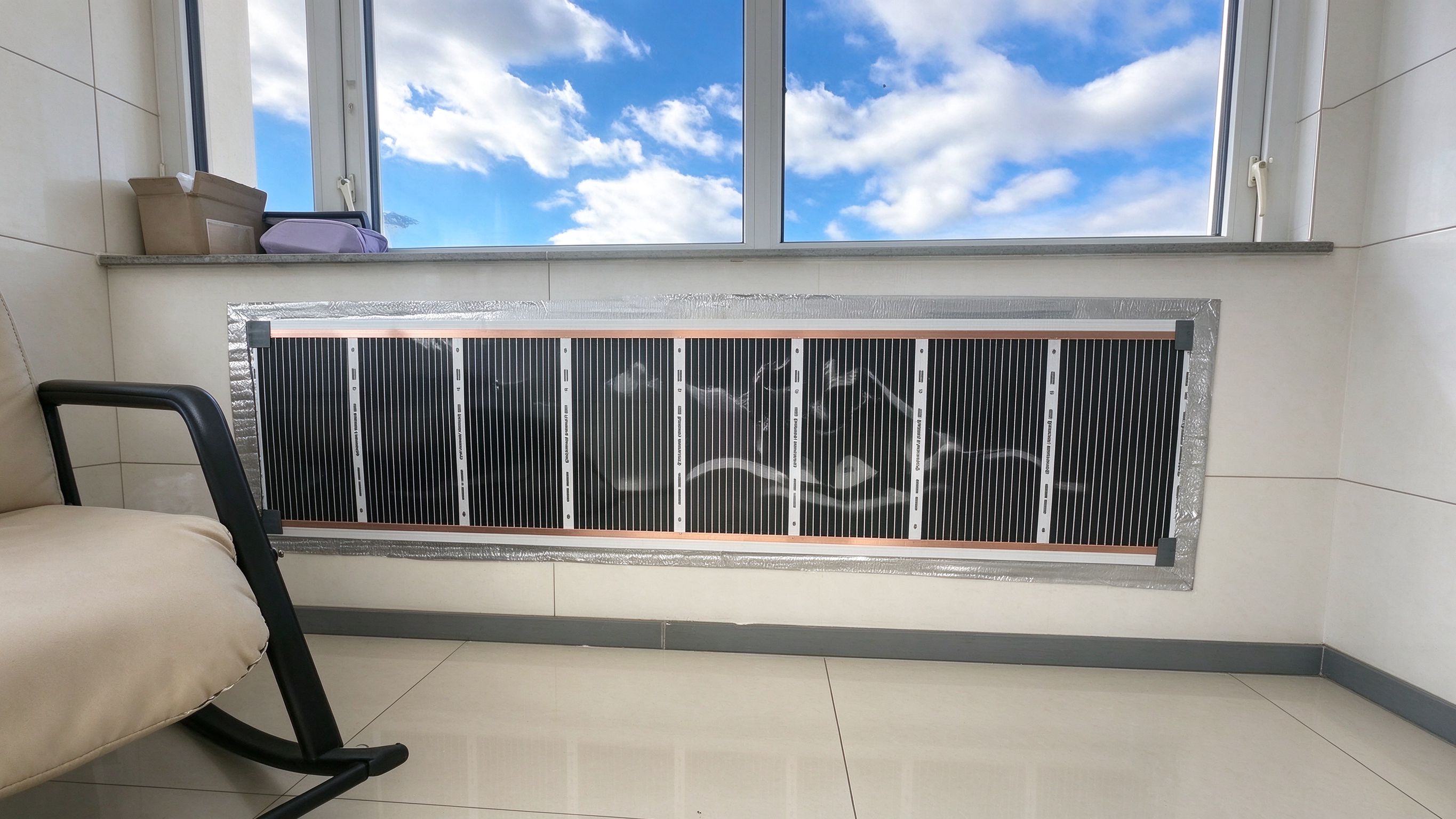
Product data: XGF-WALLFILM printed graphene-carbon resistive stripes on laminated film with silver reflective backing, 220 V supply, 500 W/m² power density, standard 50 cm strip width, panels from 30×50 cm (60 W) to 50×400 cm (1000 W), surface uniformity within 3 °C across a panel, working temperature 45–55 °C under thermostat control, roughly 60 °C typical uncovered surface, about 67.7 °C measured by infrared thermometer in the factory demonstration, approximately one minute to operating surface temperature, fully shielded with no electromagnetic radiation emission, interior wall installation only, and 500 W panel indicative coverage of 5–7 m² as a primary source and 7–9 m² as auxiliary.
Warranty: controller 1 year, film body 3 years, with a company-level 15-year warranty support framework for registered B2B partners covering manufacturing-defect handling and long-term parts supply.
Factory side: SunAura Thermal has manufactured graphene heating film, mats, cables and controls since 2008 — seventeen years from the Qingdao (Huangdao) plant, six automated production lines, approximately 500,000 m² monthly graphene film output, ISO 9001 quality and ISO 14001 environmental management, CE and RoHS certification on the wall film line, and distribution into more than 50 export markets. Certificate numbers are supplied with the quotation rather than published in marketing copy.
The running-cost figures above are arithmetic from rated load, not metered results, and are labelled as illustrative throughout. The descriptions of noise, dry air and dust behaviour are field observations from installation feedback rather than controlled comparisons.
FAQ
Is it safe to leave a wall panel on all night? Yes, on Low or under a thermostat, provided the front face is clear and nothing is draped over it. The clearance rule is the safety condition, not the duration of operation.
Can it replace an electric blanket? No, and it should not try to. The blanket warms the sleeper; the panel keeps the room from becoming a cold box. Used together they cover different jobs.
Will it make the room dry? Less so than convection heating, because it does not circulate air to the same degree. Bedrooms with wall film typically report less dry-throat discomfort than the same room with a fan heater.
What size for a 12 m² double bedroom? A 50×200 cm, 500 W panel above the headboard is the standard specification, sized within the 5–7 m² primary coverage range and adequate as the room’s main heat source in an insulated building.
Can I put it in a child’s room? Yes. Mount it above the cot or bed at a height the child cannot reach, keep the wall run clear, and enforce the no-covering rule. A lockable room thermostat is worth adding.
Does it need a floor sensor? No. A wall panel is controlled by room or remote sensing; a floor probe has nothing to measure.
Next step
Tell us the bedroom dimensions, the glazing, and whether the panel will be the room’s main heat source or a supplement. We will recommend a panel size and an overnight control arrangement, and flag if the room’s insulation is the real constraint rather than the heater. The wall heating film range lists standard panels, our renovation guide covers room-by-room selection, and the comparison with other heater types sets out where radiant wall heat wins and where it does not. For the control side, the zoning guide explains when a bedroom earns its own thermostat zone. For where the panel goes in a bedroom, see the mounting position guide; for a whole-flat retrofit, the apartment case study.