
Tortoises are heavy, ground-dwelling, diurnal reptiles that need a precise, warm basking zone and a genuinely cool retreat inside their indoor enclosure. Whether you keep a Mediterranean tortoise (Hermann’s, Greek or Russian), a tropical red-foot or yellow-foot, or a larger leopard tortoise, indoor winter housing depends on two heat systems working together: an overhead basking lamp for the hot spot, and a tortoise heat mat under the enclosure floor to provide gentle belly heat and prevent the cool side from becoming dangerously cold. In this guide we set out the species-standard indoor temperature ranges, how to use a mat safely for an animal that weighs several kilos, how to size it, the thermostat rules, and the OEM/wholesale options for reptile retailers.
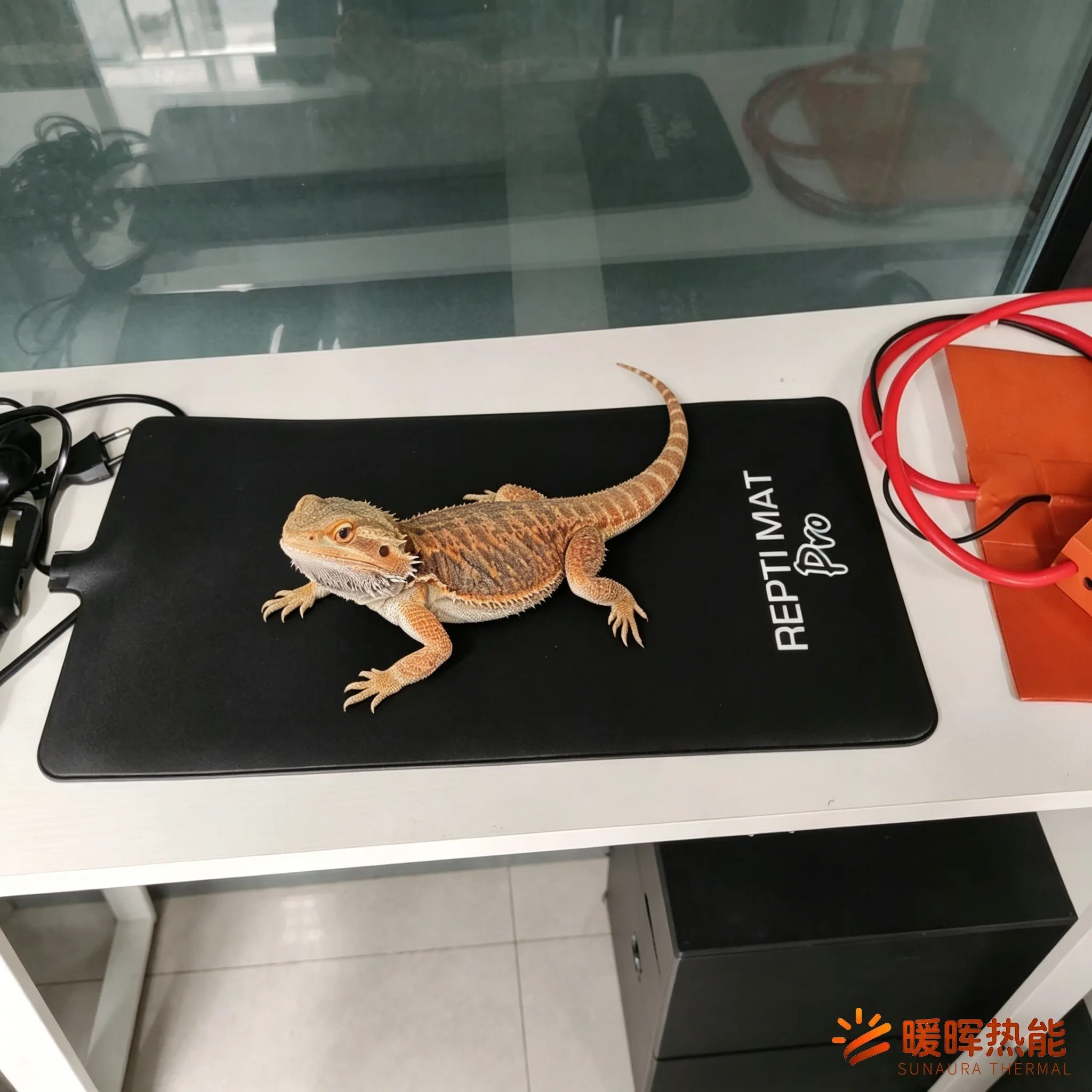
Why Correct Heating Matters for a Tortoise
Tortoises are ectothermic grazers. Their digestion, shell growth, appetite and immunity all depend on reaching the right body temperature through the day. The widely published indoor husbandry ranges are:
- Basking spot (under the lamp): approximately 30–32 °C (86–90 °F) on the basking surface.
- Warm-side floor / ambient warm end: roughly 26–28 °C (79–82 °F).
- Cool side: approximately 20–24 °C (68–75 °F) — never below ~18 °C indoors for an active tortoise.
- Night time: a drop to ~15–18 °C is acceptable for Mediterranean species; tropical species (red-foot, yellow-foot) should not fall below ~20 °C.
A tortoise kept too cool stops eating, develops runny eyes or respiratory issues, and can fail to thrive. A basking spot that is too hot (above ~35 °C) without a cool retreat forces the animal to overheat. The heat mat’s job is not to replace the basking lamp — it is to keep the floor warm enough that the tortoise can press its plastron against a surface that supports digestion, and to stop the cool end from dropping to room-temperature lows in winter.
Heat Mat vs Basking Lamp vs Ceramic Heater
- Basking / halogen lamp (overhead): the primary heat source for a tortoise. It creates the 30–32 °C hot spot the animal basks under, and — combined with UVB — drives appetite and calcium metabolism. Non-negotiable indoors.
- Heat mat (under-tank / under-table): supplements the lamp by warming the warm-end floor for belly heat and, more importantly, by preventing the cool side from becoming too cold. It runs silently with no light.
- Ceramic heat emitter: useful in very cool rooms for background air temperature, always on a separate thermostat.
For a tortoise, the honest framing is: the basking lamp creates the gradient from above, and the heat mat stabilises the floor from below. The mat is especially valuable at night, when switching the lamp off can leave an indoor tortoise table too cold in an unheated room.
How the SunAura Reptile Heat Mat Range Fits a Tortoise Setup
We manufacture the pet and reptile heating pad range in-house in Qingdao. The real specifications:
- Graphene film element sealed in a moisture-resistant, wipe-clean PVC jacket; shielded, low-EMF construction for continuous 24/7 operation.
- 10-speed temperature controller with ten fine steps to tune the warm-side floor surface; knob and plug-in variants also available.
- PTC auto temperature limiting caps the surface and prevents runaway overheating; the low-temperature construction holds the surface below 50 °C — comfortably above the tortoise’s 30–32 °C basking target but capped well below a burn threshold.
- 220 V / 110 V rated with EU, US, AU, UK and JP plug options and a 1.5 m cord.
- CE / RoHS certified under ISO 9001:2015; test reports on request.
Sizes/wattages: 15×14 cm (5 W low); 15×28 cm (7 W low / 14 W standard); 28×28 cm (14 W low / 28 W standard); 28×42 cm (20 W low / 40 W standard); 28×53 cm (28 W low / 52 W standard); 28×65 cm (35 W low / 63 W standard); 28×80 cm (45 W low / 78 W standard). Because tortoise tables are large, the 28×65 cm or 28×80 cm pads are the relevant sizes — placed under the warm end only.
Placement & Installation for a Heavy Animal
A tortoise weighs several kilos and walks everywhere — so the mat must never be inside the enclosure.
- Mount on the outside underside of the tortoise table’s bottom or under the glass tank. Never fix the mat to the inside floor where the tortoise can scratch, soil or stand directly on it.
- Cover the warm end only (about one third of the floor). The mat sits under the warm end so the floor there reaches ~26–28 °C; the cool end stays at room temperature, never below ~18 °C.
- Make firm, even contact. A tortoise table often has a thick wooden base; remember that timber insulates. If you mount the mat under a thick wooden floor, expect the surface temperature at the animal to be lower than the mat’s own surface — verify with a probe on the inside floor and step the controller up as needed.
- Substrate / bedding. Tortoises often sit on 3–5 cm of substrate or grass turf; this insulates slightly, so measure the floor at the animal’s level.
- Keep the controller and cord away from the water bowl and any cleaning area. Tortoises splash; the PVC jacket is moisture-resistant but not submersible.
Thermostat & Temperature Control
The mat must run through a thermostat with a floor probe. Even with PTC limiting, the probe is what holds the warm-end floor at 26–28 °C rather than letting it drift. Place the probe under the floor (or taped to the inside floor surface) at the warm end. Run the overhead basking lamp on its own separate thermostat or dimming thermostat so the lamp and the mat do not compound and overshoot the basking spot. Log both the basking-spot surface and the cool-side floor for the first week. Our thermostats & controllers range includes probe-controlled units suited to tortoise tables and vivariums.
Day, Night & Seasonal Management
Indoor tortoise tables are most vulnerable in winter, when an unheated room falls to 10–15 °C at night. The overhead basking lamp runs during the day to create the hot spot; overnight, the lamp switches off and the mat — on a low setpoint — keeps the warm-end floor from going cold. Mediterranean species can tolerate a night drop to ~15 °C; tropical species should not fall below ~20 °C overnight. In summer, as the room warms, step the 10-speed controller down a notch to avoid overheating the floor. If you brumate an adult tortoise, remove mat heat and follow a proper cooling protocol under supervision.
Sizing the Right Mat for Your Tortoise Enclosure
- Young / small tortoise in a 60–80 cm table: the 28×42 cm (20 W low) pad under the warm end.
- Adult Mediterranean tortoise in a 100–120 cm table: the 28×65 cm (35 W low) pad under the warm end.
- Large tropical or leopard tortoise in a 150 cm enclosure: the 28×80 cm (45 W low) pad under the warm end, paired with a suitably powerful basking lamp.
Choose the low-temperature construction and the smallest wattage that holds the warm-end floor at ~26–28 °C when the room is at its coldest. Because the mat supplements the lamp rather than replacing it, there is no benefit to over-wattaging — it simply overshoots and cycles hard.
Mediterranean vs Tropical Tortoises: Adjust the Numbers
“Tortoise” covers very different climates, and your mat setpoint should reflect the species you keep. Mediterranean tortoises — Hermann’s, Greek and Russian tortoises — come from hot, dry summers with cool winters. They tolerate a genuine night drop and even a winter brumation period. For these species, the mat’s overnight job is simply to stop the cool floor falling below ~15 °C, not to keep the table at daytime heat. Step the controller down at night and let the basking lamp do the daytime work.
Tropical tortoises — red-foot, yellow-foot and larger forest species — come from warm, humid environments with little seasonal cooling. They should not be allowed to drop below ~20 °C at night, and they do not brumate in captivity. For these animals the mat often runs at a slightly higher overnight setpoint, and the enclosure humidity is kept higher. Because a heat mat warms the floor from below without drying the air the way a ceramic emitter does, it pairs naturally with the higher-humidity substrate tropical species need — just remember to keep the controller and dry connections away from the moist bedding.
Leopard and sulcata tortoises grow very large and are not suited to small indoor tables long-term. For juveniles housed indoors through their first year, size the mat to the warm end of a large enclosure and expect to upgrade to a bigger mat (the 28×80 cm model) as the animal outgrows the first table. Whatever the species, the principle is identical: a warm-end floor around 26–28 °C, a hot basking spot under the lamp, and a cool retreat the tortoise can always reach.
Common Mistakes & Safety
- Mat inside the enclosure. A heavy tortoise standing directly on an unthermostatted mat is a burn risk and will damage the element.
- No thermostat. The PTC prevents runaway, but without a probe the floor drifts above target.
- Treating the mat as the only heat. It cannot replace the overhead basking spot and UVB.
- Forgetting insulation. A thick wooden floor weakens the mat’s effect; always measure the inside surface.
- Cool side too cold at night. Below ~18 °C indoors stresses an active tortoise.
- Water and controller sharing the warm end. Splash risk around the plug.
Finally, keep a simple maintenance habit: every few weeks, switch the system off, let the floor cool, and check the mat’s adhesive bond under the table, the probe’s position, and the controller display against a separate thermometer. A tortoise table shifts, a probe can slip, and a controller can drift over months of 24/7 running. Re-confirming the warm-end floor at ~26–28 °C is a two-minute task that prevents the slow, invisible over-cooling or overheating that tortoises, slow-moving grazers, are particularly vulnerable to.
OEM & Wholesale for Reptile Retailers & Brands
Reptile shops, tortoise-table manufacturers and pet brands source the same mats factory-direct through our OEM / ODM programme. As the manufacturer we supply custom dimensions, wattages, controller types, plug configurations and private-label branding. The shielded low-EMF element, moisture-resistant PVC jacket and PTC limiting make the range well suited to tortoise and vivarium products sold through pet retail. We support small trial orders for new brands and full-container programmes for established retailers, trade EXW / FOB Qingdao with full export documentation and CE / RoHS certification; MOQ, lead time and volume tier pricing are confirmed in writing per enquiry.
Frequently Asked Questions
Can a tortoise sit directly on a heat mat?
No. Always mount the mat on the outside underside of the enclosure, never inside. A heavy tortoise standing on an unregulated mat is a burn risk and can damage the element.
What temperature should a tortoise heat mat be?
Set the warm-end floor to roughly 26–28 °C (79–82 °F) under the mat, with the basking spot under the lamp at 30–32 °C and the cool side at 20–24 °C. Measure the floor surface with a probe.
Do tortoises need a heat mat if they have a basking lamp?
Often yes, especially in winter. The lamp creates the daytime basking spot; the mat keeps the floor warm overnight and prevents the cool end from dropping too low when the room is cold.
What size heat mat for a 120 cm tortoise table?
Use the 28×65 cm (35 W low-temp) or 28×80 cm (45 W low-temp) pad under the warm end only, never the whole floor.
Is the SunAura mat safe for a tortoise table overnight?
Yes, when mounted externally and run through a thermostat. The shielded low-EMF element, moisture-resistant PVC jacket and PTC limiting are designed for continuous use; the low-temperature construction holds the surface below 50 °C.
Related Reptile Heating Guides
Heating reptiles is species-specific. Read our leopard gecko heat mat guide, the bearded dragon heat mat setup, the ball python heating pad placement rules, and the corn snake heat mat temperature gradient guide. Choose a size and controller from the full pet and reptile heating pad collection.
Related Products & OEM Inquiries
Looking for a suitable heat mat for tortoise habitats or a factory-direct OEM/ODM partner? Explore our pet and reptile heating mats, then request a quote for your project — we supply distributors, installers and brands in 50+ countries.