
If you are specifying electric underfloor heating, sooner or later you face the same decision: heating film vs heating cable. Both turn electricity into warm floors, but they are different physical products, built differently, installed differently, and suited to different rooms and floor finishes. As the manufacturer behind both elements on our Qingdao production lines, we size film and cable for the same floor plans every week — and the choice almost always comes down to the finished floor, the available build-up height, and the room shape, not to marketing claims.
This guide compares the two on engineering terms: how each is built, how fast each warms up, how evenly each heats the floor, which finishes each can sit under, and how they pair with controls. We ground every spec in the real product pages for our graphene heating film and our double-conductor heating cable, so the numbers below are the numbers we actually ship — not catalogue averages.
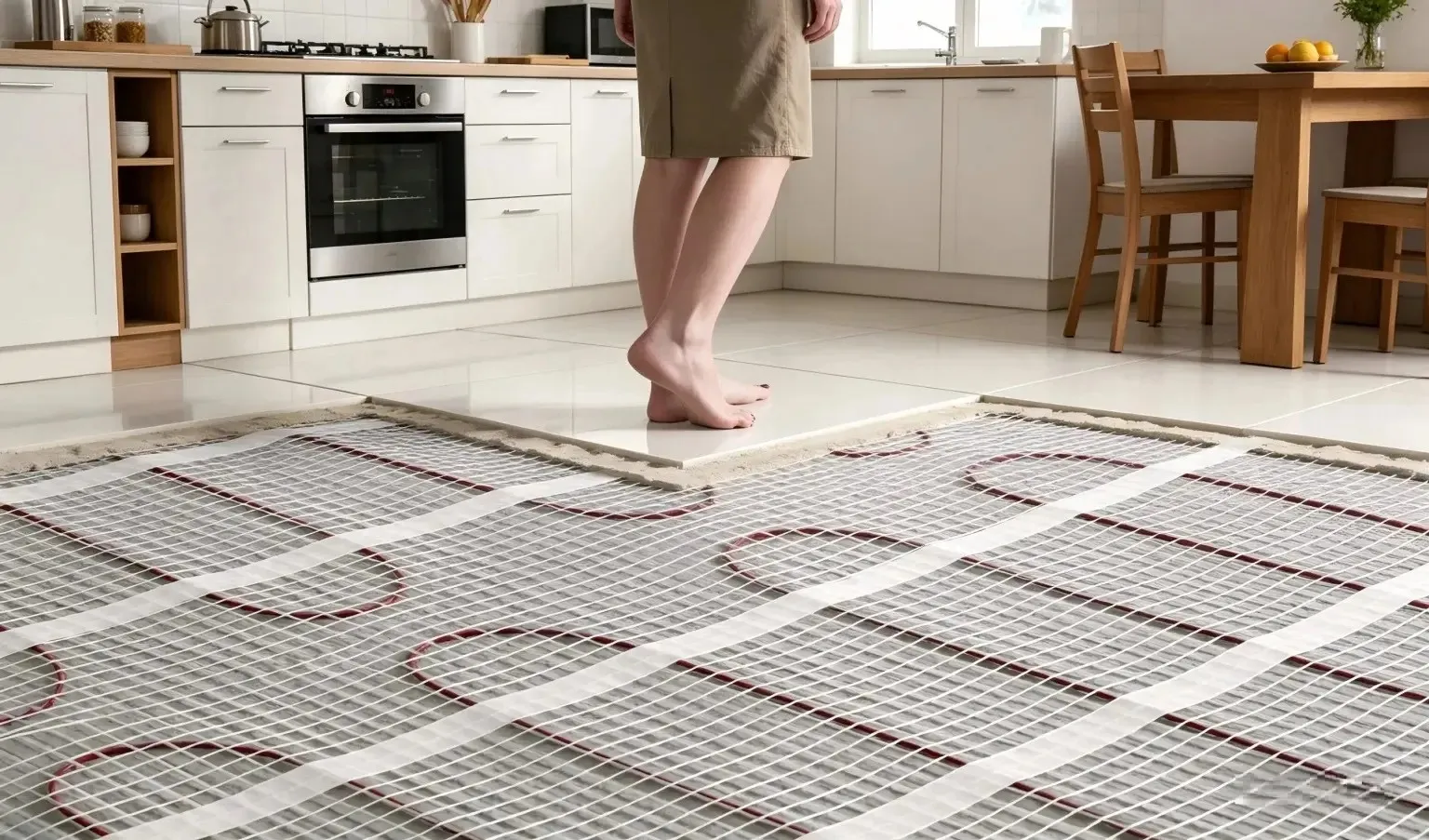
What Are Heating Film and Heating Cable?
Start with the physics. A heating film is a planar, flexible element: a graphene–carbon composite printed onto a PET substrate, with copper busbars laminated along the edges to distribute current. It heats a whole sheet of floor surface at once and radiates far-infrared heat upward. Our film is produced in twelve standard widths from 10 cm to 100 cm, cut to any project length, at 110 V or 220–230 V, with an IP67 fully waterproof encapsulation and an electrical-to-thermal efficiency above 99%.
A heating cable is a linear element: an alloy-resistance conductor inside a double-insulated, shielded jacket. It heats along its length, and the installer lays it in loops across the floor. Our cable is built as a double-conductor, single-cold-tail element, rated IPX8, with a selectable output of 10–30 W per metre, also at 110 V or 220–230 V. The same cable family is embedded in screed under floors, used for pipe antifreeze, and run across roofs and driveways for snow melting — duties a sheet film simply cannot do.
So the first mental model is this: film heats an area; cable heats a line that you arrange into a pattern. That single difference drives nearly every other comparison below.
How They Are Built: Planar Film vs Linear Cable
The construction difference is the root of every other trade-off. Our heating film is a laminated sandwich: screen-printed carbon and silver–aluminium paste on PET, copper busbars, and a fully encapsulated, IP67 waterproof finish. Because the heating layer is a continuous sheet, heat leaves from every square centimetre at once. The film is cut to width and length on our lines and unrolled on site like a floor underlay.
Our heating cable is a round, flexible jacketed conductor — alloy-resistance core, double insulation, shielded, IPX8. It arrives as a coil and is fixed on site in a loop pattern with fixing clips. The double-conductor construction means only one end needs a cold-tail connection, so there is no return loop back to the start of the run. Output is specified per metre (10–30 W/m) rather than per square metre, and the installed watts per square metre depend on how tightly the installer spaces the loops.
A third element sits between the two on the product range: the self-adhesive heating mat under tile, which is essentially cable pre-spaced on a mesh at a fixed 160 W/m² and a 3.6 mm profile. It is worth remembering when you get to the tiled-floor section below.
Warm-Up Speed and Thermal Response
This is the most visible difference to a homeowner. Because film sits directly under a thin vapour membrane and the finished floor (laminate, engineered wood, vinyl or carpet), it is close to the surface it warms. The floor reaches a comfortable temperature within minutes of switch-on, and the far-infrared heat is felt on the skin quickly even while the air temperature is still rising. In our own film documentation we describe this as a minutes-level response, in direct contrast to heavy screed systems that can take an hour or more to come up to temperature.
Cable behaves the other way. When cable is embedded in a 50–70 mm screed slab, the slab itself becomes a large thermal mass that must be heated before the finished floor surface feels warm. The slab then also holds heat and releases it slowly, which is good for steady, energy-efficient background heating in well-insulated new builds, but poor if you want a room warm in ten minutes. Cable laid in thin tile adhesive (a mat or direct cable bed) responds faster than a screed embedment, but still not as fast as dry-laid film, because the adhesive layer and tile carry more thermal mass than a laminate over a film sheet.
Practical consequence: film is the responsive, on-demand choice; cable-in-screed is the slow, steady, heat-storage choice. If your rooms are used on a schedule rather than run continuously, film’s quick response favours timed comfort; if you can pre-heat a slab and let it coast, cable-in-screed can be the more efficient steady-state option.
Floor Build-Up Height and Renovation Fit
Heating film is the thin-profile winner. The standard underfloor film build-up is, from the base floor upward: thermal insulation, the graphene heating film, a vapour membrane, and the finished flooring. The film itself is a slim flexible sheet — millimetres thick — so the added floor height is dominated by the insulation board you choose, not by the element. This is why film is the default renovation element in old apartments where door frames, architraves and existing skirting cannot be raised.
Cable adds more height, and the added height depends on how it is embedded. Cable fixed on mesh and bedded in tile adhesive adds roughly the adhesive-plus-tile thickness you would already lay. Cable embedded in a screed slab adds the full screed depth (typically 50 mm or more over the element), which is a new-build or major-works solution rather than a cosmetic retrofit. Cable cannot simply be unrolled under laminate like film: a round element under a floating wood floor would telegraph through the finish and create uneven pressure points, which is why film, not cable, is the dry wood-floor element.
Surface Temperature Uniformity
Because film heats a continuous sheet, the surface temperature under a correctly laid roll is naturally even across the whole covered area. The graphene–carbon composite is formulated for lateral conductivity, and the copper busbars run along the edges so current reaches every part of the film. The thermostat holds the floor surface at roughly 27–28 °C — the limit most wood and laminate manufacturers impose — and that temperature is consistent strip to strip.
Cable heats along discrete loops, so floor uniformity depends entirely on loop spacing. Tight, evenly spaced loops give an even floor; uneven spacing or a badly turned corner leaves cooler stripes between runs. This is exactly why the pre-spaced 160 W/m² heating mat exists: it takes the spacing decision away from the installer and bakes it onto the mesh. Loose cable still gives excellent results in screed, because the screed itself spreads the heat laterally between loops — the slab does the uniformity work that the film sheet does for free.
Power Output and Density
Film output is tuned by coating density rather than by layout. Our engineering team adjusts the paste laydown in-house, so the same film family can be specified at around 100 W/m² for ceiling heating, around 100–150 W/m² for a well-insulated living room, and up to roughly 180–200 W/m² for a cold bathroom or a poorly insulated retrofit room. Because film only covers the open walking area (typically 60–80% of the room, never under fixed furniture), the installed output scales with that coverage.
Cable output is chosen per metre (10–30 W/m selectable) and converted to watts per square metre by loop spacing. Tight, evenly spaced loops on a higher-wattage cable give you more output density per square metre than film typically targets for wood floors — which is why cable (or the pre-spaced mat) is the usual spec under tile and stone, where a denser floor warming is expected and the floor itself is heat-resistant. Cable is also the element of choice for non-floor duties where watts per metre matter directly: pipe trace heating, roof de-icing and tank or equipment trace heating, all rated IPX8 for wet or outdoor exposure.
Floor Finishes: What Each Element Sits Under
This is the single most practical filter for the decision.
Film is the dry-lay, low-profile element and is matched to finishes that tolerate a thin underlay and a 27–28 °C surface limit: laminate, engineered wood, vinyl/LVT, carpet laid over the film (check the carpet manufacturer’s underfloor-heating rating), and the same element in wall or ceiling orientation. It is not the element for a wet tiled floor, because the film expects a dry, ventilated dry-lay build-up and tile adhesive expects a mesh or cable to key into.
Cable is the embedment element. It beds into tile adhesive under ceramic or porcelain tile, stone, and into a screed slab under nearly any finish, and it lives comfortably in wet-room conditions at IPX8. Cable (or the pre-spaced mat at 160 W/m²) is the standard answer for bathrooms, kitchens with tile, hallways with stone, and any room where the finished floor is a wet-trade finish. It is also the only realistic option for roof, gutter, ramp and driveway snow melting — browse our snow melting mat and cable range for those outdoor duties.
Heating Film vs Heating Cable: Full Comparison Table
| Aspect | Heating Film (SunAura graphene–carbon) | Heating Cable (SunAura double-conductor) |
|---|---|---|
| Element form | Planar flexible sheet, continuous surface | Linear round conductor, laid in loops |
| Heating mode | Far-infrared radiant, whole-surface | Resistive linear conduction, embedded |
| Warm-up speed | Minutes — film sits just under the finished floor | Slower in screed (slab must heat); faster in thin adhesive |
| Floor build-up added | Very thin — film is millimetres; height set by insulation board | Thicker — adhesive-plus-tile, or full screed depth (≈50 mm+) |
| Surface temperature uniformity | Naturally even across the whole covered sheet | Even only with correct loop spacing; screed spreads heat laterally |
| Power density | ~100 W/m² ceiling up to ~180–200 W/m² cold-room spec | 10–30 W/m selectable; W/m² set by loop spacing |
| Suitable finishes | Laminate, engineered wood, vinyl, carpet, wall/ceiling panels | Tile, stone, screed under any finish; wet rooms |
| Room shapes | Best for regular open rooms; strips cut to width | Best for irregular rooms, offsets and small wet areas |
| Voltage | 110 V / 220–230 V | 110 V / 220–230 V (custom on request) |
| Waterproof rating | IP67 | IPX8 |
| Self-limiting option | PTC film available on request | PTC self-regulating cable family available |
| Energy behaviour | Quick response, on-demand, low thermal mass | Heat storage in screed; steady-state, pre-heat-and-coast |
| Cost estimate (industry range) | Typically lower element-and-labour cost for dry-lay wood floors; figures vary by market — treat as a starting range | Typically higher for screed embedment due to slab and labour; mat-under-tile sits between the two |
| Maintenance | None — no moving parts, EMF-shielded, quiet | None embedded in floor; outdoor runs need seasonal sensor checks |
| Service life / warranty | 15-year warranty against defects; 15–25 year rated service life | 15–25 year rated, maintenance-free service life |
| Outdoor / non-floor use | Underfloor, wall, ceiling only | Underfloor, pipe antifreeze, roof/driveway snow melt, tank heating |
Cost ranges above are industry-level starting estimates for specification discussion, not quotes. A firm number needs your floor plan, finish and climate — feed them into our underfloor heating calculator for a first sizing, then send the plan to our engineers for a free layout drawing.
Room-by-Room Selection Matrix
Once the floor finish is known, the choice usually resolves itself. The matrix below is how our engineering team recommends elements on a typical mixed-finish home.
| Room / floor | Recommended element | Why |
|---|---|---|
| Living room under laminate or engineered wood | Heating film | Thin dry-lay build-up, fast warm-up, even radiant surface under a floating wood floor |
| Bedroom under laminate or carpet | Heating film | Low profile for retrofit, quiet and EMF-shielded, timed pre-heat on the fast response |
| Bathroom under tile | Heating mat (160 W/m²) or loose cable in adhesive | Wet-trade finish needs an embedment element; mat fixes loop spacing automatically |
| Kitchen under tile or stone | Heating mat or cable in adhesive | Denser output under a hard finish; cable fits around cabinets and islands |
| Hallway / entrance under stone | Cable in adhesive or screed | Hard-wearing wet-trade finish; irregular footprints suit a looped element |
| Renovation with zero floor height to spare | Heating film (or 0.5 mm aluminium-film mat) | Thinnest possible build-up; no screed, no raised door line |
| New build with screed floor | Cable in screed | Slab thermal mass gives steady, efficient background heating |
| Outdoor steps, driveway, roof valleys | Cable / snow melting mat | IPX8 outdoor duty with snow/ice sensor — film is not built for this |
| Ceiling or wall heating (floor must stay free) | Heating film | Same planar element oriented upward or on the wall, ~100 W/m² ceiling density |
The honest summary: film for dry wood/laminate floors and fast retrofits; cable (or pre-spaced mat) for tile, stone, screed and outdoor duties. A typical whole-house system ends up using both — film upstairs under wood floors, cable or mat downstairs under tile — on separate thermostats. Browse the full family on the underfloor heating product page to see how the pieces fit.
Installation Considerations
Film installation is a dry-lay process. After the subfloor is prepared flat and sound, a layer of thermal insulation goes down to direct heat upward and cut downward loss, then the film rolls are unrolled strip by strip, copper busbars terminated by a qualified electrician, a vapour membrane over the top, and the laminate, engineered wood or vinyl finish above. The film is cut to the room on our lines, so on site you unroll rather than loop. Never lay film under fixed furniture, baths or cabinets, and respect the wall edge distances. Every strip is resistance-tested before the finish floor goes down, so a busbar fault is caught while the floor is still open.
Cable installation is a wet-trade process. The loop pattern is drawn from the room plan and the chosen 10–30 W/m output, the cable is fixed with clips at the stated spacing (or pre-spaced on the heating mat mesh), a floor sensor is placed mid-loop, and then the cable is embedded — either in tile adhesive under tile/stone, or in a fresh screed pour in new builds. The double-conductor build means only one cold-tail end needs wiring. Fixed-resistance cable must be ordered to length: cutting it on site changes its resistance and wattage. Resistance is measured before and after embedding so any damage during the pour is caught early. For pipe or outdoor runs, PTC self-regulating cable is used because overlapped sections cannot overheat.
Thermostat Integration and Controls
Both elements pair with the same control family. A wall thermostat with a floor sensor is the standard for embedded underfloor zones: it reads the actual floor temperature and switches the element on and off to hold the 27–28 °C floor limit that protects wood and laminate finishes. WiFi/Tuya smart thermostats add app scheduling — pre-heat the living room for the evening, set the bedrooms for the morning, set back overnight — and each room runs on its own zone.
Film zones use the same floor-sensor thermostat, because the thermostat must protect the wood finish rather than just control air temperature. Cable zones use the same control; outdoor snow-melting cable zones use a snow/ice sensor instead of a room thermostat, so the circuit only energises when precipitation actually arrives. The full range of wall, WiFi and sensor controls is on our thermostats and controls page, and the wiring logic for both film and cable zones is the same once the electrician understands the single cold-tail on the cable and the busbar terminations on the film.
Energy Behaviour and Running Costs
Film’s >99% electrical-to-thermal efficiency and its low thermal mass mean it delivers comfort quickly and then switches off. It suits a schedule: heat the room when it is used, let it set back when it is not, and rely on the fast response to catch up in minutes rather than hours. The trade-off is that it has little stored heat to coast on, so it cycles on and off more frequently than a slab system.
Cable in screed behaves like a thermal battery. The slab warms up slowly and then releases heat steadily, which is efficient when the house is well insulated and you can pre-heat off-peak — but wasteful if you expect instant warmth and keep switching it on and off. Cable in thin adhesive under tile sits between the two: more responsive than screed, slower than dry film. PTC self-regulating cable trims its own power as surfaces warm, which is why it is specified for unattended trace-heating and snow-melting duties rather than for basic room heating. Treat any running-cost figure we or anyone gives you as an industry estimate that depends on your insulation, climate, tariff and thermostat schedule — size the zone properly with the underfloor heating calculator before you budget.
Maintenance and Longevity
Neither element needs routine maintenance once it is installed. There are no moving parts, no fans and no filters. The film is IP67 encapsulated and EMF-shielded; the cable is IPX8 double-insulated and shielded. Both are backed by a 15–25 year rated, maintenance-free service life under our ISO 9001:2015 manufacturing, and the film carries a 15-year warranty against manufacturing defects. The only ongoing check points are electronic: the floor sensor, the thermostat schedule, and (for outdoor cable circuits) the snow/ice sensor each autumn. If you ever need a replacement coil or a matched element for an expansion project, our OEM/ODM programme keeps element specifications and test records on file so a replacement matches the original build exactly.
When to Pick Film, Cable, or a Mixed System
Choose heating film when the finished floor is laminate, engineered wood, vinyl or carpet, when the build-up height is constrained by a renovation, or when you want fast, on-demand radiant warmth under a dry floor. Choose heating cable when the floor is tile or stone, when you are pouring a screed, when the room has irregular offsets that a loop handles better than sheet strips, or when the duty is pipe antifreeze, roof de-icing or driveway snow melting. Choose the heating mat when the job is tiled and you want cable with the loop spacing already guaranteed on the mesh at 160 W/m².
Most real houses end up with a mixed system: film under the wood floors upstairs, cable or mat under the tile downstairs, both on independent thermostats. That is the whole-house logic we engineer to your floor plan, and it is the answer we give when a distributor asks us “film or cable?” — the correct response is usually “both, per room.” Send us the room list with floor finishes and climate zone, and our engineering team returns a free layout drawing marking the element per zone.
Frequently Asked Questions
Which warms a room faster: heating film or heating cable?
Heating film warms the floor much faster because it sits millimetres under the finished floor in a dry-lay build-up, so the floor surface reaches comfort within minutes. Heating cable embedded in screed must first warm the whole slab, which can take an hour or more; cable laid in thin tile adhesive responds faster than screed but still not as quickly as dry film.
Can heating film be used under tile, or must I use cable?
Film is designed for dry-lay finishes such as laminate, engineered wood, vinyl and carpet, not for being bedded in tile adhesive. Under tile or stone, use a heating cable or the pre-spaced 160 W/m² self-adhesive heating mat, which is built to key into adhesive and carries the output density a tiled floor expects.
Is heating cable better for bathrooms than film?
Yes, for a tiled bathroom. The wet-trade tile or stone finish needs an embedment element, and our IPX8 double-conductor cable (or the mat version) is rated for wet screed and wet-room duty. Film can heat a bathroom wall or ceiling panel, but the shower floor itself is a cable or mat application.
Can I mix heating film and heating cable in one house?
Yes — and this is the typical whole-house setup. Film goes under laminate and engineered-wood rooms, cable or mat goes under tile and stone rooms, each on its own thermostat. Our engineers draw a per-zone layout marking which element fits which floor finish, so the whole house runs on one coordinated control schedule.
What voltage are heating film and heating cable available in?
Both are produced at 110 V and 220–230 V to match your local grid — film at 110 V / 220–230 V, and cable at 110 V / 220–230 V with custom builds on request. The voltage build is fixed at manufacturing time, so always state your target market on the enquiry; a voltage mismatch cannot be corrected on site.
How long do heating film and heating cable last?
Both carry a rated, maintenance-free service life of 15–25 years under our ISO 9001:2015 manufacturing. The heating film additionally carries a 15-year warranty against manufacturing defects. Neither element has moving parts, so in normal use there is nothing to service beyond checking the thermostat and floor sensor.
Related Products & OEM Inquiries
Looking for the right heating product to match film-vs-cable decisions or a factory-direct OEM/ODM partner? Explore our graphene far-infrared heating film range and twin-conductor heating cables, then request a quote for your project — we supply distributors, installers and brands in 50+ countries.