
As a manufacturer that designs and builds electric underfloor heating (UFH) elements in Qingdao for brands, installers and projects across Europe, North America and Asia-Pacific, we watch the 2026 underfloor heating market the way an engineer reads a drawing: by layers, and by what each layer implies for a production plan. This article is our factory-side read of the 2026 landscape — where demand is forming, which regulations are pulling it, which product formats are winning, and what all of that means if you are specifying, sourcing or private-labelling UFH this year.
An honest caveat on every number below. The market-size, growth, share and price figures in this article are industry estimate ranges drawn from published third-party research and industry commentary; they are not SunAura measurement, and they should not be read as exact. We present them as rounded, directional bands so buyers can size opportunity and risk, not as audited fact. Where we cite our own products, those are our real engineering specifications.
Executive Summary: The 2026 Underfloor Heating Market at a Glance
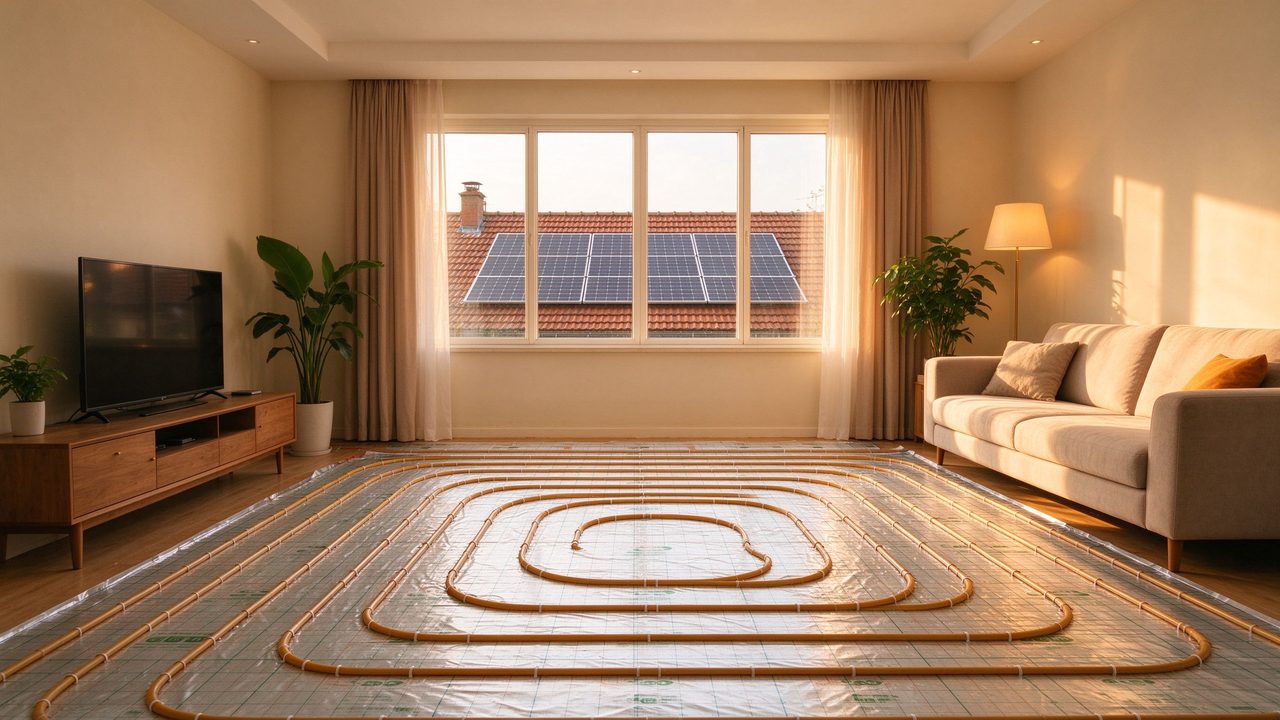
If you only have thirty seconds, here is the factory-side summary. Across published industry estimates, the global underfloor heating market is broadly estimated to be in the low-to-mid single-digit billions of US dollars in 2026 (industry estimate range), growing at an estimated mid-single-digit annual pace. Europe — led by Germany, the Nordics, the UK and a fast-moving Central and Eastern European (CEE) block — is the largest regional demand centre, while North America and APAC (especially China, South Korea and Australia) are the two growth regions.
The demand story in 2026 is not a fashion story; it is a regulation story. The recast Energy Performance of Buildings Directive (EPBD), national gas and oil boiler phase-outs, heat-pump build-out, and electrification of heating are pulling heated floor systems into both new build and retrofit. The technology story is equally specific: far-infrared heating film and thin mats are gaining share over loose cable in renovation, smart thermostats are becoming the default control, and low-EMF (electro-magnetic field) construction is moving from a niche claim to a spec line. For OEM buyers and brands, the 2026 implication is to standardise on a platform that is thin, controllable, low-EMF and heat-pump compatible, rather than chasing the cheapest element on a per-square-metre basis.
How We Size the Market: Methodology and the Estimate Caveat
Before any number is quoted, it is worth saying how a responsible manufacturer should read market reports. Commercial UFH market studies vary widely in scope — some count only embedded wet (hydronic) systems, some add electric film and mats, some include thermostats and accessories, some are regional. That is why two “authoritative” reports can quote 2026 global market sizes that differ by a factor of two or more without either being wrong.
We therefore treat all market figures in this article as industry estimate ranges: directional bands gathered from published research, suitable for planning and opportunity sizing, not for financial modelling to the dollar. If you need a precise figure for an investment case, commission a bespoke study; if you need to understand where the 2026 market is moving, the direction of travel below is what matters more than the exact point estimate. This is the same discipline we apply when a customer asks “what wattage film do you sell” — we quote real, buildable ranges like 100, 150 and 200 W/m² far-infrared heating film, not a vague number.
2026 Market Size and Growth: Industry Estimate Ranges
Published industry estimates broadly place the 2026 global underfloor heating market somewhere in the low-to-mid single-digit-billion-USD band (industry estimate range), with an estimated compound annual growth rate (CAGR) commonly described in the mid-to-high single-digit percent range over 2026–2030 (industry estimate range). Electric UFH — film, mats and cable — is typically estimated to be a large and growing share of that total, having gained in retrofit as heat pumps and electrification push low-flow-temperature, fast-response electric options into mainstream fit-outs.
For a buyer, the practical read is not the exact dollar figure. It is that the market is large enough to support a multi-supplier, multi-region value chain, but growing fast enough that supply capacity, certification and lead-time reliability — not list price — become the differentiators. A manufacturer that can hold certified, repeatable stock and ship on EXW/FOB Qingdao terms is the one brands will return to when project volumes scale.
Regional Split: Europe, North America and APAC
Published estimates consistently describe Europe as the largest regional block, broadly estimated at around two-fifths to half of global demand (industry estimate range). Within Europe, the demand is split between Western Europe (Germany, Nordics, Benelux, UK) and a rising CEE block (Poland, Czechia, Romania, the Baltics), where boiler replacement and heat-pump subsidies are accelerating electrification. North America is estimated as the next-largest block, broadly around one-fifth to a quarter of global demand, led by renovation and luxury residential. APAC is estimated around one-quarter to one-third, led by South Korea (a mature film-heating market), China and Australia.
What this means on the factory floor: a 2026 production plan should not assume a single “export” customer. It should assume a European book with UK/EU plug and thermostat configurations, a North American book with 120/240 V wiring and NEMA-ready controls, and an APAC book with thinner-film and film-under-tile builds. We size production lines and SKU ranges around that regional split rather than around a generic “underfloor heating” SKU.
Regulatory Drivers: EPBD, Boiler Phase-outs and Heat Pump Coupling
The single most important 2026 driver is regulatory. The recast EPBD and member-state implementing rules, national gas/oil boiler bans and heat-pump incentives are shifting heating load away from fossil boilers and toward electric and low-temperature hydronic systems — both natural homes for heated floors.
For OEM buyers, three procurement rules follow from regulation:
- Heat-pump compatibility is now a baseline. Low-flow-temperature, fast-responding electric film and mats pair naturally with heat pumps; specify products that can cycle efficiently at part load.
- Electrification favours electric retrofit kits. In apartment and renovation where a wet retrofit is invasive, thin film and peel-and-stick mats are the practical electric route — this is where our heating film range is most often quoted.
- Certification is non-negotiable. CE, RoHS, REACH and the relevant national standards are table stakes; a 2026 supplier that cannot produce them on request will be disqualified at spec stage.
Technology Trends: Film vs Mat vs Cable in 2026
The electric UFH format mix is moving. Loose heating cable built the early retrofit market, but in 2026 the centre of gravity has shifted toward thin, low-profile film and mats, especially in renovation where floor build-up height is constrained. From the production side, the practical comparison looks like this:
| Format | Best-fit application | Typical build-up | Typical power density | Factory note |
|---|---|---|---|---|
| Far-infrared heating film | Retrofit over screed, under laminate/vinyl, renovated bathrooms | Very thin (a few mm incl. insulation) | ~100–200 W/m² (our standard builds) | Fastest growing format; cut-to-length on site |
| Thin heating mat | Under tile/stone in wet rooms and bathrooms | Low profile over insulation board | ~120–200 W/m² range | Pre-spaced, easy tiling; popular in bathrooms |
| Twin-conductor heating cable | New-build screed, large open areas | Embedded in screed | ~100–200 W/m² range | Robust but taller build-up; less suited to retrofit |
The 2026 trend is not that cable disappears; it is that film and mats take retrofit share, while cable remains the new-build screed workhorse. Brands that stock only one format leave retrofit business on the table. We manufacture all three, so a distributor can carry a coordinated range rather than piecemeal SKUs.
Smart Thermostats and Low-EMF Expectations
Two control-side trends are reshaping the 2026 spec sheet. First, smart thermostats — app-controlled, scheduling, open-window detection and floor-sensor safety — have moved from premium upgrade to expected default. A heated floor sold without a competent control is now a value-engineered liability, because the control is what delivers comfort and efficiency.
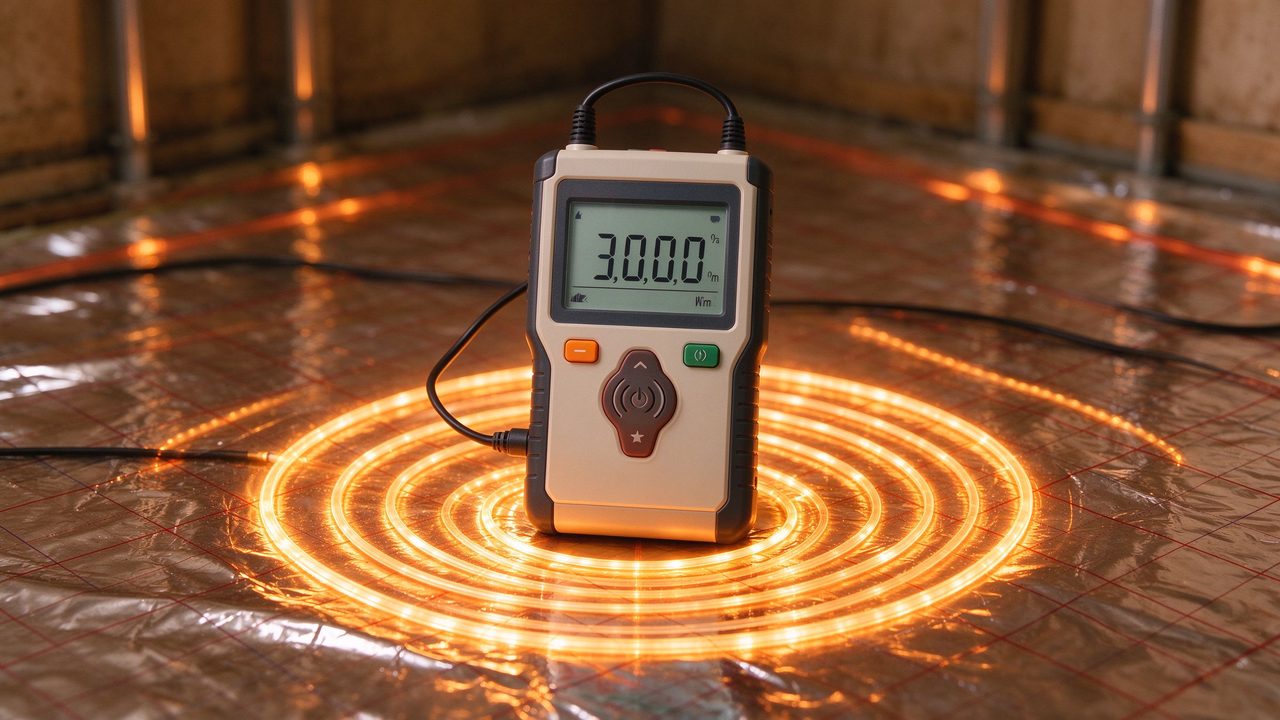
Second, low-EMF design is moving out of wellness marketing and into engineering specs. Shielded, balanced twin-conductor and film constructions that keep electro-magnetic fields low near the floor surface are increasingly requested by installers serving health-conscious and commercial buyers. As a manufacturer, we design low-EMF as a construction property — shielding layers, balanced conductors, controlled grounding — rather than as a sticker. Buyers should ask a supplier for the actual shielding/grounding construction, not just the words “low-EMF”.
Cost and Price Dynamics: Industry Estimate Ranges
Published cost guidance varies widely by country, floor type and renovation vs new build, so any headline installation cost is an industry estimate range, not a quote. What is consistent across markets is the structure: material cost (element + insulation + thermostat) is only part of the installed number; labour, floor build-up and underfloor preparation usually dominate.
For country-specific planning, our own cost guides are built for installers and homeowners and give real, localised reference points rather than a single global number: see the UK underfloor heating cost guide, the US underfloor heating cost guide, the Canadian underfloor heating cost guide, and the Australian underfloor heating cost guide. For sizing the element itself, our underfloor heating wattage calculator works from room dimensions and floor type so you order the right power density — a detail that matters because undersized film under-insulated floor will never reach comfort temperature, however good the thermostat.
Distribution and Channel Structure for 2026 Buyers
The 2026 channel picture is a three-way split that a brand or installer should understand before choosing a supplier. There are large multi-national heating groups selling hydronic and electric systems through national plumbing/heating merchants; there are specialist UFH brands selling direct to installers and via online channels; and there are contract/OEM manufacturers selling private-label and platform product to brands and distributors. SunAura sits in the third group: we build the elements, controls and kits that other brands sell.
The practical buying implication is that channel choice should follow volume and brand strategy. A retail brand wanting its own box and plug should engage an OEM manufacturer early, because custom packaging, plug configuration and controller pairing take lead time. A contractor buying for a single project should buy through stock where speed matters rather than waiting on a container. We support both: small trial orders for new brands and full-container programmes for established retailers, on EXW / FOB Qingdao terms with full export documentation.
OEM and Private-Label Buying Implications
For brands and distributors sourcing private-label UFH in 2026, the market estimate bands above translate into a concrete supplier checklist:
- One platform, three formats. Can the supplier build film, mat and cable to a coordinated spec so your range looks engineered, not assembled from three factories?
- Heat-pump-ready controls. Does the thermostat range support scheduling, floor-sensor safety and app control, and can it be private-labelled?
- Low-EMF as construction, not copy. Ask for the shielding and grounding design, not the marketing line.
- Regional plug and certification. UK 3-pin, EU Schuko, NEMA, AU — and CE/RoHS/REACH paperwork in writing.
- Real minimums and lead times in writing. Trial MOQ for new brands, container pricing for scaled programmes, confirmed lead time per order.
If you are comparing electric-specific sizing in more depth, our electric underfloor heating market data review covers the electric-channel numbers in the same estimate-range discipline. The regional, regulatory and OEM reading here is the companion view across the whole 2026 market.
How SunAura Fits the 2026 Market
We are a Qingdao-based manufacturer of electric underfloor heating elements — far-infrared heating film, thin mats and twin-conductor cable — together with the thermostats and controls that make them work as a system. We supply brands, installers and projects across Europe, North America and APAC, on EXW / FOB Qingdao terms, with the certification and export documentation that 2026 regulation now demands. Our standard film builds run at 100, 150 and 200 W/m², we design low-EMF as a construction property, and we pair every element with a thermostat range that installers can actually commission. We are not a trading desk quoting the cheapest reel; we are the factory behind brands that need repeatable, certified, on-time supply through a year of rising regulation and rising demand.
Frequently Asked Questions
What size is the underfloor heating market in 2026?
Published industry estimates broadly place the 2026 global underfloor heating market in the low-to-mid single-digit-billion-USD range, growing at an estimated mid-to-high single-digit percent CAGR. Because commercial reports differ in scope (some count only wet systems, some add electric film and accessories), these are industry estimate ranges for planning, not exact audited figures.
Which region is the largest underfloor heating market in 2026?
Published estimates consistently describe Europe as the largest regional block, broadly around two-fifths to half of global demand, led by Germany, the Nordics, the UK and a fast-growing CEE block. North America and APAC (South Korea, China, Australia) are the next-largest, estimated around one-fifth to one-third each. These are directional industry estimate ranges.
What is driving underfloor heating demand in 2026?
The main 2026 drivers are regulatory rather than aesthetic: the recast EU Energy Performance of Buildings Directive (EPBD), national gas and oil boiler phase-outs, heat-pump build-out and heating electrification. These pull heated floors — both low-temperature hydronic and fast electric film/mat — into new build and retrofit.
Is heating film replacing heating cable in 2026?
Film and thin mats are gaining retrofit share because they sit lower in floor build-up and suit renovation, while twin-conductor cable remains the new-build screed workhorse. The 2026 trend is a format split by application, not cable disappearing. Our standard film builds run at 100, 150 and 200 W/m².
What should an OEM buyer check when sourcing underfloor heating in 2026?
Check that the supplier can offer a coordinated platform across film, mat and cable; heat-pump-ready, private-label thermostats; low-EMF as an actual shielding/grounding construction; the right regional plugs (UK, EU, NEMA, AU) and CE/RoHS/REACH certification in writing; and confirmed trial MOQ plus container lead times per order.
How much does underfloor heating cost in 2026?
Installed cost varies widely by country, floor type and new build vs retrofit, so any single figure is an industry estimate range. Material is only part of the installed number; labour and floor preparation usually dominate. For localised reference, see our UK, US, Canadian and Australian cost guides, and size the element with our wattage calculator.
Related Products & OEM Inquiries
Sourcing for a 2026 project? Our core builds include far-infrared heating film in 100, 150 and 200 W/m², together with thin mats, twin-conductor cable and the smart thermostat range that commissions them as a system. Use the underfloor heating wattage calculator to size the element, then request a factory quote for private-label or container supply — we support trial orders for new brands and full programmes for established buyers, on EXW / FOB Qingdao terms.