
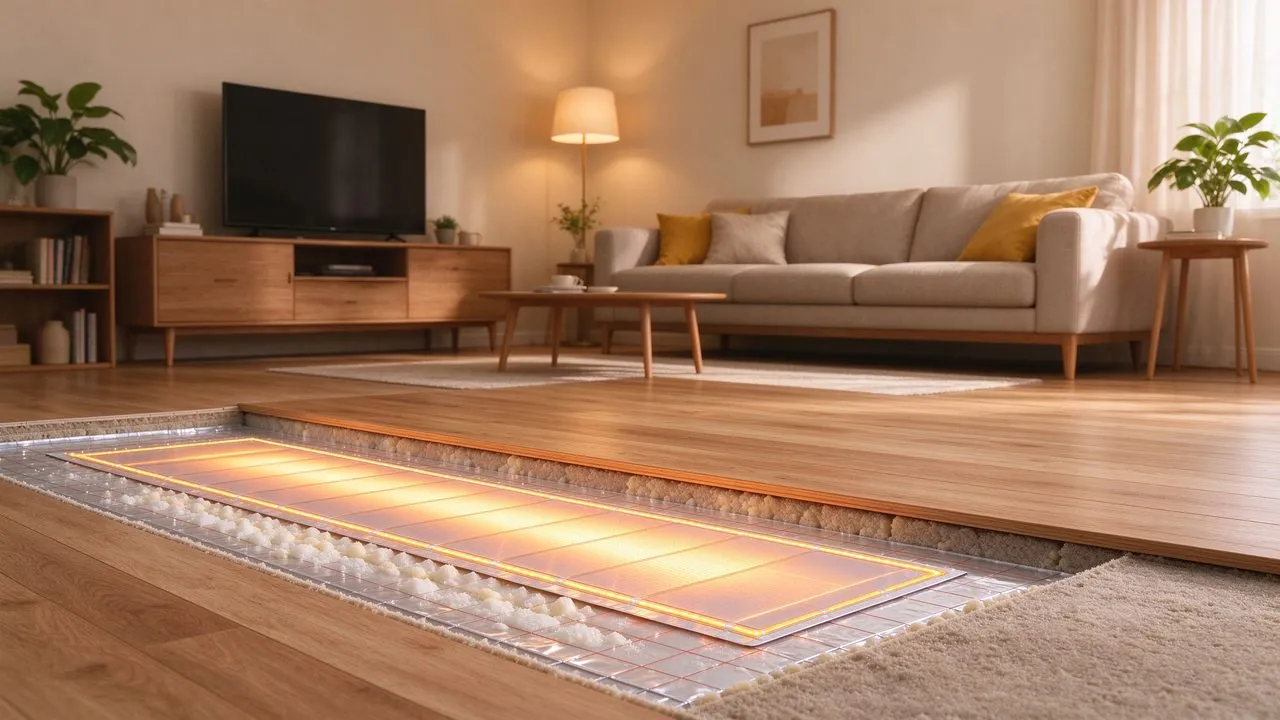
“Electric underfloor heating is expensive to run” is the most repeated objection in the heating market — and the most misunderstood. The real answer depends on four numbers: the installed output per square metre, the hours the system actually runs, the local electricity price, and the quality of the insulation underneath. This guide walks through each one with worked examples, so you can estimate the electric underfloor heating running cost for your own project before you buy — and spot the specification choices that quietly double the bill.

The Four Numbers That Decide Your Bill
- Installed output (W/m²): the rated wattage of the heating element per square metre — typically 150–160 W/m² for tile floors in insulated rooms.
- Operating hours: how many hours per day the system actually heats — a well-controlled system runs far less than the 24-hour maximum.
- Electricity price: your local rate per kWh, including any time-of-use tariff.
- Insulation quality: the single biggest lever on how much of that heat stays in the room instead of draining into the slab.
Worked Example: A 12 m² Kitchen at 160 W/m²
Take a typical well-insulated kitchen: 12 m² heated area, 160 W/m² mat, electricity at €0.28/kWh (a typical European household rate). Full power would draw 12 × 160 = 1,920 W (1.92 kW). But the system does not run at full power all day. With a floor-probe thermostat and a schedule — heating up in the morning and evening — a realistic duty cycle is 4–6 hours per day. Using 5 hours:
| Item | Calculation | Result |
|---|---|---|
| Installed load | 12 m² × 160 W/m² | 1.92 kW |
| Daily energy | 1.92 kW × 5 h | 9.6 kWh |
| Daily cost | 9.6 kWh × €0.28 | €2.69 |
| Monthly cost | €2.69 × 30 | ≈ €80 |
| Heating season (5 months) | €80 × 5 | ≈ €400 |
That is a real-world order of magnitude for a well-controlled, well-insulated room. The underfloor heating cost per square metre in this example works out to roughly €6.70 per m² per month in season — before any time-of-use savings. Now let’s look at what changes that number.
How to Cut the Cost: The Three Levers
1. Insulation Board Under the Element
Without insulation under the element, a significant share of the heat — up to 30–40% on solid floors — travels downward into the slab instead of into the room. Fitting 10–30 mm of XPS or PIR board with reflective facing pushes that heat back up, cuts preheat time and lowers the duty cycle. Insulation is the highest-ROI upgrade in electric floor heating, and it is why factory-direct suppliers always ask about your floor build before quoting output.
2. Floor-Probe Thermostat with Scheduling
A floor-probe thermostat limits the surface temperature to the flooring’s safe range and prevents the system from running hotter than needed. Add a weekly schedule and adaptive preheat, and the system heats only when the room is actually occupied. A WiFi thermostat for underfloor heating takes this further: app control, energy reports and remote off-switching when plans change. Typical savings from scheduling alone are 20–30% of running hours compared with a fixed thermostat.

3. Time-of-Use Tariffs and Zoning
Many European markets offer time-of-use electricity tariffs with overnight rates 30–60% below daytime rates. A schedule that pre-heats on the cheap overnight tariff and coasts through the day can cut the effective cost by a third or more. Zoning matters too: heating only the rooms you use, with a thermostat per zone, is the single most effective way to lower total consumption in a whole-home retrofit.
Comparing Electric Floor Heating with Other Systems
Running cost is only half the story — the other half is what you pay to install and maintain the system. A gas boiler carries a large capital cost, annual servicing and standing charges; a heat pump carries the largest capital cost of all; electric underfloor heating has low installation cost, zero moving parts, no servicing requirement and no standing charge for fuel. When you compare electric floor heating energy consumption against a boiler or heat pump, the honest comparison is total cost over 10–15 years, not the price per kWh alone. In smaller spaces, wet rooms and homes without gas, electric floor heating frequently wins the lifecycle comparison — especially with insulation and scheduling done properly.

Common Mistakes That Inflate the Bill
- Heating under permanent furniture — wasted energy and overheating risk; measure the heated area, not the room.
- Skipping insulation board to save €50 at install — typically the most expensive economy in floor heating.
- No floor sensor — the system runs hotter and longer than it needs to.
- One thermostat for the whole house — unused rooms get heated at full schedule.
- Choosing output by habit instead of calculation — 200 W/m² where 150 W/m² suffices wastes 25% every hour it runs.
Data and Evidence: Factory Data and Efficiency Context
SunAura Thermal has manufactured electric heating products at our Qingdao, Huangdao factory since 2008 — 17 years — under ISO 9001/14001/45001, with CE and RoHS documentation for the product range (per SunAura factory records). Our electric heating mats and cables are supplied with written specifications so your installer can calculate the exact installed load before purchase. Because the element converts electricity to heat at close to 100% efficiency at the point of use, the system’s real efficiency is decided by insulation, control and duty cycle — not by the element. Our energy efficiency regulations article explains how EU rules are raising the bar for exactly these factors.
Frequently Asked Questions
Is electric underfloor heating more expensive than radiators? Radiant heat lets you feel comfortable at a lower air temperature, and with scheduling the system runs fewer hours than a boiler-fed radiator system. In well-insulated rooms the lifecycle cost is competitive — and there is no boiler servicing or gas standing charge.
How many hours per day will my system actually run? With a floor-probe thermostat and schedule, a well-insulated room typically heats 4–6 hours per day in season; a poorly insulated room can run 8–12 hours. The insulation board is the lever that moves this number most.
Should I undersize the element to save money? No — undersized elements cannot reach the target temperature, run for longer and disappoint. Size to 150–160 W/m² for insulated rooms and control the running time instead; that is where the savings are.
Where can I see the actual maintenance cost profile over the years? Electric systems have no filters, no pumps and no moving parts in the element — maintenance is essentially electrical checks only, which our 20-year maintenance guide details. The cost profile stays flat, which is part of the lifecycle advantage.
Real-World Cost Scenarios: Three Homes Compared
Abstract numbers only become useful when they sit next to real homes. Consider three common cases. Home A: a 6 m² bathroom with a 160 W/m² mat, floor-probe thermostat and insulation board — the classic top-up application; it runs roughly 3 hours a day at €0.28/kWh, costing about €1.60 per day in season, under €50 per month. Home B: a 40 m² open-plan ground floor at 160 W/m² with good insulation and zonal scheduling — 5 hours of effective running across two zones gives around 32 kWh/day and roughly €9 per day, about €270 per month in a five-month season. Home C: the same 40 m² but uninsulated, running 9 hours a day — around 58 kWh/day and about €16 per day, €480 per month. The insulation and control difference between Home B and Home C is the entire margin between a sensible heating bill and a shock — and it has nothing to do with the element itself.

Night Heating: Time-of-Use Strategy in Practice
Many European markets price electricity lower at night, and electric floor heating is uniquely suited to that tariff. The floor acts as a thermal store: pre-heated overnight, it releases warmth through the morning without the element running during the expensive daytime window. A concrete or tile floor holds that stored heat for hours; even a wood-floor build extends the benefit for a couple of hours after the element switches off. The practical setup is a smart thermostat scheduled to preheat during the cheap overnight window and hold or coast during the day. Combined with a floor sensor to avoid overshooting, time-of-use scheduling typically cuts the effective running cost by 30–50% in markets with strong overnight discounts — the single largest lever after insulation.

Installation Quality and the Running Cost Connection
Installation mistakes have a direct cost signature. A mat laid over an uninsulated slab wastes a third of its heat downward. A floor sensor installed in the wrong position reads the temperature of a cold corner, so the system runs longer than it should. Overlapping elements create hot zones that trigger the sensor and shorten the effective duty cycle. And an undersized circuit forces the thermostat to limit power, stretching every heat-up. None of these faults are visible after the floor covering goes down, which is why the electric heating mat and cable specifications should be reviewed by the installer before purchase, not after. Factory-direct suppliers provide installation guidance with every order precisely because a correctly installed system is also the lowest-cost system — the running cost is written at installation time, not at the meter.

How to Estimate Your Own Running Cost in Five Minutes
You can build your own estimate before any supplier quotes you. Step one: multiply the heated area in m² by the planned output (150–160 W/m² for insulated rooms) to get installed watts. Step two: divide by 1000 to get kW. Step three: multiply by realistic daily hours — start with 5 for an insulated, scheduled system. Step four: multiply by your electricity rate in €/kWh. Step five: multiply by 30 for a monthly figure. That five-line calculation gives you the number every supplier discussion should be anchored to. If a quotation implies running hours far above your estimate, the specification is probably missing insulation, a floor sensor or zonal control — ask before buying, not after the first bill.
Frequently Asked Questions
Will the cost drop as heat pumps spread? Yes — the more the grid runs on renewables, the lower the carbon and often the price of electricity at off-peak hours. Electric floor heating is future-compatible with a cleaner grid in a way gas heating is not.
Does a bigger mat always mean a bigger bill? No. A correctly sized mat with insulation and scheduling can cost less than an undersized mat without control, because it reaches temperature and switches off. Size by calculation, control by schedule.
Where do I find the factory-direct price? Send your floor plan and local tariff to our sales team for a written quotation including the wattage calculation, wholesale cost and lead time. That quotation becomes your cost baseline before installation.
Wrapping Up: The Cost Question Has a Clear Answer
After all the calculations, the honest summary is simple. Electric underfloor heating is not inherently expensive to run — it is expensive to run badly. Badly means no insulation, no floor sensor, no schedule, oversized elements or undersized circuits. Run it well — 150–160 W/m², insulation board, floor-probe thermostat on a schedule, time-of-use where available — and it lands in the same cost band as other efficient heating systems, with lower installation and maintenance costs than most. The question to ask any supplier is not “is it expensive?” but “show me the wattage calculation for my floor build and the control package that keeps the hours down.” The answer to that question is where the real running cost is decided.
In short: output times hours times price minus insulation — that is the entire running cost equation. Control the variables you can, size correctly, and electric underfloor heating becomes a comfortable, competitive and predictable part of the home budget.
Measure the heated area, run the five-line calculation, and you will never again accept a vague answer to the running cost question.
Conclusion
The underfloor heating electricity bill estimate is not a single number — it is the product of output, hours, price and insulation. Size the element correctly, insulate underneath, control with a floor-probe thermostat on a schedule, and the running cost lands comfortably in the same range as any other efficient heating system — with lower install and maintenance costs. For a factory-direct quotation with the correct wattage for your floor build, send your room dimensions and local electricity tariff to our sales team.
About the author: Ethan Sun is the Founder and CEO of SunAura Thermal, a heating-systems manufacturer based in Qingdao, China. Under his leadership the company has grown from a single workshop into an ISO-certified factory exporting electric underfloor heating, heating cable, heating film and snow melting products to more than 50 countries worldwide.
Related Products & OEM Inquiries
Worried about electric underfloor heating running costs? The right system sizing and control makes all the difference. Explore our efficient underfloor heating systems paired with programmable and smart thermostats that optimize time-of-use tariffs. Ask for a cost-saving assessment — we help installers and homeowners in 50+ countries choose the most economical heating solution.