
Why Voltage Is the First Procurement Decision
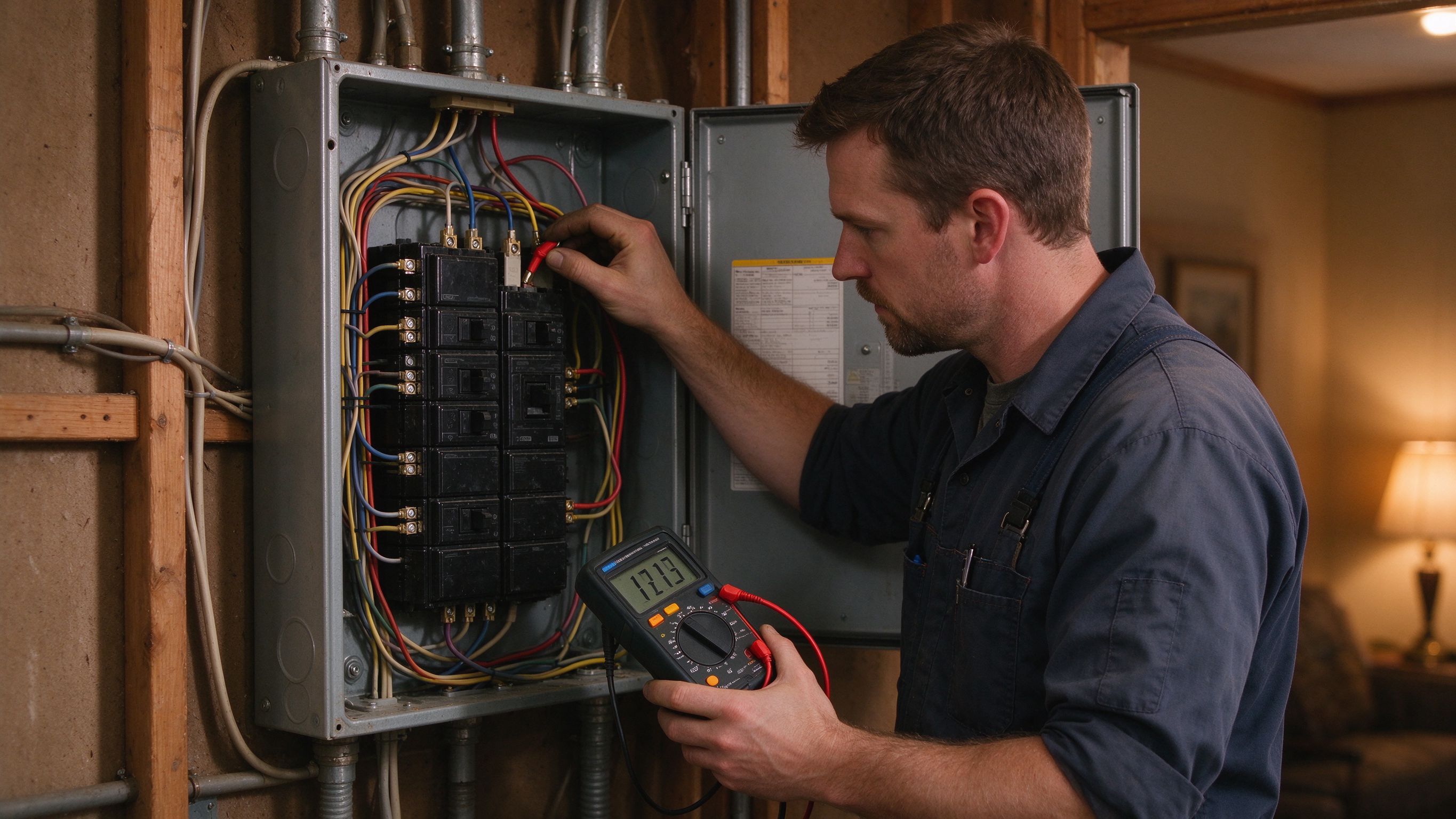
In North America, the very first question a heating supplier should ask you is not “how many square metres” — it is “what voltage”. A 120V vs 240V electric underfloor heating system looks identical on the floor and performs differently at the breaker panel: 120V systems draw roughly twice the current of 240V systems for the same wattage, which changes circuit capacity, wiring gauge, breaker sizing, and how many rooms you can heat per circuit. Buyers who ignore voltage discover the problem late, at the electrical inspection stage, when re-doing the electrical design costs more than the heating product itself.
This article explains the electrical reality of both voltages, compares them across the dimensions that matter for procurement, and gives you a checklist that lets a factory quote you accurately the first time. Factory data referenced below reflects SunAura Thermal production records in Qingdao, China (per SunAura factory records); the company has manufactured electric heating film, mat and cable for 17 years.
120V Systems: What They Are and Where They Fit
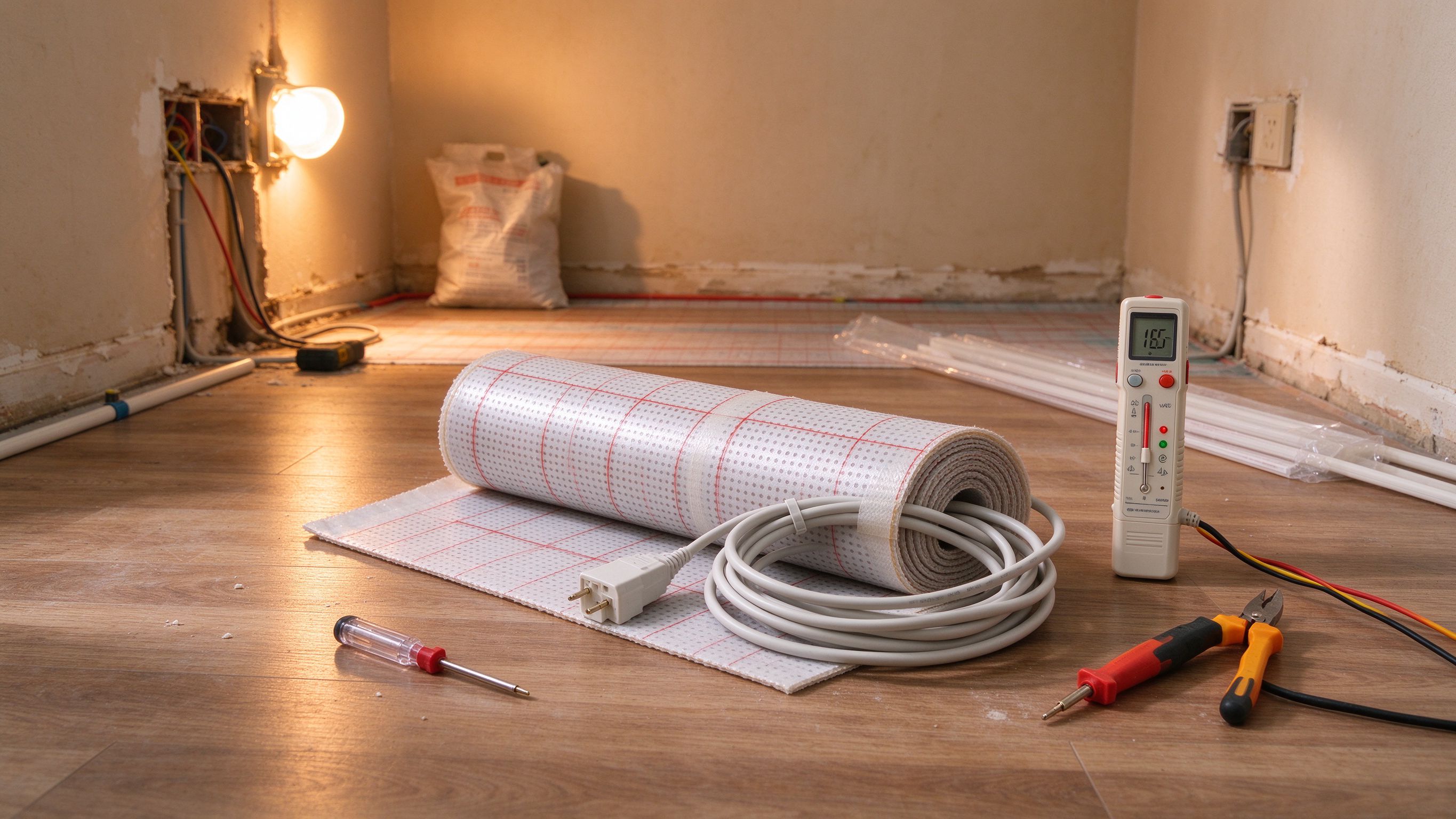
A 120V underfloor heating system is designed for the standard North American 120/240V split-phase panel — the common configuration in the United States, where most 15A and 20A branch circuits are 120V. The system’s heating elements (film, mat or cable) are engineered for 120V input, and the circuit is protected by a standard single-pole breaker with GFCI where the code requires it.
The practical consequences of 120V:
- Higher current per watt — a 1200 W system draws 10 A at 120V; the same wattage at 240V draws only 5 A.
- Lower wattage per circuit — a 15A 120V circuit comfortably supports about 1500 W (derated), which typically covers one modest room; larger rooms need a dedicated circuit or a 20A circuit.
- Ease of integration — in retrofit projects, tapping an existing 120V circuit (where code and load allow) avoids pulling new cable to the panel.
- Great fit for small zones — bathrooms, powder rooms, small kitchens, and the “warming” rather than “full heating” role.
Where 120V is a poor fit: large open areas that need 2400 W or more, where the current requirement would force a heavy-gauge wire run and still limit capacity.
240V Systems: Power, Efficiency and Circuit Reality
A 240V system uses a double-pole breaker and the two hot legs of the split-phase panel. Because current is halved for the same wattage, a 240V circuit can carry about twice the heating load of a 120V circuit of the same wire gauge.
The practical consequences of 240V:
- More wattage per circuit — a 240V 20A circuit can support roughly 3800 W derated, enough for a large living room, an open-plan area, or several rooms zoned together.
- Lower line loss — for long wire runs, halving the current cuts resistive loss by about three-quarters, which matters in slab-embedded wiring where resistance heat is wasted.
- Standard in Canada and many retrofit additions — Canadian 240V electric baseboard and heating circuits are common, so adding a 240V floor heating zone aligns with existing electrical practice.
- Requires a spare panel slot and correct breaker — a double-pole breaker occupies two slots; if the panel is full, the cost of the upgrade appears before the product cost.
Where 240V is a poor fit: tiny zones where the doubled cost of a double-pole circuit and a dedicated run is hard to justify against a 120V solution.
120V vs 240V Comparison Table
| Dimension | 120V system | 240V system |
|---|---|---|
| Current for 1200 W | 10 A | 5 A |
| Typical max load per 15A/20A circuit (derated) | ~1440/1920 W | ~2880/3840 W |
| Breaker | Single-pole | Double-pole (2 slots) |
| Best room size | Bathrooms, small kitchens, single rooms, zone warming | Large rooms, open plan, whole-floor zones |
| Retrofit friendliness | Can often tap existing circuits | Usually needs a dedicated circuit run |
| Line loss on long runs | Higher | Lower |
| Typical product availability | Heating mats and film for small zones | Full range: mat, cable, film, high-wattage constructions |
The table is a starting point, not a substitute for a load calculation. The definitive input is your room-by-room wattage requirement — computed with the underfloor heating wattage calculation method — because only then do you know whether a 120V circuit is sufficient or a 240V circuit is needed.
Matching Voltage to Your Project: Room by Room
Use these patterns to assign voltage before you talk to suppliers:
- Bathroom (2–5 m²) → 120V mat or film on an existing circuit; the lowest-cost, fastest solution.
- Kitchen (5–12 m²) → 120V on a dedicated 20A circuit if the wattage stays under ~1900 W; otherwise 240V.
- Living room or open plan (15–40 m²) → 240V almost always; the wattage will exceed 120V circuit capacity.
- Whole-floor zoning → 240V with multiple thermostats, each zone on its own double-pole circuit; this is the configuration used by most North American distributors for new builds.
- RV, marine or off-grid → not 120V or 240V at all; low-voltage DC film and mats (12–24V) are the right family — see our DC heating film for RV and marine guide.
If your project spans several zones, plan the electrical schedule early: the panel layout, the number of available slots, and the thermostat control strategy (one thermostat per zone) drive the bill of materials as much as the heating product does.

Data & Evidence: What the Factory Verifies
Voltage is not a marketing label — it is a tested electrical specification. Our factory verifies voltage-related parameters on every production run (per SunAura factory records):
- Rated voltage confirmation — mats, film and cable are produced and tested for the exact rated voltage (120V or 240V); mixing voltages in one order is flagged by our engineers before production.
- Resistance matching — finished products are resistance-tested so the wattage at rated voltage matches the specification within tolerance.
- Dielectric and insulation testing — each production batch passes high-voltage and insulation-resistance tests with logged results.
- Leakage current and safety checks — relevant for GFCI/ELCB compatibility in wet areas.
- Compliance — production runs under ISO 9001, ISO 14001 and ISO 45001 management systems; products are CE marked and assessed for RoHS, LVD and EMC where applicable, with certificate copies and batch reports provided on request.
We do not list certificate numbers in this article; verify the documents against your specific order and destination market.
Procurement Checklist: What to Send a Supplier
To get a correct voltage-specific quotation, send your supplier the following:
- Room-by-room area — square metres per zone, plus floor type (tile, laminate, vinyl, screed).
- Target wattage — W/m² (or total W per room); reference the wattage calculation guide if unsure.
- Mains voltage — 120V, 240V, or dual-rated product requirement; state whether circuits are dedicated or shared.
- Panel capacity — available slots and breaker sizes, if known; the factory cannot decide this for you, but it affects product selection (e.g. lower-wattage mats on 120V).
- Control requirement — number of thermostats, floor probe or air probe, WiFi or touchscreen preference, and whether you want a floor heating thermostat bundled.
- Product family — film, mat, or cable; if unsure, describe the floor build-up and renovation constraints.
- Certification and documentation — CE/RoHS documents, batch reports, MOQ, sample policy, and lead time.
SunAura Thermal supplies voltage-specific heating film, mat and cable to North American distributors, and our engineers confirm the voltage and wattage for every order before production — we will not ship a 240V product to a 120V site or vice versa.
Worked Example: Sizing a 120V vs 240V Circuit
Numbers make the voltage decision concrete. Work through this example with your own room sizes and you will never guess again.
Step 1 — wattage requirement. A tiled living room of 22 m², at 150 W/m² (a typical design value for primary heating in a well-insulated room), needs 3300 W. Add a 10% margin for heat-loss uncertainty: about 3600 W of installed capacity.
Step 2 — current at each voltage. At 120V, 3600 W requires 30 A — beyond a single 20A circuit, so the room would need two 120V circuits (or a sub-panel), plus a heavier feeder. At 240V, 3600 W requires 15 A — a single 20A double-pole circuit handles it comfortably with margin.
Step 3 — wire run. If the panel is 25 m from the thermostat, the 120V twin-circuit solution needs two runs of heavier gauge; the 240V solution needs one run of standard 12 AWG. Material and labour both favour 240V.
Step 4 — thermostat count. Both solutions can use one thermostat in the room, but the 240V solution keeps the load under a single controller’s rating, simplifying wiring. For multi-zone floors, repeat this calculation per zone and add a thermostat per zone — see our system comparison guide for the full cost picture.
The conclusion is typical: small zones (under about 1500 W) are often cheapest on 120V; everything above that belongs on 240V. Confirm the site voltage and panel capacity with an electrician before ordering, and state the exact voltage on your purchase order.
Installation Notes for Voltage-Specific Products
Voltage-specific products also need voltage-correct installation habits. Three points deserve emphasis for installers and distributors:
- Never mix voltages in one zone. A 240V thermostat controlling a 120V mat, or two mats of different voltages on one controller, creates under- or over-heating and invalidates warranty. Order the controller that matches the product voltage.
- Use the correct breaker and wire. The conductor size, breaker rating, and termination torque in the thermostat must follow the product’s electrical data sheet — this is both a code requirement and a safety matter. GFCI/ELCB protection is required in wet areas and recommended everywhere for floor heating.
- Verify before the pour or cover. Measure insulation resistance and continuity of every zone at the voltage rating, record the readings, and photograph the layout. This one habit prevents the majority of field failures and makes future troubleshooting trivial.
Distributors sourcing for the North American market should carry both 120V and 240V variants of fast-moving mats and film, and confirm the voltage on every order line — a mixed-voltage container is a costly error to discover at the customer’s site. Our factory labels every reel and carton with the rated voltage, and our underfloor heating product pages state voltage options for each family.
FAQ
Can the same heating mat run on 120V and 240V? No — the element resistance is designed for the rated voltage. Using the wrong voltage either reduces output drastically (120V on a 240V mat) or overloads the element (240V on a 120V mat), both dangerous. Always order the rated voltage for your site.
Is 240V more efficient than 120V? In delivered heat, no — both convert nearly all input power to heat. The practical efficiency difference is line loss on long wire runs and the ability to use higher-wattage zones on one circuit, which reduces installation cost.
Does a 240V system cost more to install? Usually yes for the electrical work (double-pole breaker, dedicated run, heavier termination), but for large zones it is often the only practical option, and per-watt product cost is similar.
What about 208V? Some commercial panels provide 208V between phases; confirm the actual supply voltage with the site electrician and order the correct rated product.
Do 120V and 240V heating products cost the same per watt? Generally yes — the element cost is similar; the difference is in the electrical work. The total project cost favours 240V for large zones and 120V for small zones, which is why the room-by-room calculation matters.
Can a distributor stock one voltage and convert later? No — the element resistance is set at the factory for the rated voltage. Order the exact voltage per project; our factory confirms voltage on every order line and labels every reel, which prevents mixed-voltage errors at the customer site.
Next Step: Confirm the Voltage, Then Compare Suppliers
Voltage decides the circuit, the breaker, the wire, and the product family. Work out your room-by-room wattage, confirm the site voltage with an electrician, and send the checklist above to our export team. You will receive a voltage-correct quotation, samples where needed, and factory pricing backed by 17 years of manufacturing.
Contact us at [email protected].
About the author: Ethan Sun, Founder & CEO, SunAura Thermal. SunAura has manufactured electric heating film, mat and cable in Qingdao, China, for 17 years, supplying CE/RoHS-compliant heating products to more than 50 countries.