
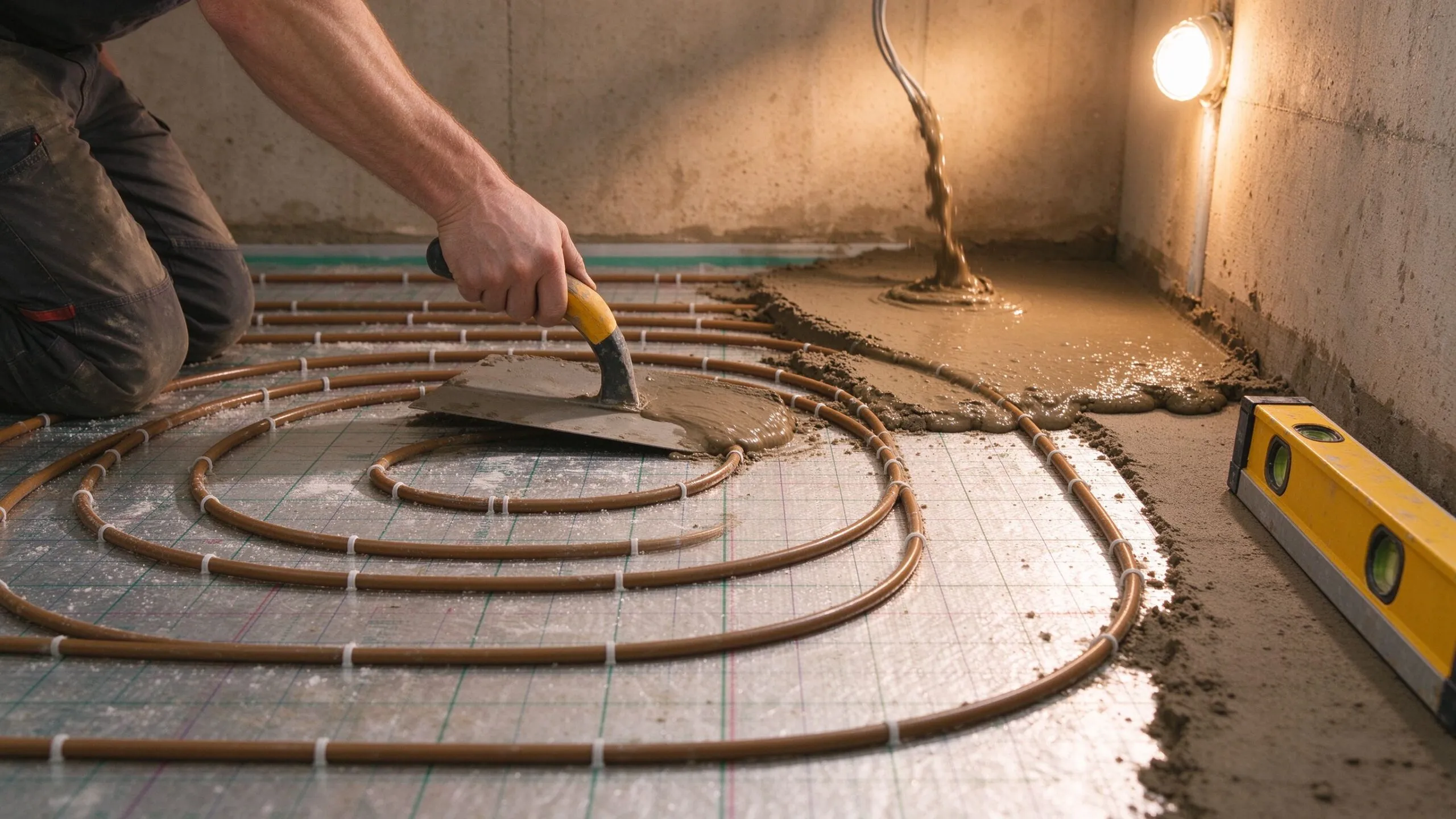
Electric underfloor heating looks like magic until you understand the physics — and once you do, every specification, installation and fault decision gets easier. This article explains how electric underfloor heating works, from the heating element to the floor surface, in terms any buyer or installer can use. Written by Ethan Sun, Founder & CEO, SunAura Thermal.
The Core Principle: Resistance Heating
Every electric underfloor heating system works on one principle: electrical resistance. When current flows through a material that resists it, the electrical energy converts into heat — exactly like the filament in an old light bulb, but without the light. The heating element is designed so that its resistance is predictable, its heat output is even across its length or area, and its surface temperature stays within a safe range.
The three product families are simply three ways of arranging that element:
- Heating film — a flat laminate with a printed carbon (graphene) layer; heat is generated across the whole surface area.
- Heating mat — a cable element pre-spaced on a mesh; heat is generated along the cable runs at fixed spacing.
- Heating cable — a loose cable element laid to the project’s own spacing; heat is generated along the cable runs at installer-determined spacing.
All three convert the same amount of electrical energy into heat — the difference is in how the heat reaches the floor surface and the room. This is why electric heating cable installation, mat installation and film installation share the same sizing logic: match the element’s wattage to the room’s heat loss.
How the Heat Moves: Three Mechanisms
Once the element generates heat, three transfer mechanisms carry it to the room:
- Conduction — heat moves from the element into the surrounding floor build-up (adhesive, screed, tile or the substrate under a floating floor). Conduction is how the heat leaves the element; the quality of the build-up determines how evenly it spreads.
- Radiation — the warm floor surface radiates infrared energy to the people and objects in the room. This is the “radiant” part of radiant heating: your body absorbs that radiation directly, so you feel warm even when the air is a couple of degrees cooler.
- Convection — warm air rises off the floor and slowly circulates the room. In underfloor heating, convection is the minor contributor; radiation and conduction do the real work, which is why the room feels even and draught-free.
The practical consequence of this physics: the floor surface temperature, not the element temperature, is what the system is really controlling. Most systems are controlled by a floor sensor precisely because the surface temperature is the comfort variable. The recommended surface range for occupied rooms sits comfortably within building-code limits — the exact figures are stated in the product and control documentation.
The System: Five Components Working Together
An electric underfloor heating system is five components, each with a job:
| Component | Function |
| Heating element | Converts electricity to heat (film, mat or cable) |
| Floor sensor | Reads the floor temperature at a representative point |
| Thermostat | Compares the reading to the set point and switches the element |
| Electrical protection | Circuit breaker and RCD/GFCI protecting the zone |
| Insulation | Stops downward heat loss into the floor void |
The thermostat is the brain and the element is the muscle
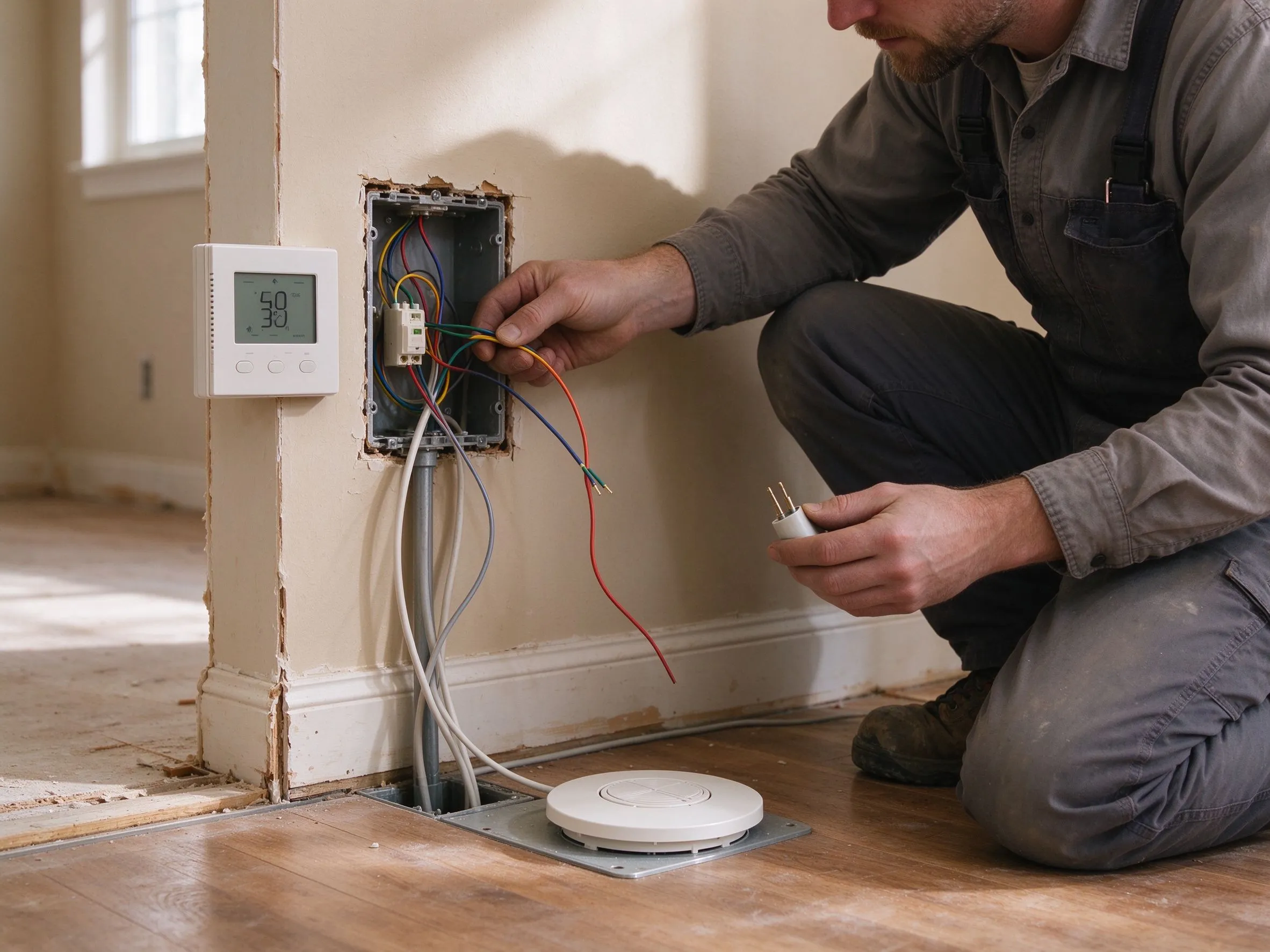
, but the unsung component is the floor sensor. Without it, the system guesses the floor temperature from the air — and in a room with sun or drafts, that guess is wrong. The smart thermostat for underfloor heating range controls the floor sensor reading directly, which is the difference between a comfortable system and one that overshoots in one corner and undershoots in another.
Why It Feels Different from Forced Air
The physics explains the comfort difference. A forced-air system heats the air, and warm air rises to the ceiling while the floor stays cold — the classic “cold feet, warm head” problem. Radiant floor heating does the reverse: the warmest surface is the floor, heat radiates to people first, and the temperature gradient across the room is small.
There are three measurable effects:
- Lower air temperature for the same comfort — because radiant heat reaches people directly, the thermostat can run a degree or two lower for the same perceived warmth (the exact saving depends on the building and climate; it is a comfort benefit first and an efficiency benefit second).
- Even room temperature — no hot ceiling, no cold floor, no draughts from forced air.
- Quiet operation — no fan noise; the only moving part is the thermostat.
This is why electric underfloor heating working principle is usually described as “comfort by radiation” rather than “warmth by air”. The same principle applies whether the element is film, mat or cable.
Efficiency and Control: Where the Savings Come From
Resistance heating converts essentially all input electricity into heat — the conversion efficiency at the element is near 100%. What separates an efficient installation from an inefficient one is everything around the element:
- Insulation below — without it, heat goes down into the floor void. Insulation below the element is the single biggest efficiency lever.
- Control quality — a programmable thermostat with a floor sensor avoids heating when the room does not need it. Setback scheduling is where running costs are actually controlled.
- Zoning — heating only the rooms in use is the biggest structural saving of all; room-level zones are why electric underfloor heating is economical in practice.
For the same reason, electric underfloor heating troubleshooting starts with the control chain: if the system is not behaving, check the sensor, the thermostat settings and the schedule before suspecting the element — most faults live in the control loop, not in the wire.
Film, Mat or Cable: How the Choice Works
Because the physics is shared, the product choice is about the build-up, not the principle:
- Film — the thinnest option; used under floating floors (laminate, LVT) and in dry-lay renovation where no screed is wanted. See our graphene heating film installation guide for the method.
- Mat — pre-spaced cable on mesh; the fastest tile-floor option, embedded in a thin levelling screed. Our electric heating mat wholesale range covers the common sizes.
- Loose cable — maximum layout freedom for irregular rooms; fixed and spaced by the installer, embedded in screed or adhesive. The same cable family also serves pipe heating and snow melting.
The sizing rule is identical for all three
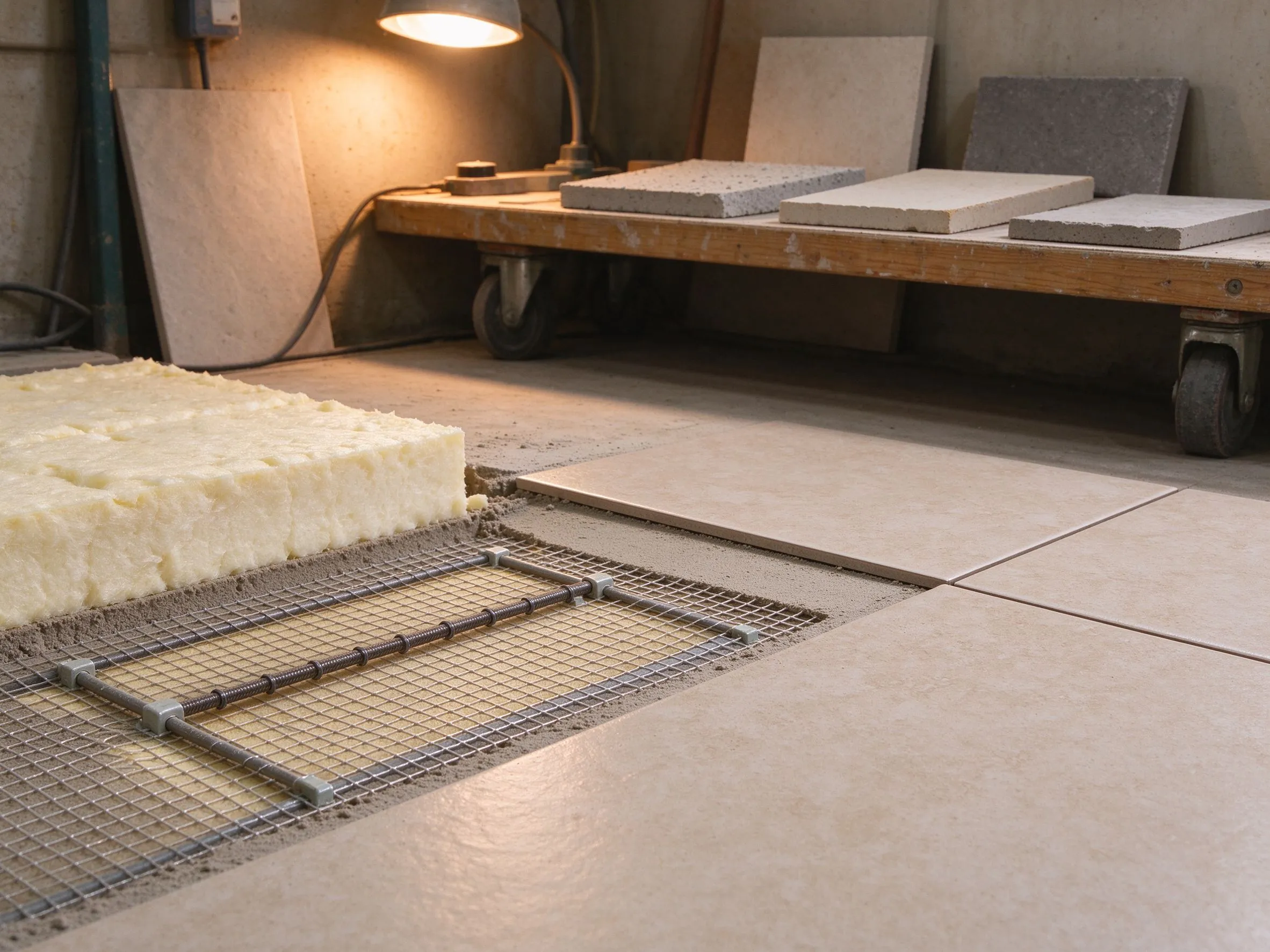
: net floor area minus fixed obstructions, wattage per square metre matched to the application, and the total zone load matched to a protected circuit. The layout drawing is the delivery document that makes the principle concrete for the installer.
Data and Evidence
This article is written from the electrical and thermal design of SunAura heating elements and the installation practice of our engineering team (per SunAura factory records). Supporting facts about the manufacturer:
- 17 years of continuous heating manufacturing since 2008, based in Qingdao’s Huangdao district (per SunAura factory records).
- ISO 9001 quality management, ISO 14001 environmental management and ISO 45001 occupational health & safety certification covering the product range.
- CE, RoHS, LVD and EMC compliance for EU-bound orders; documentation provided with every shipment.
- Products exported to 50+ countries across Europe, North America, Latin America, the Middle East and Southeast Asia.
- Every element batch is tested before packing, with resistance and insulation checks recorded per unit (per SunAura factory records).
For the underlying physics, the U.S. Department of Energy publishes a general overview of radiant heating: energy.gov radiant heating overview.
Heat Loss and Sizing: The Math Behind the Comfort
Underneath the physics, sizing is arithmetic: the system must replace the heat the room loses. The calculation considers the room’s envelope (walls, windows, floor, ceiling), the climate, and the target floor surface temperature — and it produces the wattage the element must deliver per square metre.
The numbers that matter in practice:
- Wattage per square metre — the specified output per unit area of heated floor. Typical residential values sit around 150 W/m² for primary living spaces, adjusted for floor construction and insulation; the exact figure for your project is stated in the quotation.
- Net heated area — the gross floor area minus fixed obstructions (cabinets, appliances, fixed joinery). Sizing on gross area oversizes the system; sizing on net area is the engineering standard.
- Zone load — the total wattage of the zone, which drives the circuit and breaker sizing. A 15 A / 120 V circuit handles a specific load; larger zones need dedicated circuits or 240 V supply.
- Surface temperature limits — occupied floors are held within the comfortable surface range, which also keeps the system within code limits. The floor sensor enforces this by switching on the surface reading rather than the air reading.
This arithmetic is why every SunAura quotation includes a load summary: the buyer or installer can verify the sizing against the building before installation, instead of discovering an undersized or oversized zone on site. The same numbers feed the commissioning and balancing checks that confirm the installed system matches the design.
Frequently Asked Questions
Does electric underfloor heating use a lot of electricity?
The element converts all input electricity to heat, so the consumption equals the heat delivered. The practical cost depends on zoning, insulation and control: heating one bathroom for a few hours a day is modest; heating a whole uninsulated house continuously is not. Design for the rooms you use, and control the rest.
Can I install it myself?
The element installation is straightforward, but the electrical connection must be done by a qualified electrician in most jurisdictions, and permits may be required. The typical division: the installer prepares and lays the element, and the electrician connects and commissions it.
Why does my system need a floor sensor if I have a thermostat?
Because the comfort variable is the floor temperature, not the air temperature. Without a floor sensor, the system cannot tell when the floor has reached the set surface temperature — it would heat by guesswork. The sensor makes the control precise.
What happens if the element fails?
Elements are tested before packing, and most faults live in the control loop or connections rather than the element itself. The service manual and our troubleshooting article walk through the diagnostic sequence; for a genuine element fault, the zone is traced with a resistance and insulation test, and the warranty process covers it with the test records.
What is the difference between constant-wattage and self-regulating elements?
A constant-wattage element delivers fixed output per metre at a given voltage, which is the standard for floor heating because the floor build-up controls the surface temperature. A self-regulating (PTC) element reduces output as temperature rises, which suits applications where the element must not overheat against its surroundings — see our self-regulating cable technology article for the mechanism.
Can electric underfloor heating be combined with a heat pump?
Yes, in practice they are complementary: the heat pump handles the base load, and electric radiant zones cover specific rooms or cold periods. The control side matters — each system needs its own control path, and our low-temperature compatibility article explains how electric elements pair with heat-pump systems.
Common Misconceptions, Corrected
Three ideas regularly confuse first-time buyers. The first is that “the element is the system” — in reality the control loop and insulation do as much for comfort and running cost as the element itself. The second is that electric heating is inherently expensive — room-level zoning changes the economics completely. The third is that film, mat and cable are different technologies — they are the same resistance principle arranged three ways, which is why one control family and one sizing logic serve all three. Holding the principle in mind makes every later decision — sizing, product choice, troubleshooting — more straightforward.
Build a System That Works
Understanding the principle is the first step; applying it correctly is the second. If you are planning an electric underfloor heating project — or building a product range — send the room details and the build-up to our engineering team. You will receive the element selection, the layout drawing, the load summary and the thermostat recommendation within 24 hours. Email [email protected] to start.
Related Products & OEM Inquiries
Understanding how electric underfloor heating works helps you specify the right product. Our complete underfloor heating systems include thin heating film for dry installs, pre-meshed mats for tile, and cable for custom layouts. Ask for a product selection guide — factory-direct supply for homeowners, installers and brands in 50+ countries.