

Choosing the right electric underfloor heating system can significantly improve your home comfort while reducing energy costs. With over 17 years of experience manufacturing electric heating solutions, SunAura Thermal has helped thousands of homeowners, installers and distributors select and source the right heating systems for their projects — from a single bathroom renovation to multi-room residential builds and commercial refurbishments. This guide walks through every decision point in plain language, so you can specify the correct product the first time.
Understanding Electric Underfloor Heating Systems
Electric underfloor heating systems are an efficient and comfortable way to heat your home. Unlike traditional radiators that heat the air, underfloor heating provides radiant heat from the floor up, creating a more even temperature distribution with no cold spots, no draughts and no wall-mounted radiators taking up space. Because radiant warmth makes you feel comfortable at lower air temperatures, correctly sized electric systems typically operate at lower setpoints than convection heating, which is where much of the energy saving comes from.
Types of Electric Underfloor Heating
Three main element families dominate the market. Your floor build, room geometry and heating duty determine which one fits:
- Heating Film: Ultra-thin graphene heating film that sits under laminate and engineered wood without raising the floor height. The film is cut to length on site, so it suits renovation projects where the subfloor cannot be altered. It is the fastest system to lay in dry installations.
- Heating Mat: Pre-spaced heating cables bonded to a mesh backing at fixed centres, so wattage per square metre is already engineered. Mats roll out quickly and are the standard choice for ceramic, porcelain and stone floors laid in adhesive.
- Heating Cable: Loose heating cable that the installer routes freely. It gives maximum flexibility for irregular room shapes, stairwells, greenhouse benches, roof valleys and any area where a fixed-width mat cannot fit.
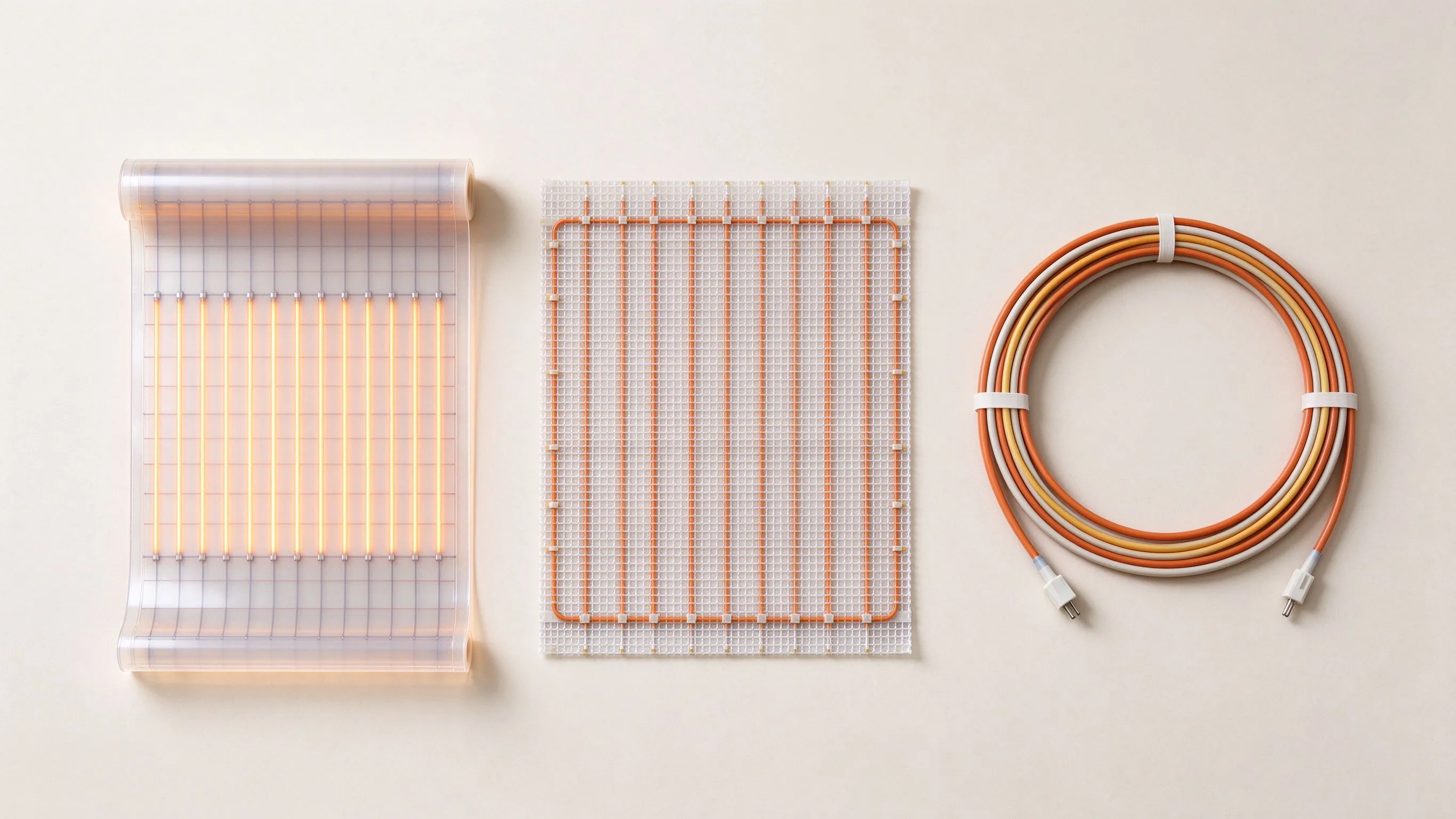
| Criteria | Graphene Heating Film | Heating Mat | Loose Heating Cable |
|---|---|---|---|
| Best floor type | Laminate, engineered wood, dry builds | Tile, stone, porcelain in adhesive | Any — including irregular layouts |
| Floor height added | ≈0.5 mm film + floor covering | ≈3.6 mm including cable | Varies with fixing method |
| Installation speed | Fastest (dry lay, cut to length) | Fast (roll out, no spacing calculation) | Slower (routing and fixing each run) |
| Typical output | 120–150 W/m² | 150–160 W/m² | 10–20 W/m per linear metre, spaced to suit |
| Best for | Renovation over existing wood floors | Bathrooms, kitchens, hallways | Custom shapes and cold areas |
Key Factors to Consider
1. Room Size and Layout
The heated floor area — not the total room area — drives the specification. Permanent fixtures (kitchen islands, bath units, fitted wardrobes) and a 50–100 mm clearance from walls reduce the effective heated area. For standard rectangular rooms, electric heating mats for tile floors give the fastest installation because the wattage per square metre is pre-engineered. For irregular shapes, loose heating cable provides better coverage flexibility with controlled centre spacing.
2. Flooring Type
Different flooring materials conduct heat differently, and this decides both the element family and the safe surface temperature limit:
- Tile and stone: Excellent thermal conductivity; works with mats, film and cable at full output.
- Laminate and engineered wood: Lower-temperature elements such as graphene heating film for laminate flooring prevent wood damage; keep surface temperature within the wood manufacturer’s limit (typically 27–28 °C).
- Carpet: Needs higher installed output to overcome insulation, a floor sensor to protect the carpet, and a tog rating below 2.5; many suppliers advise against carpet over electric floor heating for exactly this reason.
- Luxury vinyl (SPC/WPC): Works well, but confirm the plank’s heat resistance and expansion rating with the manufacturer before laying.
3. Insulation Quality
Insulation below the heating layer is the single biggest lever on running cost. In an uninsulated solid floor, up to 30–40% of the heat travels downward into the slab. Installing 10–30 mm of XPS or PIR insulation board beneath the elements — with reflective foil facing up — pushes heat back into the room and lets the system reach temperature faster. Well-insulated rooms achieve the same comfort at a lower power setting and shorter preheat time.
4. Electrical Circuit Capacity
An electric underfloor heating circuit is a dedicated electrical load. A 16 A circuit at 230 V handles roughly 3,680 W, which is approximately 20–23 m² of 160 W/m² mat — but thermostats and wiring regulations often cap each circuit lower, and the floor sensor must be installed in a protective conduit. If you are heating a large open-plan area, plan for more than one circuit from the start; splitting zones also gives per-room temperature control.
How Much Power Does Your Room Need?
A simple three-step calculation removes the guesswork:
- Measure the heated area. Room length × width, minus fixed furniture footprints and the wall clearance, in square metres.
- Pick the installed output. 160 W/m² for tile and stone floors in well-insulated rooms; 150 W/m² for wood builds; up to 180–200 W/m² for poor insulation or bathroom top-up duty.
- Multiply and check the circuit. Heated area × output = total wattage. Divide by 230 V (or 110 V in North America) to confirm it fits one circuit, or split into zones.
Example: a 12 m² kitchen on a 160 W/m² mat draws ≈1,920 W — about 8.3 A at 230 V, safely inside a 16 A circuit with the thermostat, sensor and wiring allowance. A 40 m² open-plan ground floor at 160 W/m² draws ≈6,400 W, which must be split across two circuits and two thermostats.
Choosing the Right Thermostat
The thermostat is where the energy saving actually happens. Modern WiFi thermostats for underfloor heating allow you to control the system remotely, set weekly schedules, run adaptive preheat and monitor consumption. A programmable or app-controlled thermostat with a floor sensor typically reduces running costs by 20–30% compared with leaving the system at a fixed temperature all day.
- Basic dial thermostat: Low cost, reliable, manual temperature control — fine for a bathroom top-up.
- Programmable touch thermostat: 7-day scheduling and floor limiting; the sensible default for living areas.
- WiFi smart thermostat: App control, scheduling, energy reports and voice-assistant integration; best for whole-home systems and rental management.

Whichever model you choose, specify one with a floor sensor (NTC10K is standard in the industry) so the floor surface temperature never exceeds the flooring limit. Pairing a floor-sensor thermostat with an insulation board is the most effective two-part upgrade for cutting running costs.
Installation Considerations
Correct installation determines both comfort and the service life of the element. The essentials:
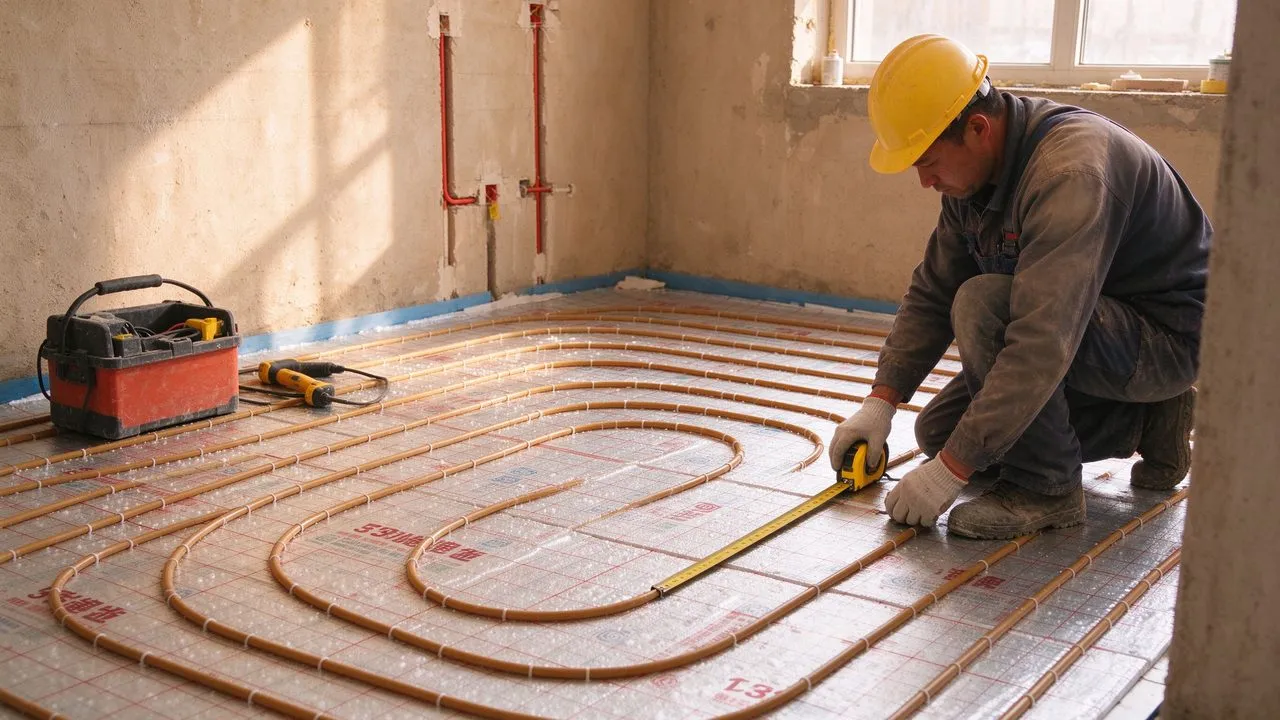
- Test the element resistance and insulation before, during and after laying — before the final floor covering goes down.
- Maintain the correct centre spacing between heating runs; never cross, cut or shorten a heating cable.
- Install the floor sensor in a protective conduit between two heating runs, so it can be replaced without lifting the floor.
- Protect every circuit with an RCD/GFCI and follow the local wiring code; connection work belongs to a qualified electrician.
- Follow the screed and adhesive drying rules for wet installations — see our step-by-step electric heating mat installation under tile tutorial.
If you are renovating over an existing wood floor, dry-lay film is usually the least disruptive option — no screed, no adhesive and minimal height gain. For new tile floors, a mat in a thin adhesive bed is the fastest wet build.
Common Mistakes to Avoid
Most problems with electric floor heating come from specification or installation errors, not the element itself:
- Heating under permanent furniture — waste and overheating risk; measure the heated area, not the room.
- Skipping the insulation board — the most common cause of “expensive to run” complaints.
- No floor sensor — floors overheat, wood floors warp, carpets degrade.
- Cutting the heating cable to fit — it changes the resistance and voids the warranty; buy the right length instead.
- Choosing by price alone — certification, wire quality and warranty history matter more than the lowest quote.
Energy Efficiency and Cost Savings
Electric underfloor heating is most efficient when it is correctly sized, insulated and controlled. Radiant warmth lets you feel comfortable at an air temperature 1–2 °C lower than with radiators, and every degree of setpoint reduction trims roughly 5–8% of heating energy. Combined with a floor-sensor thermostat, weekly scheduling and good insulation, a modern system typically runs as the most cost-effective option for small-to-medium spaces, wet rooms and homes without gas. For a fuller picture of how regulations and energy labels are changing, see our analysis of the underfloor heating energy label.
Factory-Direct Quality: Certification, Testing and Warranty
When you source from the factory rather than a middleman, you buy the specification, the test data and the warranty terms directly from the manufacturer. SunAura Thermal has manufactured electric heating products at our Qingdao, Huangdao factory since 2008 — 17 years of continuous production across heating film, heating mats, heating cable, snow melting mats and thermostats. Our production lines operate under ISO 9001 (quality management), ISO 14001 (environmental) and ISO 45001 (occupational health and safety) certification, and the product range carries CE and RoHS documentation; LVD and EMC compliance is tested per market requirements (per SunAura factory records). We export to more than 50 countries and support OEM/ODM programs for distributors and brands.
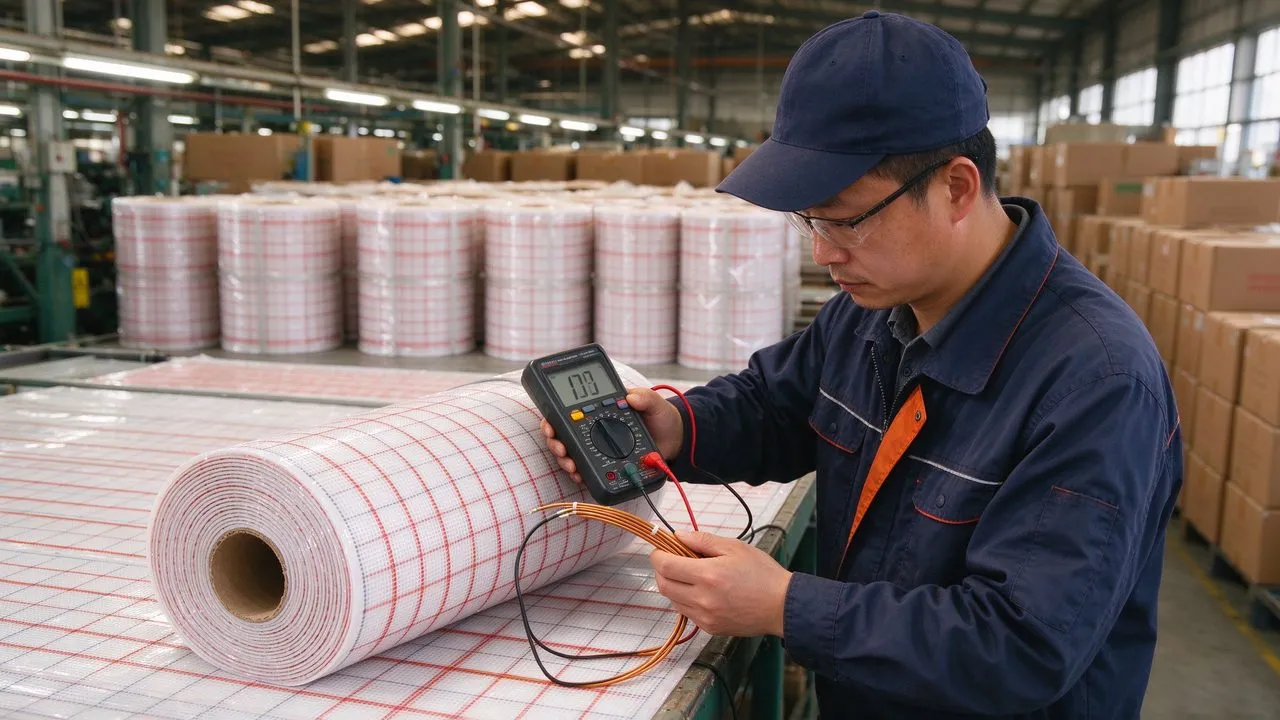
Every element is resistance-tested and visually inspected before packing, and warranty terms are confirmed in writing per order — typically 10–25 years depending on product family. Send us your room dimensions, floor build and voltage, and we return a factory-direct quotation with the correct specification, sample availability and MOQ in writing.
Frequently Asked Questions
Is electric underfloor heating expensive to run? With insulation board below the element, a floor-sensor thermostat and a weekly schedule, a typical well-insulated bathroom or kitchen runs for a fraction of the cost of an uninsulated system. The radiant effect also lets you set the room temperature lower than with radiators.
Can electric floor heating be the main heat source? Yes, in well-insulated rooms: a 160 W/m² output with good insulation provides the sole heat source in most climates. In poorly insulated or very large spaces, it works as a fast-response top-up alongside another system.
Heating mat or heating film — which should I choose? For tile and stone, choose a heating mat laid in adhesive. For laminate and engineered wood in a renovation, choose graphene heating film for the thinnest dry installation. Loose cable suits irregular layouts.
How long does the system last? The heating element is a solid-state resistive circuit with no moving parts; with correct installation and a protected floor sensor, manufacturers rate these systems for decades of service. SunAura provides written warranty terms per order, typically 10–25 years by product family.
Do I need a qualified electrician? The final circuit connection and RCD protection must be done by a qualified electrician and follow local codes. The element itself is installed by the flooring contractor or homeowner under the manufacturer’s instructions.
Can I buy a small quantity or a sample first? Yes — trade samples are available for installers and distributors, and production MOQ and pricing are confirmed in writing per order based on mat area and quantity.
Maintenance and Long-Term Performance
An electric underfloor heating system needs almost no maintenance — there are no filters, no boilers and no moving parts in the heating element. The checks that matter are electrical: record the element resistance reading taken at installation, confirm the RCD trips correctly once a year, and keep the floor sensor accessible via its protective conduit. The element itself is protected by the floor covering, so nothing wears out from normal use. For a full maintenance routine, commissioning checks and fault-finding steps, read our guide to underfloor heating maintenance for 20 years of efficiency. With correct installation and written warranty terms, a factory-built element is designed to outlast the renovation cycle it serves.
Conclusion
Selecting the right electric underfloor heating system comes down to four questions: what is the floor build, what is the heated area, what output does the insulation allow, and who supplies the system with test data and a written warranty. Answer those and the element family, thermostat and circuit plan follow naturally. With proper planning and a factory-backed specification, you can enjoy comfortable, efficient heating for decades.
Need help choosing the right system for your project? Send your room dimensions, floor type and local voltage to our sales team for a factory-direct quotation and sample programme.
About the author: Ethan Sun is the Founder and CEO of SunAura Thermal, a heating-systems manufacturer based in Qingdao, China. Under his leadership the company has grown from a single workshop into an ISO-certified factory exporting electric underfloor heating, heating cable, heating film and snow melting products to more than 50 countries worldwide.
Related Products & OEM Inquiries
Choosing the right electric underfloor heating system? Compare graphene heating film for fast dry installations, pre-meshed mats for tile-over projects, and loose cables for irregular rooms. Add a smart thermostat for control. Get a free recommendation — we supply installers, distributors and brands in 50+ countries.