
Before a single cable watt is chosen, a snow-melting project has to answer a bigger question that sets the entire electrical load and budget. Do you heat the whole driveway, or only the two strips where the tyres run? The choice between full coverage and partial, tyre-track coverage changes the cable metres, the panel capacity, the installed cost and the way the surface clears after a storm. This guide compares the two on the points that matter, using the figures from the SunAura snow melting cable page, and states which one to specify for each driveway.
What full and partial coverage mean
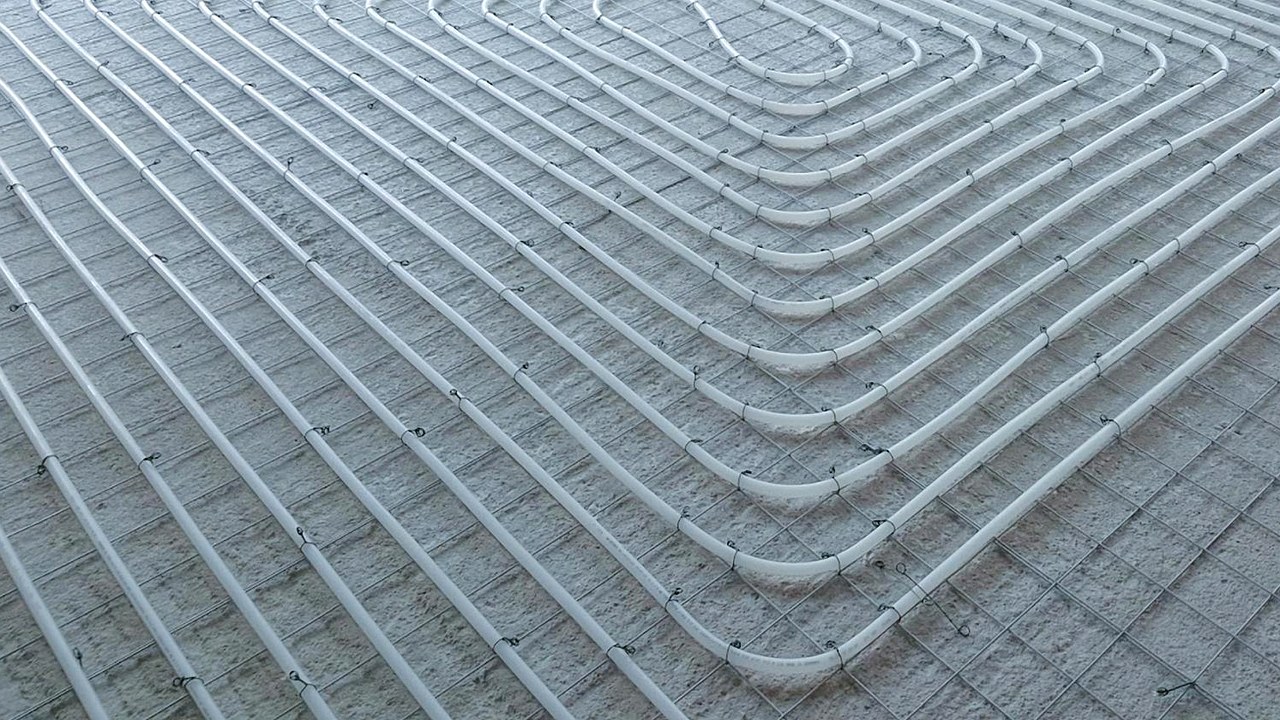
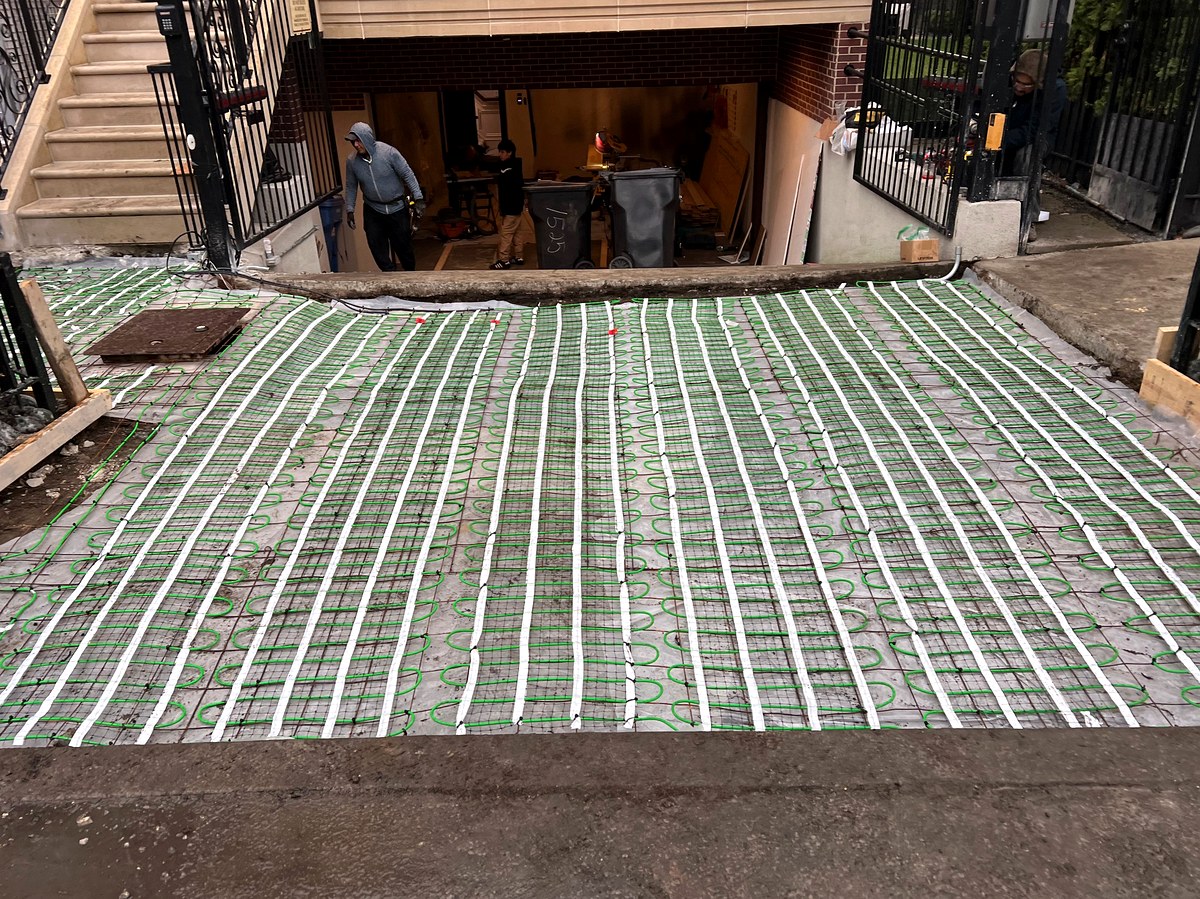
Full coverage lays cable across the entire heated area, so every square metre receives heat and the whole slab clears together. The product page shows a residential build at 200 to 250 W/m² that clears the surface in roughly 60 to 90 minutes, with commercial and ramp builds stepping higher. Once the system runs, the snow and ice melt across the full width with no manual sweeping, and the driveway is ready to use end to end.
Partial, or tyre-track, coverage lays cable only in two strips that match the wheel paths of a vehicle. The page describes edge strips only, tyre tracks, at 250 to 300 W/m² within the strips. The wheels roll on clear heated bands while the snow between and outside them is not directly heated. The capital cost is lower because far fewer cable metres are laid, but full-width clearing is slower and some residual snow may need to be swept or allowed to melt outward from the strips.
Load and electrical capacity
The total power of a system is its heated area multiplied by its density, and the coverage choice moves that number more than any other setting. A full-coverage driveway heats every square metre, so the total load can be large and a long or wide driveway often splits into several circuits, moving toward a 400 V three-phase supply on commercial work. The panel has to carry the full cold start and the running load of the whole area, which is why capacity is checked before the layout is fixed.
Tyre-track coverage heats only a fraction of the area, so the total load is much smaller even though the density inside the strips is a little higher. The same panel can usually carry the partial system on fewer, single-phase circuits, and the cold-start current is lower. For a buyer whose electrical panel has limited spare capacity, the partial build can be the difference between a system that fits the existing supply and one that needs an expensive panel upgrade. That electrical saving is often the deciding factor on long residential drives.
Cost: cable metres against later labour
The installed cost tracks the cable metres, and the product page gives an indicative range of roughly US$18 to 60 per square metre, with cable lower and mats higher. Full coverage buys more metres across the whole area plus the circuits to feed them, so it carries the higher up-front cost. Tyre-track coverage buys metres only for the two strips, which can cut the heated area sharply and bring the material and electrical work down with it.
The trade returns after every storm. A full system clears the entire slab with no one leaving the house, so the higher cost buys hands-off operation. A partial system leaves snow between the tracks that either melts slowly as heat spreads through the slab or needs a quick manual pass, and it can be less effective in a heavy, fast fall. The honest comparison is up-front capital against ongoing convenience, with the full build winning on automation and the partial build winning on price and load.
Clearing performance in real conditions
Full coverage is the more predictable performer. Because the heat is uniform, the slab melts the snow as it falls and the stated 60 to 90 minute clearing holds across the width, with no cold centre for ice to bond to. On a slope or ramp, where traction matters most, the even surface is the safest result and the higher 300 to 350 W/m² ramp class is used to keep the gradient clear.
Tyre-track strips clear the wheel paths quickly at their higher density, which is enough to drive in and out, but the centre and edges rely on heat spreading sideways through the slab. In mild snowfall that is often sufficient and the rest melts in time. In deep or drifting snow, or where several vehicles use different wheel positions, the unheated bands can remain snow-covered and need attention. The partial system is built for access, not for a showroom-clean slab.
Running energy and the heat balance behind the watts
It helps to understand what the watts are actually doing. Melting snow takes energy for three separate jobs: warming the falling snow to freezing, melting the ice into water, and losing a fixed amount of heat to the cold air and the ground below. The design density is the answer to that heat balance at the local snowfall rate, which is why a ramp or bridge, exposed to cold air on more than one side, needs a higher density than a ground-level slab. The full and partial builds use the same per-metre physics; they differ in how much area is asked to do the work.
Running cost follows the kilowatt-hours, not just the peak watts. A full system draws more power while it runs but clears in a defined window and switches off, controlled by the slab sensor. A partial system draws less in total but can run longer as heat spreads, and it may be re-energised through a longer storm. Energy agency data on radiant snow-melting shows that the sensor and pre-heat strategy, switching the system only when precipitation and low temperature coincide, does more for the annual energy bill than the coverage choice itself. Either build wastes money if it is left running on dry cold days, which is the fault the automatic control is designed to prevent.
This gives buyers a cleaner way to think about the trade. The full build’s higher running energy is the price of clearing the whole area quickly. The partial build’s lower energy is concentrated in the strips, with the unheated area never directly served. Ask for an annual operating estimate against the local number of snow events, not just the installed kilowatts, so the running cost is compared on the same basis as the capital saving.
Surface materials and how they change the install
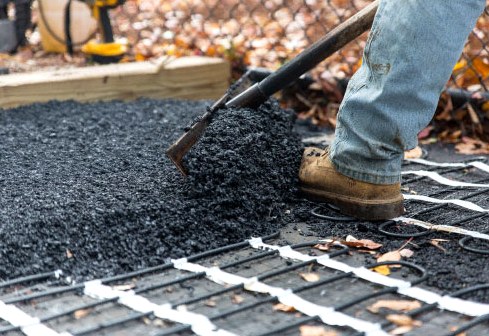
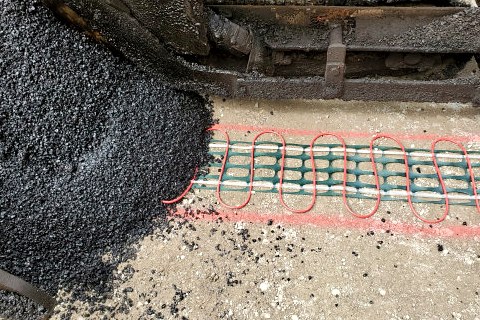
The coverage plan interacts with the surface the cable is buried in, and the details differ by material. In concrete, the cable is fixed on the grid and the slab is poured with the stated cover, with no vibrator held directly over a loop. In asphalt, the heat of the fresh material has to be managed and a layer shovelled over the cable before any equipment drives across it, since the high paving temperature can damage a jacket that is not protected. Under pavers, the cable is often bedded in sand or a base layer rather than embedded in hot material.
Full coverage is straightforward across all three surfaces because the loops are uniform and the cover is even. Tyre-track strips need the edges of the heated bands planned so the cable does not sit at a joint or a cut edge where movement can concentrate, and the transition between heated and unheated concrete should be gradual rather than a sharp boundary. The slab sensor is placed inside a heated zone regardless of coverage, so it reads the real temperature of the area the control is responsible for rather than an unheated patch that would never warm.
Side-by-side comparison
| Point | Full coverage | Tyre-track (partial) |
|---|---|---|
| Heated area | Entire driveway | Two wheel-path strips |
| Density | 200–250 W/m² residential, higher for ramps | 250–300 W/m² inside the strips |
| Total load | High, often several circuits or three-phase | Low, fewer single-phase circuits |
| Panel capacity | May need an upgrade on large drives | Fits limited spare capacity more easily |
| Clearing | Full width in 60–90 minutes, hands-off | Tracks clear first, rest slower or manual |
| Material cost | Higher, more cable metres | Lower, metres only for strips |
| Best for | Commercial, ramps, frequent use, full automation | Budget residential, long drives, light snow |
| Weakness | Up-front capital and electrical work | Residual snow, sensitive to wheel spacing |
Scene-by-scene: which to specify
Commercial loading bays and ramps. Specify full coverage. Time-critical access, mixed vehicles and the traction risk on a gradient demand an even, fully clear slab, and the higher ramp density and three-phase supply are justified.
Long residential driveway. A tyre-track build keeps the cable metres and panel load in proportion on a long run where the wheel positions are consistent. It is the budget-conscious answer for a household that can accept a quick sweep of the centre.
Short suburban drive. Full coverage costs little extra on a small area and gives fully automatic clearing, so the uniform build is usually the better value once the area is modest.
Walkways and steps. These are pedestrian surfaces where every metre is walked, so full coverage at the walkway density is used rather than strips that would leave icy patches underfoot.
Multi-vehicle household. If different cars use different track widths, the partial strips may not match every vehicle. Either widen the bands or move to full coverage rather than laying strips only one car can use.
Installation and sensor control
Whichever coverage is chosen, the cable is fixed with clips at 300 to 400 mm centres and buried with a 40 to 50 mm cover, never crossed and never raked with steel directly over a loop. The slab sensor, with its reference sensor, is set 30 to 50 mm deep so the control knows the real slab temperature and can pre-heat before a storm. The electric snow melting design guide covers the layout, and the roof and gutter de-icing guide matches the density to the surface. Record the resistance and insulation of every circuit before the pour, as the load capacity and contactor guide recommends, and confirm the control strategy, manual, slab sensor or forecast pre-heat, at order time.
Maintenance, fault finding and the hybrid middle ground
Once the surface is closed, the accessible test points are the cold-lead terminals at the junction box, so the box is planned above grade and the circuits kept identifiable. The commissioning records, resistance and insulation for every loop, become the baseline for later diagnosis. A circuit that trips its breaker on a cold start is exceeding the protection, while a loop that runs but never clears usually points to a sensor reading the wrong zone or a damaged cable rather than the coverage plan. A thermal image across the warm surface maps the heated bands and confirms the strips are where the wheels actually run.
The full and partial builds are not the only two options. A hybrid layout heats the full width at the entry, the gradient and the turning area where traction is critical, then drops to tyre-track strips along the straight, level length of a long drive. That concentrates the cable metres where full clearance matters and accepts partial coverage where access alone is enough. It is a useful answer for a long sloped driveway that would be expensive to heat fully but unsafe on the ramp if left as strips throughout. The hybrid still has to be planned as one clear electrical scheme with the circuits and sensor zones defined before the pour.
Whichever layout is chosen, the routine maintenance is light because the element has no moving parts and is sealed inside the slab. The work that remains is at the control: keep the sensor and reference sensor clear, test the RCD, and confirm the pre-heat schedule each season. The long service life of the buried cable depends more on correct installation and clean terminations than on whether the area was covered fully or in strips, so the coverage decision should be driven by access needs, budget and panel capacity rather than by durability.
Pre-inquiry parameter checklist
- Driveway dimensions and a plan marking the heated area and any wheel-path strips.
- Surface type: asphalt, concrete, pavers or deck, and the cover depth.
- Vehicle count and the wheel track widths the strips must match.
- Local snowfall intensity and whether rapid, full-width clearing is required.
- Supply: 230 V single phase or 400 V three phase, and the spare panel capacity.
- Density class from the 200–350 W/m² range for the surface and gradient.
- Number of circuits and the cold-start load each breaker must carry.
- Control type: manual, slab sensor or forecast-based pre-heating.
Questions buyers ask before they decide
Can I start with tyre tracks and add full coverage later? Adding loops later means reopening the surface, so it is not a simple retrofit. If full coverage is a likely future need, plan the panel capacity and circuits now, even if the first build is partial, rather than laying a system that cannot be extended without breaking the slab.
How wide should a tyre-track strip be? The band is sized to the wheel width and the vehicle’s track, with some margin so slight variations in parking still land on the heated area. A household with several cars either widens the bands to cover the widest spacing or moves to full coverage, since narrow strips matched to one vehicle leave the others driving on snow.
Does partial coverage work on a steep slope? It is a poor choice on a gradient. Traction is needed across the full width on a ramp, and unheated bands can leave ice that a tyre slides on. Slopes take full coverage at the higher ramp density, while the partial method stays on level straight runs.
Is the partial system cheaper to repair? The buried element is the same, so a fault is diagnosed the same way at the cold-lead terminals. The partial layout has fewer metres to inspect, but the savings are minor compared with the up-front capital difference, and the strips still need the same clean terminations and sensor placement.
What clears better in a heavy storm? Full coverage, because the whole slab melts the snow as it lands. A partial system can be overwhelmed in a fast, deep fall, with the unheated bands building snow faster than heat can spread from the strips. Match the coverage to the worst local snowfall rather than the average.
Common mistakes
Laying strips that match only one car. A multi-vehicle household needs the bands widened or full coverage, or some wheels will run on unheated snow.
Assuming partial coverage clears the whole slab. It heats the tracks; the centre relies on sideways heat or manual sweeping in a heavy fall.
Under-checking panel capacity on a full build. The whole-area load can require an upgrade or three-phase supply. Confirm capacity before the layout is fixed.
Over-densifying a partial strip to compensate. The strips already run at higher density; pushing them harder risks the slab rather than speeding the unheated bands.
Ignoring the sensor placement. A sensor outside the heated zone reads the wrong temperature and defeats the pre-heat. Seat it in the slab as designed.
Data and evidence
The comparison rests on how outdoor radiant heating is engineered and regulated. Electric snow-melting and outdoor heating systems are designed against the heat-balance methods published in industry and standards references, which calculate the watts needed to melt snow at a given rate, while national electrical codes and the IEC 60898 range govern the breakers, RCDs and cold-start protection on outdoor circuits. Transport and road research bodies, along with energy agencies, publish data on snow-melting loads and the energy cost of full versus partial operation that supports treating the coverage area as the primary load variable. Established heating manufacturers document density classes, clearing times and the tyre-track method in their technical literature, which is the correct source for those figures rather than a universal estimate. The SunAura evidence is limited to what can be shown: manufacturing since 2008, ISO 9001/14001/45001 management, CE/RoHS/LVD/EMC documentation, a Qingdao Huangdao plant with six automated lines and an in-house laboratory, and exports to more than 50 countries. No certificate numbers, load figures or client names are invented, and no hazardous-area claim is made.
Conclusion: what to choose
Choose full coverage when the surface must clear itself end to end, on commercial bays, ramps, walkways and short drives where the extra cable metres and panel capacity are repaid by hands-off, even melting. Choose tyre-track coverage when the driveway is long, the budget or panel capacity is tight, and the wheel positions are consistent, accepting that the strips clear first and the rest melts slowly or needs a sweep. Match the strip width to every vehicle that uses the drive, keep the density inside the recommended class, and record every circuit’s resistance before the surface is poured. Where the layout mixes a critical entry or ramp with a long level run, the hybrid plan can heat the high-risk area fully and the straight length in strips, rather than forcing one choice across the whole driveway. Confirm the panel capacity and the sensor zones against the worst local snowfall before the cable is ordered, so the system that is built is the one the site can actually power and the surface can rely on through the worst winter storm, with no surprises at the panel on the first cold morning. The full range of densities and the surfaces they suit are collected on the snow melting applications hub, where each driveway can be matched to a coverage plan and the right electrical protection before the order is placed, and the result can be checked against the real site conditions.