
How do heated jackets work, and why do some models warm your torso in a few seconds while others feel barely warmer than a padded coat? The short answer is that a modern heated jacket does not store heat the way a down or synthetic-insulation jacket does. It converts a small stream of electrical energy from a USB power bank into radiant heat through a printed graphene–carbon film sewn into the lining, and it directs that heat onto your core body rather than trying to warm the layer of air between you and the fabric. This article walks through the physics and the engineering: what the heating film is made of, why it runs on 5 V DC, what the 5–14 µm far-infrared band means for thermal comfort, how the three heat levels are controlled, how the heating zones are laid out, and how the shell, taped seams and wash cycle actually hold up in daily use.
Written by David Andersson, Senior Heating Technology Engineer, SunAura Thermal.
Last updated: November 8, 2026
What Is a Heated Jacket, Exactly?
A heated jacket is an outdoor shell garment with integrated heating elements that you switch on while wearing it. At SunAura, the reference product is a heated outdoor shell jacket rated at 5 V DC, powered over USB. The heating elements are not loose wire coils; they are a printed graphene–carbon film laminated into the lining. A USB power bank, carried in an inner pocket, supplies the energy. The jacket has synthetic insulation under a windproof and waterproof outer shell with sealed or taped seams, and it offers three selectable heat levels. Once the power bank is removed, it can be machine washed.
That combination — a real weather shell plus a thin, conformal heating film — is what separates a purpose-built heated jacket from a fleece with a battery pack glued to it. It is meant to be worn on its own in cool conditions, or layered under a heavier shell in very cold ones, by outdoor workers, motorcyclists, campers and anyone facing prolonged cold. If you are deciding between a jacket, a vest and a plain insulated coat, our companion piece on heated jacket vs. heated vest vs. insulated coat walks through the trade-offs.
Active Radiant Heat vs. Passive Insulation
Ordinary winter wear works passively. Your body generates heat, and the insulation — down, synthetic fill, fleece — traps a layer of still air next to your skin, slowing the rate at which that heat escapes. If you are already warm, this works well. If you are sitting on a motorcycle at dawn, or standing on a worksite before sunrise, or climbing into a cold tent at night, your metabolic heat may not be enough to overcome the heat loss through the shell, and the insulation simply cannot make up the difference.
A heated jacket works actively. It adds a small, controlled amount of heat directly onto your torso. The important engineering point is where that heat lands. The graphene–carbon film emits far-infrared radiation that is absorbed by the fabric and by your clothing, and by your skin where it contacts the lining, rather than heating the air in the jacket cavity. Because air has low thermal mass and is constantly being moved by wind and your own movement, heating the air is inefficient; heating surfaces — your clothes, your body — is efficient. This is why a garment that draws very little electrical power can still feel warm to the wearer within seconds.
| Dimension | Passive insulated coat | 5 V graphene heated shell jacket |
|---|---|---|
| Heat source | Your own metabolism; insulation traps it | USB power bank drives printed graphene–carbon film |
| How warmth reaches you | Reduced heat loss through trapped air | Added far-infrared radiant heat onto core torso |
| Time to feel warm | Depends on your own activity | About 3 seconds after switching on |
| Power needed | None | 5 V DC from a USB power bank (not included) |
| Adjustability | Fixed by thickness and layering | Three selectable heat levels |
| Washability | Machine washable as normal | Machine washable after the power bank is removed |
The takeaway is that insulation and heating are complementary, not competing. A heated jacket still needs good insulation and a weather shell to hold the heat in; what it adds is the ability to start from a cold, resting state and reach comfort quickly, and to hold that comfort while your activity level is low.
How Printed Graphene–Carbon Film Turns 5 V DC into Far-Infrared
The heating element in this jacket is a printed graphene–carbon film. That wording matters. Older heated garments used resistance wire sewn in threads — thin, brittle wires that bend with the fabric but eventually fatigue at the folds, and that tend to produce hot spots along the wire while the gaps between wires stay cold. A printed film is different: a carbon-loaded ink, with graphene as a high-conductivity filler, is screen-printed or otherwise deposited onto a flexible substrate in a controlled pattern. When DC voltage is applied across the film, current flows through the carbon network, and the film warms resistively.
Two properties follow from this geometry. First, because the resistive material is spread as a thin plane rather than concentrated in wires, the heat is distributed over a broad area and the surface temperature stays even. Second, because the film is thin and has low thermal mass, it reaches operating temperature quickly — the rated heat-up time for the SunAura jacket is about 3 seconds. The manufacturer quotes an electrothermal conversion efficiency of greater than 99 %, meaning nearly all of the electrical energy delivered to the film is converted to heat rather than lost as, say, a resistive drop elsewhere. For a deeper dive into the material, see our article on graphene heating film material science.
At 5 V DC, the film operates at extra-low voltage. This is a deliberate choice: USB is a ubiquitous, low-voltage standard, and a 5 V supply cannot deliver a dangerous current through wet fabric the way a mains-voltage heater could. The same low-voltage film technology family extends to 12 V and 24 V builds for stationary and vehicular applications, which is the subject of our note on low-voltage heating cloth for 5V, 12V and 24V systems.
Why the 5–14 µm Far-Infrared Band Matters
When the graphene–carbon film reaches operating temperature, it emits thermal radiation primarily in the far-infrared band, measured at 5–14 µm for this product. Far-infrared is the part of the thermal spectrum that objects at roughly human-skin and garment temperatures naturally radiate and absorb. In practical terms, radiation in this band is absorbed by the fabric layers and by skin rather than passing through them or reflecting away, which is why the wearer perceives it as direct warmth rather than a draft.
We explain the physics and the comfort implications in detail in far-infrared radiant heat and thermal comfort, and the same film physics applies to our graphene home heating panels. The point for the jacket is that the heating element is not just a warm pad; it is a radiant emitter tuned to the band where the human body exchanges thermal radiation. That is the engineering reason a low-power film can feel subjectively warmer than the small amount of electricity it consumes would suggest.
The Roughly Three-Second Heat-Up
Pressing the control switch on the jacket sends 5 V DC from the USB power bank to the film through the control cable. The film’s thermal mass is very low — it is a thin layer of carbon-loaded ink on a flexible substrate — so it reaches working temperature in about 3 seconds. This is noticeably faster than older wire-type heated jackets, which often take longer because the wire has to warm up and then conduct heat into the surrounding fabric before the wearer feels anything.
Engineers should note that the 3-second figure is the heat-up to a perceptible working level under the rated supply, not the time to a steady-state surface temperature. Once on, the film stabilizes quickly because the insulation and the wearer’s own heat loss balance the input. The three levels below are the user’s way of setting that balance for the conditions.
Three Heat Levels and the Control Logic
The jacket has three selectable heat levels. In practice, the user cycles through them by pressing the control button, and the jacket holds the selected level until the bank is depleted, the button is pressed again, or the jacket is turned off. The exact surface temperature at each level depends on the power bank’s output and on the conditions, and we do not publish a fixed °C figure per level because that would depend on the power bank’s current delivery and on how the garment is layered.
The control logic is simple by design. A single button, often on the chest or cuff, cycles the levels; an LED or indicator shows which level is active. Higher output is used for standstill exposure — waiting at a bus stop, on a bike at dawn, sitting in a cold tent — and lower output is used once you are moving, or when ambient conditions are mild. Because runtime is finite (see below), most wearers start on a higher level to warm up and then drop to a lower level once they are comfortable.
Heating Zones and Core-Body Warming
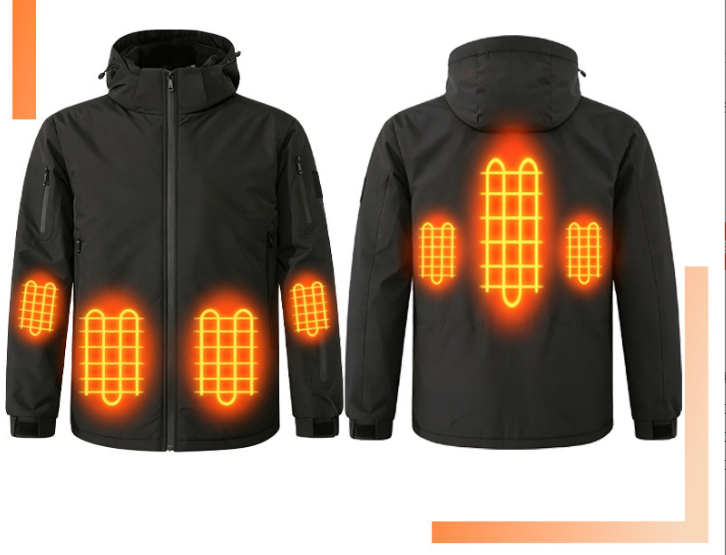
Heating elements are placed where the body loses heat and where warmth matters most: the front and back of the torso, and, on many builds, pocket areas that warm the hands. The design principle is core-body warming — keeping the chest, back and abdomen warm rather than trying to heat the limbs, which the body itself prioritizes once core temperature is stable. A cold nose and cold hands in a cold wind are largely a consequence of the body shunting blood away from the extremities to protect the core; warming the core reverses that response.
For context, the companion heated vest product uses a five-zone heating layout, and customers can compare coverage directly on the heated vest product page. For the jacket, the number and placement of zones is part of the OEM/ODM customization: size, color, heating zones, logo and packaging are all configurable for wholesale and private-label orders. If you are specifying a product line for workwear or a brand, our heated jacket buying guide covers how to decide on zones, sizing and shell spec before you place a PO.
USB Power Bank Supply and Runtime
The jacket runs on 5 V DC over USB, and the power bank is carried in an inner pocket. The bank is not included as a fixed component; it is a standard USB power bank the customer supplies. That is deliberate: the wearer can use the same bank for a phone, a headlamp and the jacket, and the garment does not ship with a sealed battery that would complicate airline transport and recycling.
Runtime is therefore not a fixed number. It depends on two variables the user controls: the capacity of the chosen power bank, and the heat level selected. A larger bank on a lower level runs longer; a smaller bank on a higher level runs shorter. When you read marketing claims like “8 hours of warmth,” treat them as tied to a specific bank capacity and level — ask for the test conditions before comparing suppliers. This article therefore does not quote mAh or runtime figures: the honest answer is that runtime varies with power-bank capacity and the selected heat level.
Low-Voltage Safety and EMF
Because the jacket runs at 5 V DC, it operates in the extra-low-voltage range. There is no mains voltage anywhere in the garment, and the USB supply is current-limited by the power bank itself. This is a large part of why heated garments moved from specialty motorcycle accessories to everyday outdoor and workwear: the safety envelope of a 5 V circuit is fundamentally different from a 230 V or 120 V heater.
Customers sometimes ask about electromagnetic field (EMF) exposure from the film. A DC-powered planar film emits a steady, low-frequency field rather than the time-varying fields associated with mains-frequency heating equipment, and at 5 V the field levels are negligible next to the EMF from ordinary consumer electronics. We cover the methodology in EMF safety for electric underfloor heating and in low-voltage heating film at 12V and 24V. For program-level certification evidence, SunAura’s graphene heating line is covered by CE/ISO evidence on the CE/ISO dual-certification product line page; we do not attach a specific certificate number to the jacket without confirming the order-level documentation.
Shell, Taped Seams and Washability
The heating film is only half the story. A heated jacket that falls apart in the rain is useless on a worksite. The SunAura jacket uses a windproof and waterproof outer shell with sealed or taped seams over synthetic insulation. The taped seams are the detail that matters: an untaped shell can be water-resistant on the fabric face but still weep through every stitched hole, and a soaked jacket loses the insulation layer that keeps the radiant heat next to the body.
The garment is machine washable — but only after the power bank is removed. The USB cable and the control are routed so that the bank can be taken out, the cable stowed, and the jacket put through a normal wash. Do not put a bank in the washing machine. For OEM customers, standard colors are blue and black; custom colors, sizing, logos and packaging are available on request.
Common Misconceptions
After years of talking to distributors, workwear buyers and end users, a few misunderstandings come up repeatedly.
| Common claim | What is actually happening |
|---|---|
| “It heats the air inside the jacket.” | The film emits far-infrared radiation that is absorbed by fabric and skin. It does not primarily heat the air gap, which would be inefficient and would lose that heat to wind. |
| “5 V can’t keep you warm.” | Perceived warmth depends on where the heat is delivered and on the surrounding insulation, not on the supply voltage alone. A low-voltage radiant film next to an insulated torso reaches comfort in about 3 seconds; the 5 V rating is what makes it safe to wear against clothing. |
| “You can’t wash a heated jacket.” | You can machine wash it once the USB power bank is removed. The heating film itself is laminated into the lining; the removable bank is the only part that must stay out of the water. |
| “Graphene film is just marketing for carbon.” | Graphene and carbon formulations are related, but they are not identical. We compare them in graphene heating film vs. carbon fiber and graphene film vs. carbon-crystal PTC; the relevant engineering point is that a printed planar film distributes heat more evenly than wire or chopped-fiber builds. |
| “Batteries are dangerous on the body.” | A standard USB power bank carried in an inner pocket is the same device used to charge a phone. The risk profile is that of any lithium-ion bank: avoid puncturing it and avoid exposing it to direct flame or extreme heat. |
Maintenance and Care
A heated jacket lasts longer with a few simple habits. The most important is also the most overlooked: always remove the power bank before washing, and always unplug the USB cable before storage. The bank is a consumer electronic; the jacket is a textile.
- Remove the USB power bank and stow the control cable in its inner pocket before washing.
- Machine wash on a gentle cycle with mild detergent; do not dry-clean, bleach, or iron the lining where the film is laminated.
- Line dry or tumble dry on low; high heat can damage the film and the shell coating over time.
- Rinse the cable connector and control button with fresh water after use in wet or coastal conditions.
- Store with the bank removed and the cable stowed loosely; do not wrap it tightly around the bank.
- Inspect the shell and taped seams seasonally; seam tape can delaminate after years of abrasion, which is a shell-repair issue rather than a heating-element issue.
If you are a brand owner specifying a product line, warranty, replacement and spare-parts arrangements are agreed at the OEM/ODM stage. The SunAura reference jacket is manufactured in-house on the Qingdao graphene heating production line, so the film, lamination and shell assembly are controlled under one roof rather than sourced as a finished garment from a trading house.
Glossary
- Printed graphene–carbon film — a flexible planar heating element made from a carbon-loaded ink with graphene as a high-conductivity filler, deposited on a substrate.
- Far-infrared (FIR) — infrared radiation in the longer-wavelength thermal band; for this jacket, the emitted band is 5–14 µm.
- Electrothermal conversion efficiency — the fraction of electrical input converted to heat; quoted at greater than 99 % for this film.
- 5 V DC — the extra-low-voltage USB supply that powers the jacket.
- Heat-up time — about 3 seconds from switch-on to a perceptible working level under rated supply.
- Heating zone — a defined area of film placement on the torso; zone count and placement are OEM-configurable on the jacket, while the companion vest uses five zones.
- Taped seams — seams sealed with a waterproof tape to stop water wicking through stitch holes.
- Extra-low voltage — a safety classification for low-voltage circuits; 5 V DC falls well within it.
Frequently Asked Questions
Q: How long does a heated jacket take to warm up?
A: Under its rated 5 V USB supply, the SunAura graphene–carbon film reaches a perceptible working level in about 3 seconds. That is faster than older resistance-wire heated jackets because the film is thin, has low thermal mass, and spreads heat across a broad area rather than along individual wires.
Q: Is 5 V enough to actually keep you warm?
A: Yes, in the conditions it is designed for. The 5 V rating is about safety and convenience, not about how much heat you feel. Because the film emits far-infrared radiation that is absorbed by clothing and skin, and because the jacket’s insulated, taped shell holds that heat next to your torso, a low-voltage radiant film can bring a wearer from cold to comfortable in seconds. Runtime depends on the power bank and the chosen level; see our buying guide for how to size it.
Q: Can you put a heated jacket in the washing machine?
A: Yes, but only after you remove the USB power bank and stow the cable. The heating film is laminated into the lining and is designed to survive a normal gentle wash. The power bank is an electronic device and must never go through the wash. Do not dry-clean or bleach the jacket.
Q: How long will a heated jacket run on a power bank?
A: There is no single answer. Runtime varies with the capacity of the USB power bank you choose and with the heat level selected. A larger bank on a lower level runs longer; a smaller bank on a higher level runs shorter. This is why the jacket ships without a fixed battery and lets you pick the bank — it also means you can swap in a fresh bank for a long shift.
Q: Are heated jackets safe to wear every day?
A: They run at 5 V DC, which is extra-low voltage, with no mains voltage anywhere in the garment. The USB supply is current-limited by the power bank itself. The film emits a steady, low-frequency field rather than the time-varying fields associated with mains-frequency heating equipment, and at 5 V the field levels are comparable to other consumer electronics. Treat the lithium-ion bank as you would any phone bank: avoid punctures and open flame.
Q: What is the difference between a heated jacket and a heated vest?
A: A heated vest covers the torso without sleeves, while a heated jacket adds sleeves and a weather shell. The vest is easier to layer under an existing coat and is better for high-movement activities; the jacket is a self-contained outdoor shell for standstill exposure. The reference vest uses a five-zone heating layout; the jacket’s zone count is OEM-configurable. We compare them in detail on the jacket vs. vest vs. insulated coat comparison page.
Q: Can I use any USB power bank with a heated jacket?
A: In practice, any standard USB power bank that delivers the expected 5 V output over USB will power the jacket. The jacket does not include a bank, so you can use the same bank for your phone, headlamp or other USB gear. Match the bank’s capacity to the runtime you need for the day, and remember that a higher heat level will drain it faster.
Q: How many heating zones does a heated jacket have?
A: The reference jacket places film on the core torso (front and back, with pocket areas on many builds) rather than on the limbs. The exact number and placement of zones is part of the OEM/ODM customization — size, color, heating zones, logo and packaging are all configurable for wholesale and private-label orders. For a fixed published figure, the companion heated vest uses five zones, which you can compare on the heated vest product page.
Related Reading and Requesting a Sample
If you are a brand owner, distributor or workwear procurement manager sizing a wholesale or private-label program, the next step is usually a sample and a spec conversation. The reference 5V USB graphene heated jacket is produced in-house on the Qingdao graphene heating line, with OEM/ODM options across size, color, heating zones, logo and packaging. For the sourcing workflow — MOQ, samples, factory audit, cost structure and RFQ — read our heated jacket buying guide. For the garment-format decision, see heated jacket vs. heated vest vs. insulated coat.
Further reading on the underlying technology:
- Far-infrared radiant heat and thermal comfort
- Graphene heating film material science
- Graphene heating film vs. carbon fiber
- EMF safety for electric heating film
- Low-voltage heating film at 12V and 24V
- CE/ISO dual-certification product line
To request a sample or a wholesale quotation, contact the SunAura team through the contact page and specify your target market, sizing, color, and any heating-zone or logo requirements.