
Two electric floor systems sit on the same shelf and use the same shielded heating element, but they ask different things of the installer. A heating mat arrives with the cable already spaced and bonded to a mesh. A loose cable arrives as a coil and leaves every spacing decision to the person on the floor. The choice between them is not about which heats better, because both can deliver the same watts. It is about room shape, installation time, labour cost and how much on-site control the project needs. This guide compares the two on those points, using the figures from the SunAura heating mat product page, and states which one to lay in each room.
What each system actually is
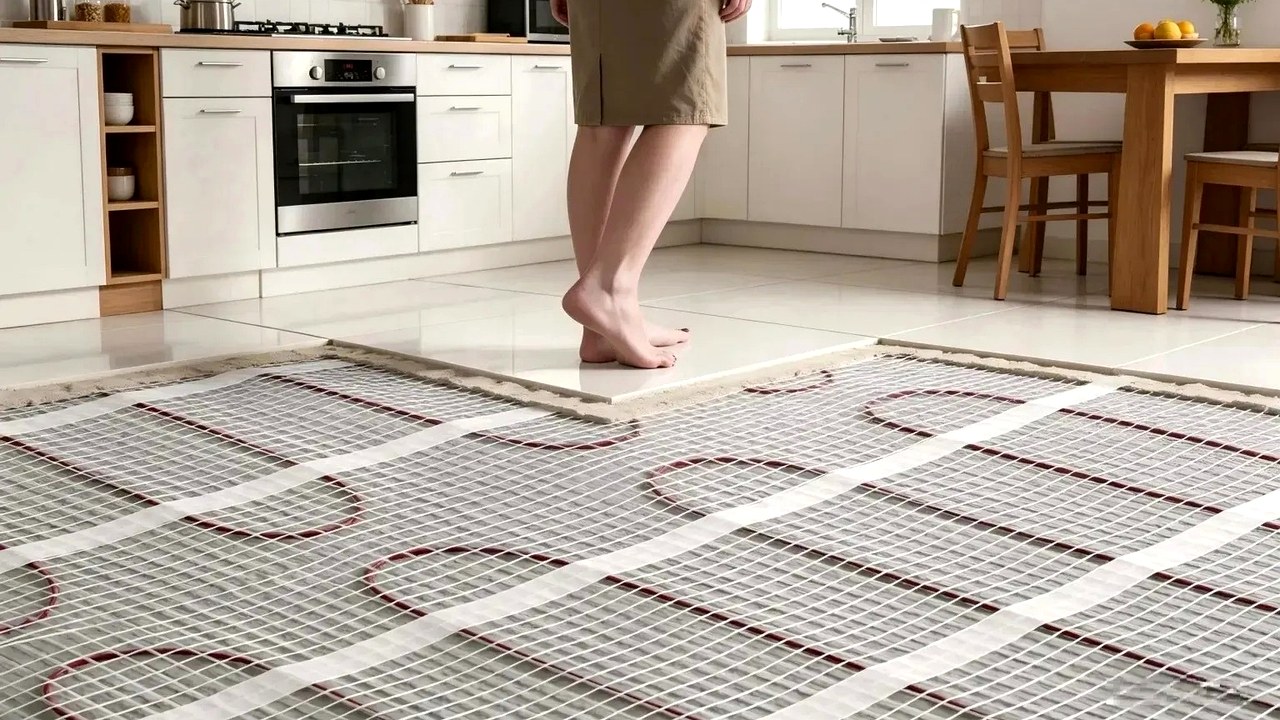
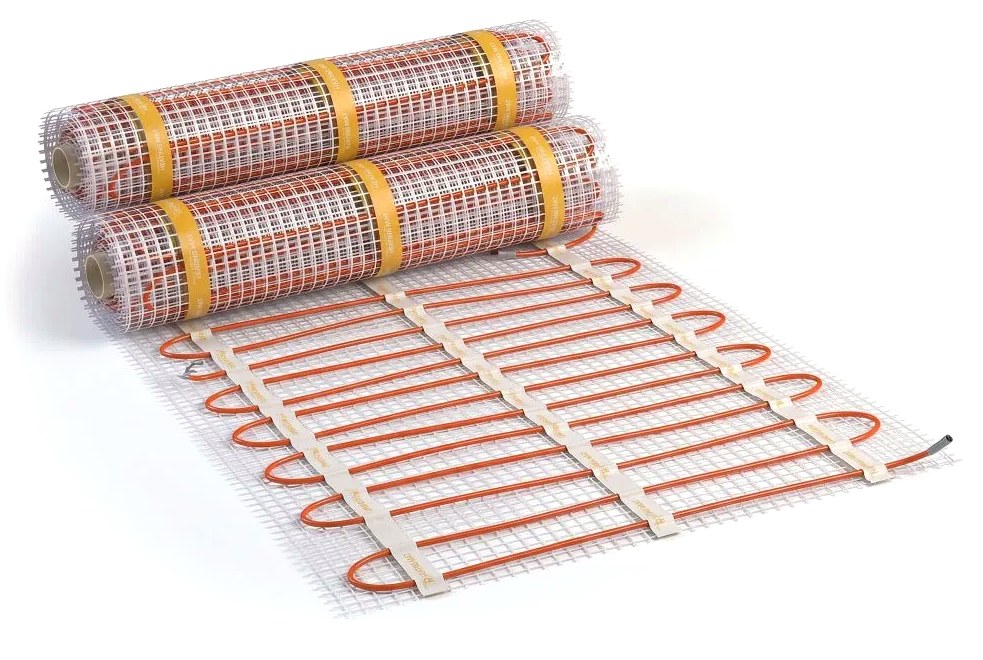
A heating mat is a twin-conductor cable pre-attached to a self-adhesive mesh or backing. The manufacturer sets the cable spacing, so the output per square metre is guaranteed before the roll leaves the factory. The SunAura mat carries a 160 W/m² output, a standard 0.5 m width and a 3.6 mm profile including the cable, with a double-insulated, fully shielded, EMF-free build. The installer rolls the mesh out, peels the backing and presses it down, then cuts and turns the fabric, never the cable, to fill the room.
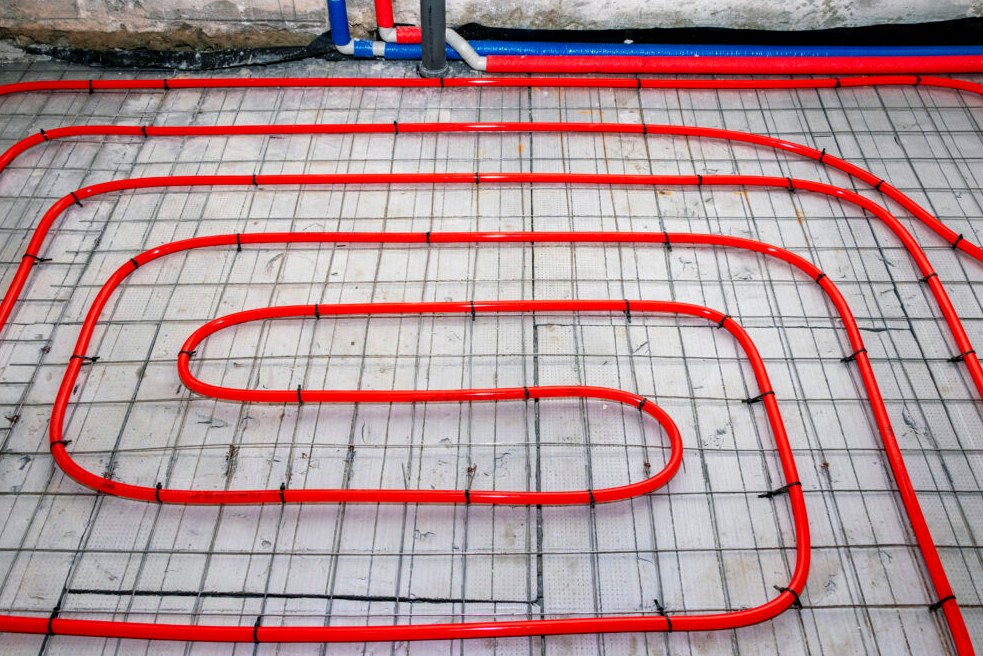
A loose cable is the same class of shielded twin-conductor element sold on its own, without the mesh. It is fixed to the floor with clips, strapping or a backing fabric, and the installer sets the spacing by hand to hit the target density. Because the spacing is adjustable, the same cable can be run close for a higher output or wider for a lower one, and it can be steered around any obstacle. The trade is that the evenness of the heat now depends on the installer’s measuring rather than on a factory mesh.
Installation time: the gap that drives the budget
On a mat, the spacing work has already been done. The open-floor job is to unroll, cut the backing at turns, and press the self-adhesive fabric flat. There is no measuring of cable centres, no fixing of individual clips, and no risk of drifting spacing across a long run. For a regular rectangular room the mat goes down quickly, which is why it is the common choice for a single bathroom retrofit where the floor is open for a short window.
A loose cable takes longer on the same area. The installer first marks or lays a fixing system, then runs the cable in measured loops, fixing it at regular centres and checking the spacing as they go. Every turn and return is controlled by hand, and the cold lead is routed to the thermostat. The extra hours are real, but they buy flexibility: the cable can be packed tighter near a cold exterior wall and spaced wider elsewhere, and it can fill shapes a rectangular mat cannot. The honest comparison is therefore speed against adaptability, with the mat winning the first and the loose cable winning the second.
Cost: where the material and labour move in opposite directions
The two systems reverse the usual cost split. The mat carries a higher material price per square metre because the factory has added the mesh and pre-fixed the cable, but it needs less on-site labour. The loose cable is cheaper per metre of element, but the measured fixing and spacing add installer hours. On a small, regular floor the labour saving of a mat often outweighs its higher material cost, and the guaranteed spacing reduces the risk of a call-back. On a large area, the extra labour is spread across many metres and the lower material price of loose cable can take over, especially when the crew is experienced and fast.
Count the risk as well as the hours. A loose cable with uneven spacing produces hot and cool bands that surface after the tile is down and are expensive to correct. A mat removes that variable at the factory. For a buyer who cannot easily supervise the installer, the mat’s fixed spacing is a form of insurance; for a skilled crew with a clear layout, the loose cable is a cheaper, more adjustable tool. Price the installed system, material plus labour, rather than comparing the two products on their box price alone.
The installation sequence, side by side
Walking through the actual steps shows where the hours diverge. Both systems start the same way: a clean, dry, level subfloor, insulation fitted where downward loss matters, and the cold lead and sensor conduit routed to the thermostat position. From that point the two jobs separate.
On a mat, the next step is to dry-lay the rolls to confirm the coverage, then peel the backing and press the self-adhesive mesh flat in sequence. At each wall the backing is cut and the mat turned, with the cable kept intact, and the strips are butted so the heated area is continuous without overlap. The floor sensor is seated in its tube, and the system is ready for its resistance test. There is no separate fixing stage because the mesh is the fixing.
On a loose cable, the subfloor is first fitted with a fixing system, clip rail, strapping or a backing fabric, and the loop centres are marked from the layout. The cable is then run in measured loops, fixed at each centre and turned at the walls, with the spacing checked repeatedly as the run grows. The cold lead is dressed to the box and the sensor placed. The fixing and measuring stages that the mat hides inside its price are here done on site, which is the source of both the extra time and the extra control over density.
Both finish with the same commissioning work, resistance and insulation readings, sensor and thermostat checks, then the covering. The sequence makes the trade concrete: a mat collapses several steps into one roll-and-press operation, while a loose cable keeps them separate so an experienced installer can tune the floor as it goes down.
Odd-shaped rooms and fixed fixtures
This is the loose cable’s strongest case. A bathroom crowded with a toilet, vanity, shower tray and built-in units leaves a heated area with many cut-outs and narrow strips. A rectangular mat has to be cut and turned repeatedly, and its fixed spacing can be hard to steer through the gaps. A loose cable follows every contour, runs around each fixture and keeps the loops even in spaces a mesh will not reach. Rooms with permanent fixtures, columns, curves and doorways are where the adjustable element earns its extra labour.
Mats are not helpless in irregular rooms, because the backing fabric can be cut and the cable turned, but the cable itself must never be cut and the fixed spacing limits how tightly it can be packed into a narrow strip. The practical rule is simple. A floor that is mostly rectangular with a few turns takes a mat. A floor defined by obstacles and odd shapes takes a loose cable, which is built to be routed rather than rolled.
Side-by-side comparison
| Point | Heating mat | Loose cable |
|---|---|---|
| Format | Cable pre-fixed on self-adhesive mesh | Cable coil, fixed on site |
| Spacing | Factory-set, guaranteed even | Measured by installer, adjustable |
| Output | 160 W/m² (150 carpet/wood, 200 wet) | Set by chosen spacing, density tunable |
| Profile | 3.6 mm, 0.5 m standard width | Cable only, very low profile |
| Build | Double-insulated, fully shielded, EMF-free | Same shielded twin-conductor class |
| Install time | Short, unroll and press | Longer, measure and fix loops |
| Material cost | Higher per square metre | Lower per metre |
| Best shape | Regular rectangles, small rooms | Odd shapes, fixtures, large areas |
| Skill needed | Lower, spacing is given | Higher, spacing is controlled by hand |
| Warranty | 25 years on the element | 15–25 years when correctly fitted |
Scene-by-scene: which to specify
Single bathroom retrofit. Take the mat. A small, mostly rectangular floor with a short open window rewards the quick unroll and fixed spacing, and the 3.6 mm profile protects door clearance.
Kitchen or hallway with fixtures. Where cabinets and fixed units break the heated area into strips, a loose cable steers around them more cleanly than a cut-and-turned mat.
Large open-plan floors. A loose cable on a fixing system across a big area keeps material cost down and lets the density vary, tighter near cold walls and wider in the centre, while an experienced crew holds the spacing even.
Wet rooms and outdoor duty. Either element can be rated for the duty, but the 200 W/m² wet build and the correct RCD protection matter more than the format. Choose the mat for simple wet rooms and the cable where the shape is complex.
Multi-unit and developer projects. The product page notes a 500,000 m² per month capacity and matched mat, sensor and thermostat kits, which makes the repeatable mat the safer choice for identical rooms where installers move fast and the result must be the same unit to unit.
Output and spacing control
Because the mat’s spacing is fixed, its density is chosen at order time from the 160 W/m² tile build, the 150 W/m² carpet or floating wood build, or the 200 W/m² wet or outdoor build. The underfloor heating mat explainer covers how to match the area to the correct mat. A loose cable instead lets the same element produce different densities by spacing, which is useful when one floor mixes a cold glazed wall with a warmer interior. The heating element quality control guide sets out the underlying construction.
Both systems are commissioned the same way. Take the conductor resistance and insulation readings before the covering goes down, confirm the floor sensor and thermostat, and record the baseline. The electric versus hydronic heating guide and the underfloor heating lifespan guide cover the covering methods that protect the element, whichever format is used.
Floor build-up, finishes and repair access
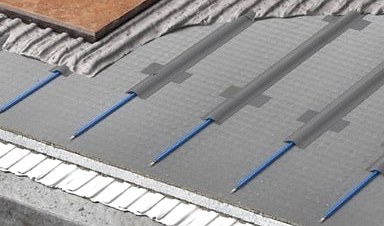
The format interacts with the floor build-up in ways buyers should check before ordering. The mat’s 3.6 mm profile is designed to bed into tile adhesive or a thin covering without raising the floor much, which protects door clearance and the height at transitions. A loose cable has a similar element diameter but is fixed directly, so its final height depends on the fixing system and the depth of adhesive or screed used over it. On a retrofit over an existing floor, where every millimetre counts, the mat’s known thin profile is easier to plan around.
Floor finish compatibility is shared rather than format-specific. Both elements work under tile, stone and porcelain, which are good heat conductors and tolerate the slab temperature. Under carpet or floating wood the density is held to 150 W/m² to stay within the covering manufacturer’s temperature limit, and the wet or outdoor build steps up to 200 W/m². The floor-limiting sensor is the device that enforces those limits regardless of whether the element arrived on a mesh or a coil, so the finish drives the density more than the format does.
Repair access is where the two differ subtly. A mat’s fixed spacing means a fault usually maps to a specific strip or a cold-lead joint, and the regular layout makes a thermal scan easy to read. A loose cable’s hand-run loops can be harder to trace under a covering, though the adjustable density means a damaged section can sometimes be isolated by the way it was routed. In both cases the accessible test points are the cold-lead terminals, so the junction box should be planned to leave them reachable, and the commissioning records kept so a later fault is compared against a known baseline rather than found by guessing.
Procurement logic for projects and distributors
For a distributor or developer, the choice also turns on logistics and repeatability. Mats are stock-held SKUs with a fixed width and density, easy to specify against a room list and simple to bundle with a sensor and thermostat into a kit. The product page’s matched kits and high monthly capacity suit repeat orders where the same floor is fitted many times and the result must be identical. Loose cable is more of a project product, ordered against a layout with the spacing and density specified per job, and it rewards the engineering service that produces the loop plan rather than a one-size part number.
There is a cost-of-error angle. A mis-ordered mat, wrong density or width, is harder to adapt on site because the spacing is fixed, while a loose cable gives the installer room to adjust the layout if the room differs from the drawing. Conversely, a loose cable relies entirely on the crew’s skill, so where supervision is thin, the mat’s factory guarantee is the safer bet. Match the product to the buyer’s situation: repeatable, supervised, regular rooms take mats, and bespoke, skilled, irregular projects take loose cable, with the quotation confirming the MOQ and lead time for each.
Pre-inquiry parameter checklist
- Heated area and a dimensioned plan showing every fixed fixture and cut-out.
- Floor finish: tile, stone, porcelain, carpet, floating wood or vinyl.
- Target density: 160, 150 or 200 W/m² according to the room and covering.
- Supply voltage: 100, 110–120 or 220–240 V.
- Whether the room is regular enough for a mat or irregular enough for a loose cable.
- The fixing system and whether a self-adhesive backing is wanted.
- Thermostat, floor sensor and RCD protection for the circuit.
- For multi-unit jobs, the number of identical rooms and the need for matched kits.
Questions buyers ask before they choose
Can a mat be joined to a loose cable on the same floor? They can meet at a planned boundary, each on its own circuit and terminated correctly, but mixing them inside one loop is poor practice. Keep the two formats to separate zones with a clear layout rather than splicing them together.
Which is quieter or warmer? Neither. Both use the same shielded element and run silently without moving parts. Comfort comes from even spacing and the correct density, not from whether the cable is on a mesh. A well-laid loose cable and a mat at the same output feel identical underfoot.
Does one fail more often? The element is the same, so failure rates are comparable when installed correctly. The difference is where the risk sits: a mat depends on the factory spacing, and a loose cable depends on the installer’s measured loops. Most failures trace to a cold-lead joint or mechanical damage rather than the format.
How do I cover a room that is half regular and half irregular? Use a mat across the open rectangular area and a loose cable through the fixture-heavy section, with each sized to its own circuit and the cold leads brought to the same box. That hybrid keeps the quick coverage where it works and the flexible element where it is needed.
Common mistakes
Cutting the cable to turn a mat. Only the backing is cut. Slicing the element breaks the circuit and ruins the loop.
Using a mat in a fixture-heavy room. The fixed spacing fights the narrow strips and the savings are lost in repeated turning. Obstacle-heavy floors take loose cable.
Letting loose-cable spacing drift. Uneven loops create hot and cool bands. Measure and fix the centres throughout, not just at the start.
Comparing box prices only. The mat’s higher material cost can be repaid in lower labour and fewer call-backs. Price the installed system.
Ignoring door clearance. Confirm the 3.6 mm profile fits under the finish and the door before ordering, especially on a retrofit over an existing floor.
Data and evidence
The comparison rests on the way embedded radiant heating is built and regulated. In Europe, floor heating systems are designed and tested under the EN 1264 series, which covers the radiant surfaces and their installation, while national electrical codes and the IEC 60898 range govern the breakers and RCDs that protect the circuits. Building research bodies and energy agencies publish guidance on radiant floor efficiency and on the importance of even spacing and correct insulation, which supports treating spacing control as a real performance variable rather than a cosmetic detail. Technical literature from established heating manufacturers documents the output, profile and shielding of mat and cable systems and the thermal-cycle testing behind their service lives. The SunAura evidence is limited to what can be shown: manufacturing since 2008, ISO 9001/14001/45001 management, CE/RoHS/LVD/EMC documentation, a Qingdao Huangdao plant with six automated lines and an in-house laboratory, exports to more than 50 countries, and the stated production capacity. No certificate numbers, output figures or client names are invented, and no medical or hazardous-area claim is made.
Conclusion: what to choose
Reach for the mat when the floor is regular, the open window is short and the guaranteed spacing matters more than the material price. It unrolls quickly, holds a fixed 160 W/m² output and removes the risk of uneven loops. Reach for the loose cable when the room is defined by odd shapes and fixtures, when the area is large enough for the lower material price to repay the extra labour, or when the density has to vary across the floor. Both use the same shielded twin-conductor element and both are commissioned with the same resistance and insulation tests, so the decision is a clean trade of speed against adaptability, with the room drawing, the available labour and the level of on-site supervision deciding the answer. If the plan is mostly straight and the window is tight, the mat is the lower-risk pick; if the floor is broken up and the crew is skilled, the loose cable is the cheaper, more tunable route. The full range of builds and the rooms they suit are collected on the heating mat applications hub, where each floor can be matched to a format before the order is placed.