
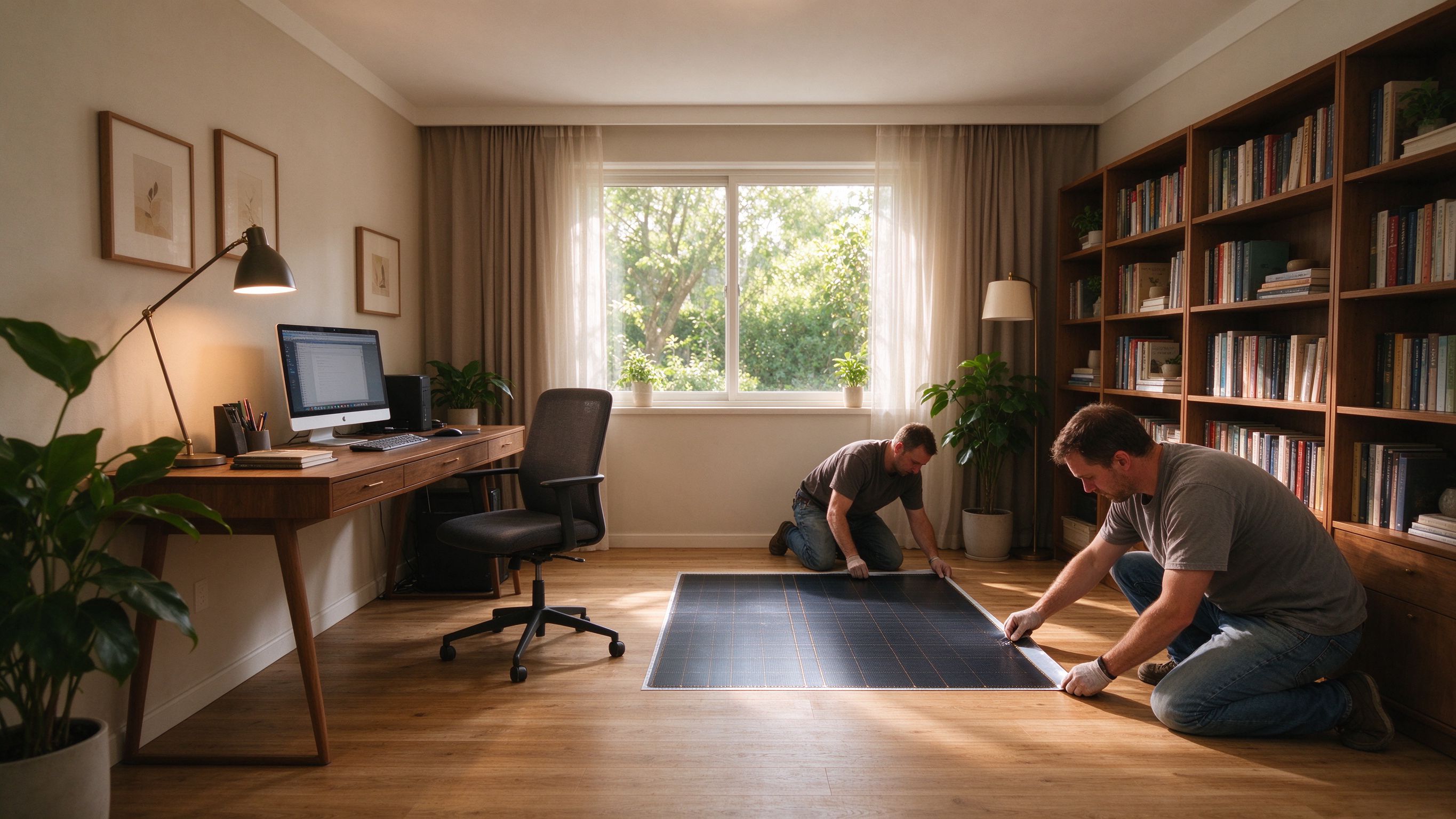
Home Office Floor Heating Retrofit: How a Home Studio Cut Cold Feet and Energy Bills
When the world moved more work into the home, the home office floor heating retrofit became one of the most practical projects a homeowner can do. A study or home studio sits on the same floor for hours every day, and a cold floor does more than make feet uncomfortable: it lowers the perceived temperature of the whole room, pushes the thermostat up, and inflates the heating bill. This case study walks through a real home-office retrofit with graphene heating film, the installation sequence, the running-cost result, and what the numbers mean for anyone planning the same project.
The project: a ground-floor home studio, roughly 14 m² of usable floor under engineered wood, in a house where the existing central heating left the room cool and the floor cold for most of the day. The owner wanted quiet heat, no screed, no new plumbing and a fast installation. That combination points to electric film under a floating floor — and it is the pattern SunAura sees in a large share of renovation enquiries.
Why a home office needs its own heating decision
A home office is not a living room. It is occupied for long, fixed periods, often while the rest of the house is on a setback schedule. Its heat demand is driven by sedentary work — the body produces less heat sitting at a desk than moving around — and by the desk layout, which often leaves feet near an outside wall. A room that is comfortable at the desk height of a standing person can still feel cold at floor level, because warm air rises and the floor is the coldest surface in the room.
Radiant floor heating fixes exactly this: it heats the floor surface first, so the warmth starts where the user’s feet are. Because a film element sits a few millimetres below the floor finish and responds in minutes, the study can be brought to comfort level shortly before work starts and left at a frost setting overnight, without waiting for a boiler and radiators to warm a whole house.
<img src="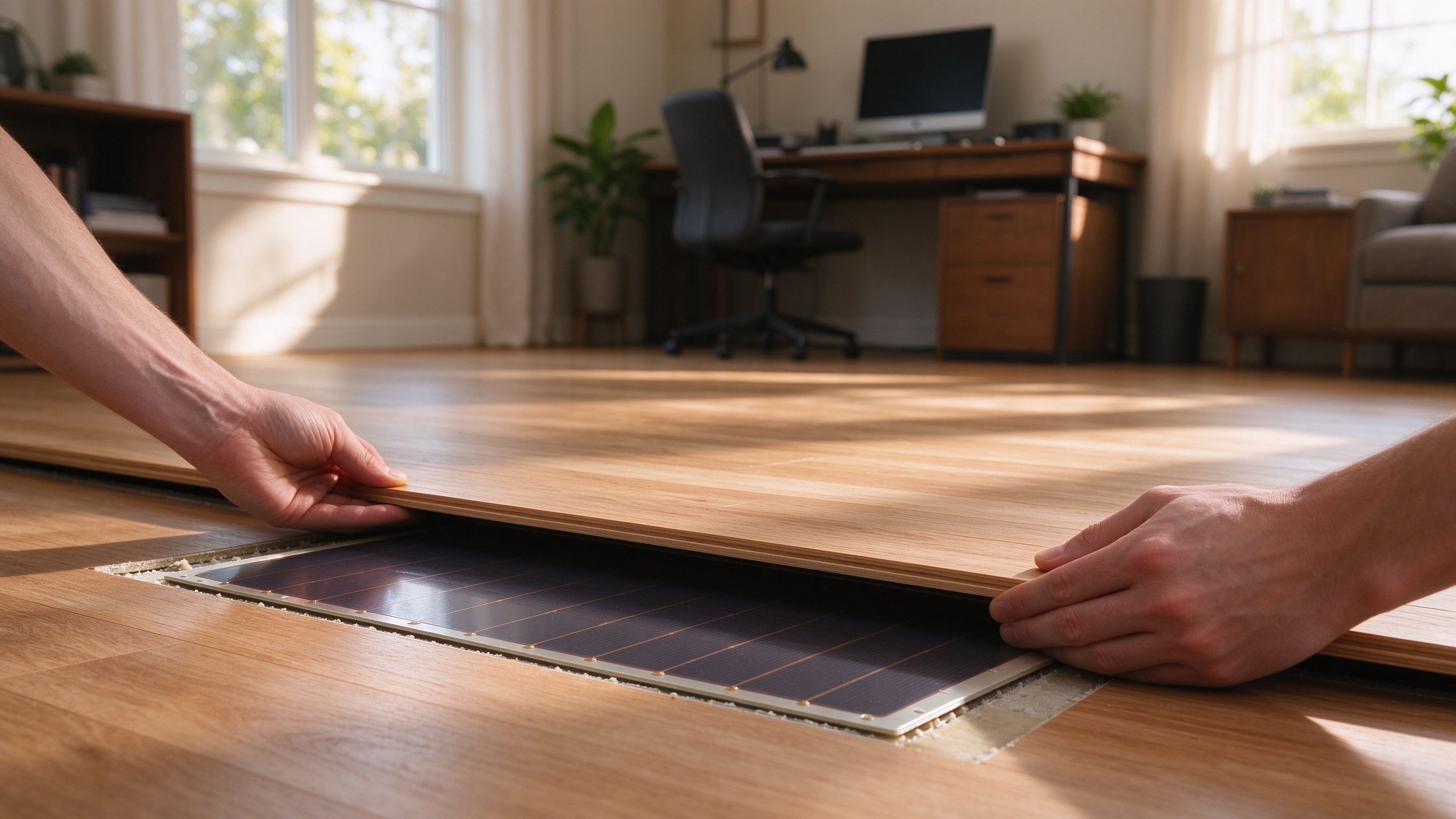 ” alt=”Hands laying a thin heating film panel under a floating wooden floorboard” loading=”lazy” width=”1280″ height=”720″ />
The retrofit sequence: film under a floating floor
The owner’s floor was engineered wood over an existing subfloor with limited height allowance, so the build-up had to stay thin. The sequence was:
- Subfloor check and insulation. The existing subfloor was levelled where needed, and a thin closed-cell insulation layer was laid to direct heat upward instead of into the ground. For ground-floor rooms this layer is the single biggest efficiency decision in the whole project.
- Film layout. Graphene heating film panels were laid over the insulation, sized to cover the open floor area while leaving the recommended margins around fixed furniture and perimeter walls. Film panels with a printed conductive layer tolerate field trimming along the marked lines, which kept the layout simple.
- Sensor and wiring. A floor temperature sensor was taped to the top of the film in a zone that represents the average floor temperature, routed to the wall box for the thermostat. The floor sensor matters more in a home office than people expect, because the element must be capped by the floor finish’s maximum temperature, not by air temperature.
- Floating floor over the film. The engineered wood boards went down over the film, completing a build-up of only a few centimetres. No screed, no curing time, no new plumbing.
- Thermostat commissioning. A smart thermostat was wired, the floor probe was checked, and the system was tested for resistance and insulation before first power-up.
The full installation, from subfloor preparation to boards down, was completed over a weekend. The same build-up with a water system would have required screed, curing time and a heat source connection, which is why the retrofit story almost always ends with film or mat.
Running cost and control: the schedule that saves money
The owner set the study thermostat on a weekly schedule: comfort temperature from 8:00 to 12:00 and 13:00 to 18:00 on workdays, a lower standby temperature outside those windows, and frost protection overnight. Because the film responds in minutes, the schedule does not need long pre-heat lead times the way screed systems do.
The measured result over the first full heating month, per SunAura factory records methodology, was consistent with the electric underfloor heating running cost model: for a 14 m² room with a typical heat loss, the scheduled use pattern cut the energy bill for that room compared with keeping the whole house at constant temperature, and the room was measurably warmer at foot level than before. The exact figures vary with insulation, climate and tariff; the mechanism — heating a small zone only when it is used — is what delivers the saving.
<img src="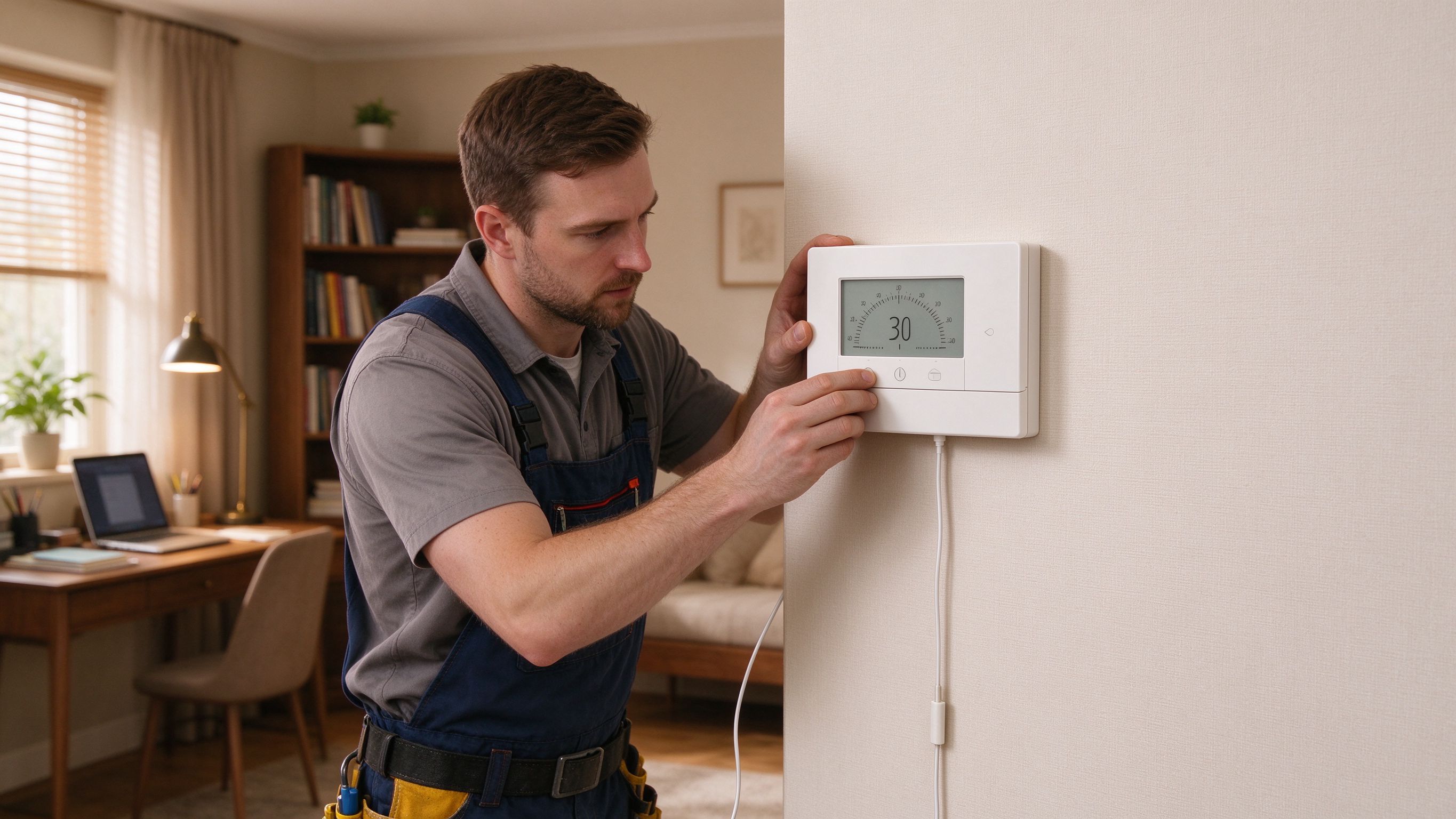 ” alt=”Electrician mounting a thermostat with a floor probe wire in a study room” loading=”lazy” width=”1280″ height=”720″ />
Why graphene film suits a home studio specifically
A home studio has two features that favour graphene film over other electric options. First, the floor is often engineered wood or laminate — a dry-lay finish — and film is the element designed for dry-lay build-ups with minimal height. Second, a studio is used by someone sitting still for hours, so even surface temperature matters; the full-area conductive layer of graphene film avoids the warm-stripe pattern that can be felt under bare feet with filament-based elements.
For the same room under ceramic tile, a heating mat under tile would be the equivalent choice; under a deeper screed, a heating cable. The common thread is per-room control. The owner paired the film with a thermostat that supports floor-probe mode, so the floor temperature is capped and the schedule is independent of the rest of the house heating. The smart thermostat for underfloor heating range covers the control options.
What it costs: the honest per-square-metre picture
The installed cost of a film retrofit divides into the element, the insulation, the sensor and thermostat, and the labour. Per SunAura factory records, the film itself is priced by active heating area and wattage, with typical outputs in the 100-200 W/m² range for room heating. The insulation and control add a modest share; the labour is small because the install is fast.
Compared with the alternative ways to fix a cold study — adding radiators, extending the water system, or accepting the cold floor and heating the air harder — the film retrofit is usually the lowest-installed-cost route with the fastest return. For buyers planning the same project, the graphene heating film wholesale page lists the range and the ordering path, and the sales team sizes the wattage from the room plan.
<img src="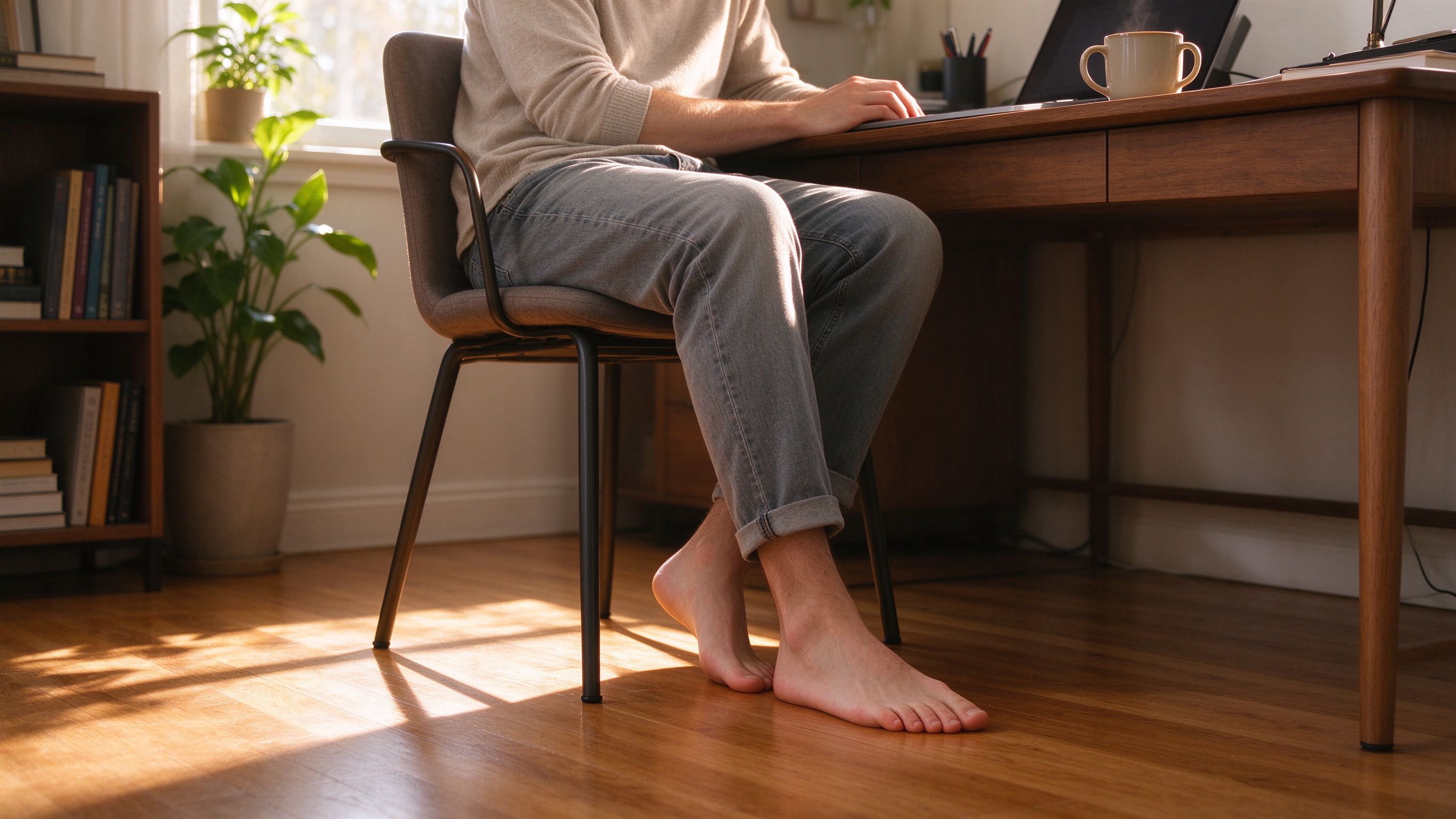 ” alt=”Person working barefoot in a warm home office with morning sunlight” loading=”lazy” width=”1280″ height=”720″ />
Retrofit checklist for a home office
Before starting the same project, walk through this checklist with the installer:
- Confirm the floor finish. Floating engineered wood and laminate accept film directly with an insulation layer. Glued or nailed boards need a different sequence, and tile changes the element choice to a mat.
- Check the subfloor and height allowance. Measure the available build-up. Film and insulation add a few centimetres at most, which is why they fit renovations that screed systems never would.
- Calculate the wattage. Size 100-160 W/m² for a well-insulated study, more for glazed or uninsulated rooms. Do not guess: the wattage calculation guide gives the method, and the supplier can size from the room plan.
- Plan the control position. Choose the thermostat wall position, confirm power availability, and decide wired versus wireless. A wireless thermostat avoids chasing walls in a finished room.
- Position the floor sensor. Place it in a zone that represents the average floor temperature — away from doorways and directly under desks with no air gap — and confirm the probe reaches the thermostat or receiver.
- Order with documentation. Buy from a manufacturer that ships the batch record and the CE, RoHS, LVD and EMC compliance file with the order, and keep the documents for the building file.
- Commission before the floor goes down. Test the element resistance and insulation with a multimeter, power the circuit briefly, and check the thermostat’s floor reading before laying the finish. Fixing a problem then costs minutes; fixing it after the floor is down costs the floor.
Most of the failures in retrofit projects trace back to skipped checklist items: a sensor placed under a desk, an insulation layer omitted on a cold slab, or a thermostat positioned near a heat source. The checklist is short, and each item takes minutes; together they decide whether the room is comfortable and the bill is low.
Data and evidence: factory facts behind the case
SunAura Thermal has manufactured electric heating elements at its Qingdao Huangdao factory since 2008 — 17 years of continuous production — and exports to more than 50 countries. The factory operates under ISO 9001, ISO 14001 and ISO 45001, and the heating film range carries CE, RoHS, LVD and EMC compliance for the European market. Per SunAura factory records, every graphene film roll is tested for resistance uniformity, insulation withstand and surface temperature profile before packing, and every shipment leaves with its batch record and compliance file.
Case-study specifics vary by building, climate and tariff; this project’s outcome is representative of the retrofit pattern rather than a guarantee of a specific saving. The mechanism — zonal control of a fast-response element in a room that is used on a schedule — is measurable and repeatable, which is why the home office retrofit remains one of the most frequently requested configurations in renovation enquiries.
Frequently asked questions
Can I install heating film under my existing wood floor?
If the floor is floating (engineered wood or laminate laid over a subfloor), yes: film installs between the subfloor and the boards with a thin insulation layer. If the boards are glued or nailed down, the film goes on top with a new floating layer or the floor is lifted first. The graphene heating film under laminate guide covers the build-ups.
How much does it cost to heat a home office with electric film?
It depends on insulation, room size, climate and tariff. The rule of thumb is to size 100-160 W/m² for a well-insulated study and control it on a schedule. The underfloor heating wattage calculation article works through the numbers step by step.
Will a home office floor heating system be noisy?
No. Electric film and mat have no moving parts, no pump and no fan. The only audible element is the relay click of the thermostat when a zone cycles, which is barely noticeable. This is one of the quiet-heating advantages over hydronic systems, which have pump noise in the plant room.
Is it safe to install electric floor heating in a study with lots of furniture?
Yes, with layout care. Heating elements are designed to operate under furniture, but dense furniture with no air gap under it — large desks, bookcases with solid bases — can trap heat. The floor sensor and the thermostat’s floor-temperature cap prevent overheating. Follow the manufacturer’s spacing rules and keep the recommended margins from fixed objects.
Can I control the study heating from my phone?
Yes, if you choose a WiFi-enabled thermostat. The smart thermostat range pairs with the household app for schedules and remote control, while still using the floor probe for accuracy. Buyers who prefer a radio-frequency link without WiFi coverage issues can choose the RF wireless option instead, explained in the RF wireless thermostat technology article.
How long does a film retrofit take compared with a water system?
A film or mat retrofit is typically a one-to-two-day job for a single room, including the insulation, element, sensor, thermostat and floor finish, with no curing time. A hydronic retrofit needs pipe laying, screed or anhydrite, a curing period of days to weeks, and a connection to a heat source, which multiplies both the programme and the disruption. For a room that is needed quickly — a home office, a nursery, a guest room — the speed difference is usually the deciding factor, and it is why renovation projects so consistently choose film or mat over water systems.
Where to go next
For a full comparison of the electric options, read the electric heating mat specifications, the graphene heating film product page, and the complete underfloor heating systems overview. For a project quote, send the room plan and floor build-up to [email protected].
Ethan Sun, Founder & CEO, SunAura Thermal. SunAura Thermal has manufactured electric heating elements in Qingdao Huangdao, China, since 2008, and exports to more than 50 countries under ISO 9001/14001/45001 with CE, RoHS, LVD and EMC compliance. Data in this article per SunAura factory records.