
Ball pythons (Python regius) are ground-dwelling, nocturnal snakes from the savannahs and open forests of West and Central Africa. They are famously shy, they do not bask openly in the way a diurnal lizard does, and their whole health — feeding response, shedding rhythm, digestion and even stress-related illness — tracks closely to the floor temperature inside their enclosure. A correctly sized ball python heating pad mounted under one end of the tub is the single most important piece of equipment in a ball python setup. In this guide we cover the species-standard thermal ranges, why belly heat matters more than overhead heat for this species, how to size and place a SunAura reptile heat mat, the thermostat discipline these snakes demand, and the mistakes that lead to regurgitation, stuck shed and loss of appetite.
Why Correct Heating Matters for a Ball Python
Ball pythons are ectothermic ambush hunters that sit and wait under cover, pressing their body against the ground. In their natural range they experience a warm savannah floor during the day and a gentle cooling at night — not the desert-style highs of a bearded dragon. The widely published husbandry ranges for a captive ball python are:
- Warm side floor (belly heat): approximately 31–33 °C (88–92 °F) directly under the warm hide.
- Cool side floor: approximately 24–26 °C (75–79 °F).
- Night time: a slight drop to ~23–25 °C is fine, but do not let the enclosure fall below about 22 °C (72 °F) — ball pythons dislike cold roots.
The warm-side floor temperature is the number that matters. Ball pythons digest prey with their core body temperature, which they raise by laying on a warm surface. If the warm side runs below ~29 °C, the snake cannot process a rodent and may regurgitate; repeated regurgitation is one of the most serious events you can cause in a python. If the warm side runs above ~35 °C, the snake cannot cool down in a small tub, becomes stressed, stops feeding, and can overheat. This is why a thermostat-controlled heat mat — rather than an overhead lamp — is the standard, species-correct heat source.
Heating Pad vs Basking Lamp vs Ceramic Heater
- Heat pad / under-tank mat: the primary heat source for a ball python. It delivers conductive belly heat exactly where the snake’s body contacts the floor, and it runs silently with no light — perfect for a nocturnal, shy animal that hides all day.
- Overhead basking lamp: not recommended as the main heat source for a ball python. Ball pythons do not bask; an overhead lamp heats air rather than the floor, and the snake never gets the belly heat it needs. High-wattage overhead heat also dries out the enclosure and stresses a shy python.
- Ceramic heat emitter: useful only in very cool rooms as an air-heating supplement, and always on a separate thermostat. Even then, the floor pad remains the primary heat source.
The engineering-honest answer: for a ball python, an under-tank heating pad under the warm hide is the correct, species-appropriate heat source. Anything that heats the air instead of the floor is working against the animal’s biology.
How the SunAura Reptile Heating Pad Range Fits a Ball Python Setup
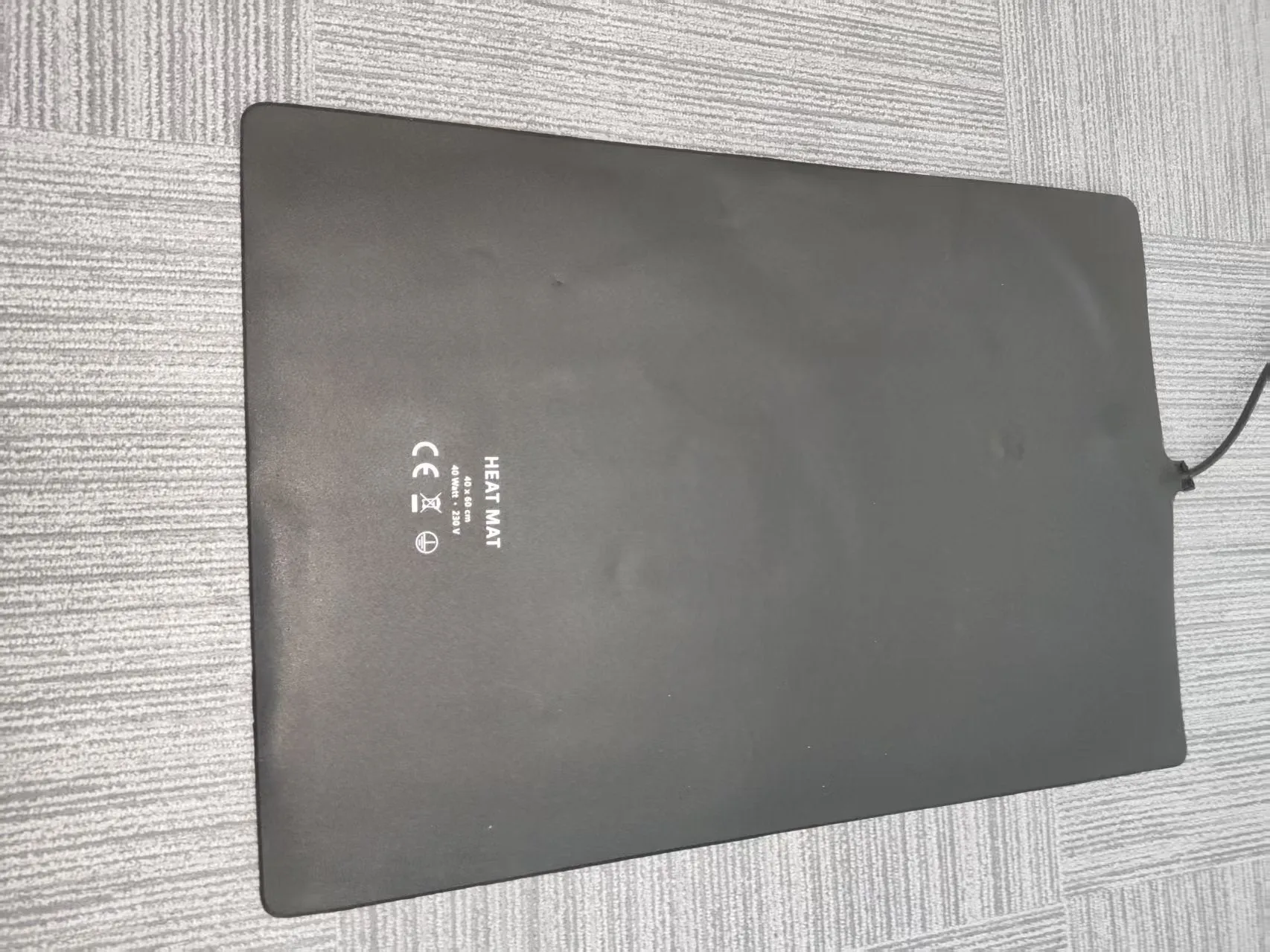
We manufacture the reptile heating pad and pet heat mat range in-house in Qingdao. The real product specifications:
- Graphene film element sealed in a moisture-resistant PVC jacket; shielded, low-EMF construction for continuous 24/7 use near animals.
- 10-speed temperature controller (ten fine steps) so you can tune the warm-side surface to exactly 31–33 °C; knob and plug-in variants also available.
- PTC auto temperature limiting caps the surface and prevents runaway overheating — the low-temperature construction holds the surface below 50 °C, well clear of the 31–33 °C target band.
- 220 V / 110 V rated with EU, US, AU, UK and JP plug options and a 1.5 m cord.
- CE / RoHS certified under ISO 9001:2015; test reports available on request.
Available sizes/wattages: 15×14 cm (5 W low); 15×28 cm (7 W low / 14 W standard); 28×28 cm (14 W low / 28 W standard); 28×42 cm (20 W low / 40 W standard); 28×53 cm (28 W low / 52 W standard); 28×65 cm (35 W low / 63 W standard); 28×80 cm (45 W low / 78 W standard). A ball python rack or 40 gallon-style tub is typically heated with the 28×28 cm or 28×42 cm low-temp pad.
Placement & Installation
- Mount on the outside bottom of the enclosure — under the glass or tub wall, never inside. Ball pythons burrow and can damage or soil an internal pad; an external pad is also far easier to clean around.
- Cover only one third of the floor, under the warm hide. The warm hide sits directly over the mat so the snake’s belly contacts the warmed floor. The cool end must remain completely unheated so the snake can choose to move away.
- Good contact matters. Press the adhesive backing firmly to a flat, dry surface and remove air bubbles. In a plastic tub, a mat with poor contact loses heat into the air gap instead of into the tub floor.
- Substrate depth. Ball pythons often have 5–8 cm of substrate. This insulates slightly; measure the floor temperature at the animal’s level (under the substrate, on the tub floor) with a probe, not the air.
- Water bowl on the cool side. This keeps humidity off the controller and gives the snake a cool drinking spot.
Thermostat & Temperature Control
Ball pythons are unforgiving of unregulated heat. Even with PTC limiting, you must run the pad through a thermostat with a floor probe set to 32 °C. Place the probe under the tub floor directly beneath the warm hide — this is the surface the snake actually lies on. Avoid the common mistake of taping the probe to the glass in the air gap, which reads a much hotter temperature than the snake feels and causes the pad to under-heat. For a rack system, each enclosure’s pad is ideally controlled by its own probe. Our range of thermostats & controllers includes probe-controlled units well suited to ball python rack and vivarium setups. Always verify with a second digital thermometer before introducing the snake.
Day, Night & Seasonal Management
Unlike desert lizards, ball pythons do not need a dramatic night drop. Maintain the warm side at 31–33 °C around the clock; a modest overnight fall to 23–25 °C on the cool side is acceptable and natural. In winter, as room temperatures fall, step the 10-speed controller up a notch and re-check the warm-side floor — the pad that held 32 °C in summer may need one more step in a cold room. Never let the cool side drop below ~22 °C for long; a python kept too cool for weeks will stop feeding and develop respiratory problems.
Sizing the Right Pad for Your Ball Python Enclosure
- Baby / juvenile in a 20–30 cm tub: the 15×14 cm (5 W low) pad under the warm hide.
- Sub-adult in a 40–55 cm tub: the 28×28 cm (14 W low) pad covering one end.
- Adult in a 60–90 cm terrarium or rack drawer: the 28×42 cm (20 W low) pad under the warm hide only.
Choose the low-temperature construction and the smallest wattage that holds 31–33 °C when the room is at its coldest. Because ball pythons are sensitive to overshoot, oversizing wattage is worse than undersizing — a smaller pad that cycles gently on a thermostat is safer than a powerful pad that spikes above target between cycles.
Heating, Humidity and Shedding: How They Interact
Ball pythons come from a relatively humid West African climate, and their heating and humidity must be balanced, not fought. A heat pad mounted under one end of the tub gently warms the floor and, because it works from below, it does not dry out the air the way an overhead bulb or a ceramic emitter does. This is one of the reasons under-tank heat is preferred for this species: you can hold a steady warm-side floor of 31–33 °C while keeping ambient humidity around 55–65% in the cool end, where the water bowl and a humidity hide live. The warm end naturally runs a touch drier; the cool end stays moist, which is exactly the gradient a shedding python needs.
Stuck shed around the eyes and the vent is most often a humidity problem, but it is frequently caused indirectly by heating — a keeper who adds an overhead dryer to “fix” a cool floor makes the humidity worse and the shedding harder. The correct fix is to get the warm-side floor right with the pad and thermostat, then add a damp moss-filled hide on the warm side for the snake to rub against during a shed. Because the SunAura pad’s PVC jacket is moisture-resistant, occasional humidity spills and misting around the enclosure are not a problem for the element itself; just keep the controller and dry plug connections away from standing water.
Feed on the warm side, after the snake has spent the day fully warmed. A python that strikes a rodent while its core temperature is low — because the warm floor is under-powered — is far more likely to regurgitate. If regurgitation does happen, wait at least two weeks before the next feed, double-check the warm-side floor probe with a separate thermometer, and only offer smaller prey. A pad held at a precise 32 °C by a thermostat is the simplest insurance against this whole chain of problems.
Common Mistakes & Safety
- No thermostat. The leading cause of ball python overheating and regurgitation.
- Heating the whole floor. Removes the cool retreat; the snake cannot escape heat.
- Overhead heat only. Air heat leaves the floor too cool for digestion.
- Probe in the air gap. Reads hot, under-heats the actual belly surface.
- Letting the enclosure get cold in winter. Suppresses feeding and immunity.
- Placing the pad inside the tub. Burrowing damage and water exposure.
OEM & Wholesale for Reptile Brands & Rack Builders
Ball python breeders, reptile retailers and enclosure/rack builders source the same pads factory-direct through our OEM / ODM programme. As the manufacturer we supply custom dimensions, wattages, controller types, plug configurations and private-label branding. The shielded low-EMF element and PTC limiting make the pads well suited to multi-enclosure rack systems where reliability 24/7 matters most. We support small trial orders and full-container programmes, trade EXW / FOB Qingdao with full export documentation and CE / RoHS certification; MOQ, lead time and volume pricing are confirmed per enquiry.
Frequently Asked Questions
What temperature should a ball python heating pad be?
Set the warm-side floor to roughly 31–33 °C (88–92 °F) under the warm hide, with the cool side at 24–26 °C. Measure the floor surface with a probe thermometer, not the air temperature.
Do ball pythons need a basking lamp?
No. They are nocturnal ambush snakes that use belly heat, not overhead basking. An under-tank heating pad under the warm hide is the correct primary heat source; overhead lamps heat air and dry the enclosure.
Should the heating pad stay on at night?
Yes, the warm side should remain around 31–33 °C. A slight cool-side drop to 23–25 °C is natural, but do not let the enclosure fall below ~22 °C.
What size heating pad for an adult ball python?
For a 60–90 cm enclosure use the 28×42 cm (20 W low-temp) pad under the warm hide only. Juveniles do well on the 28×28 cm (14 W low) pad.
Is the SunAura pad safe for a ball python rack?
Yes. The shielded low-EMF element, moisture-resistant PVC jacket and PTC temperature-limiting mechanism are designed for continuous 24/7 operation. Always run each pad through a thermostat with a floor probe for the species range.
Related Reptile Heating Guides
Reptile heating must be planned species by species. See our leopard gecko heat mat guide, the bearded dragon heat mat setup, the corn snake heat mat temperature gradient guide, and the tortoise heat mat indoor enclosure guide. Browse the full pet and reptile heating pad collection to choose the right size and controller.
Related Products & OEM Inquiries
Looking for a safe, even heat source for ball python enclosures or a factory-direct OEM/ODM partner? Explore our pet and reptile heating mats and electric underfloor heating mats, then request a quote for your project — we supply distributors, installers and brands in 50+ countries.