
Bearded dragons (Pogona vitticeps) are active, diurnal desert lizards that need one of the highest basking temperatures of any commonly kept pet reptile. Getting that thermal envelope right — a hot basking zone, a usable middle, and a genuinely cool retreat — is the difference between a thriving dragon and one that stops eating, develops digestive impaction, or suffers chronic stress. A bearded dragon heat mat is rarely the primary heat source for an adult dragon, but it is a valuable supplement for belly heat, nighttime background warmth, and juvenile enclosures. In this guide we cover the species-standard temperature ranges, when a mat is the right tool and when a basking lamp is, how to size and place a SunAura reptile heat mat safely, and the thermostat rules that make any of it safe.
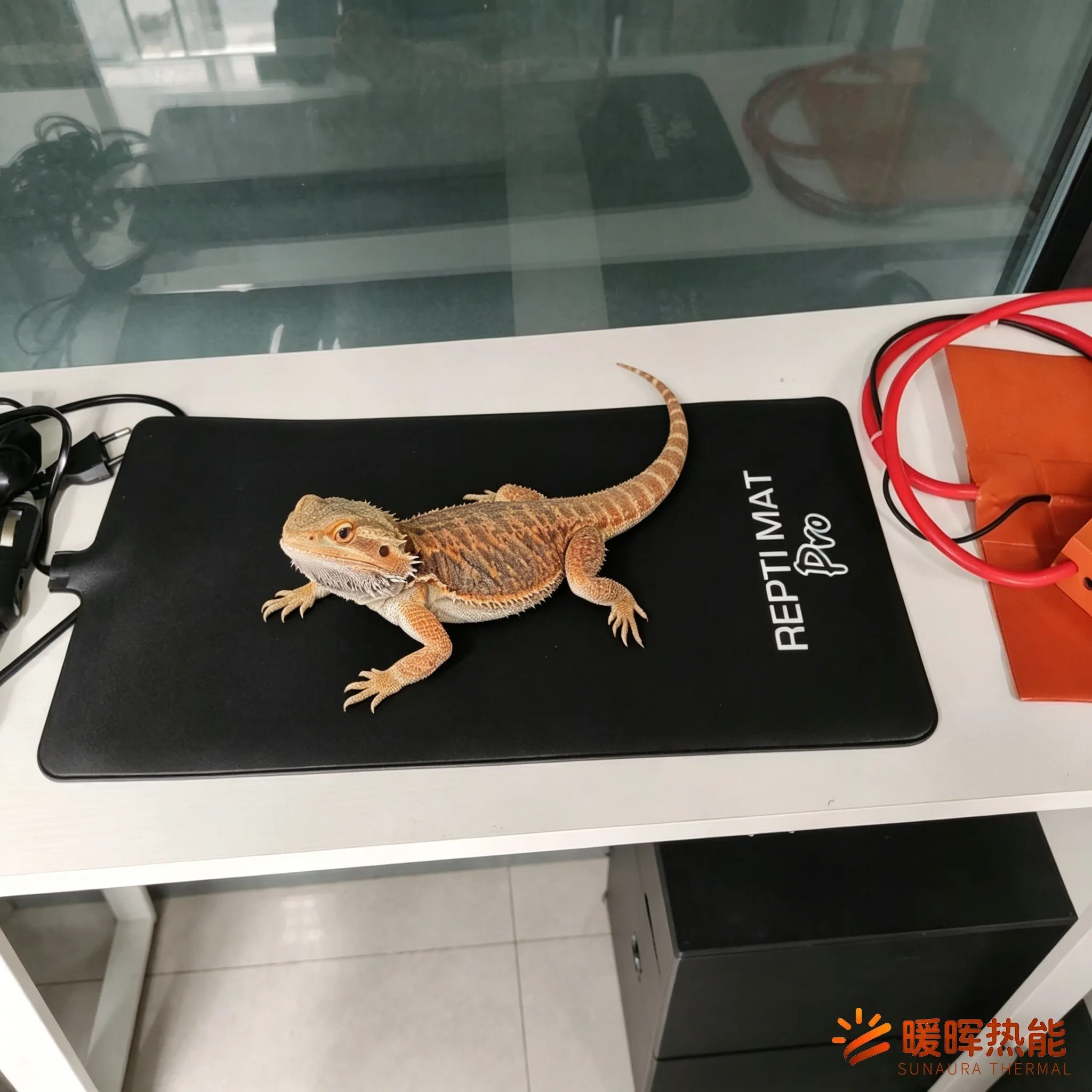
Why Correct Heating Matters for a Bearded Dragon
Bearded dragons are heliotherms — they genuinely bask under strong sun to raise their core body temperature, then move back to cooler ground to digest. In captivity this means they need a steep thermal gradient from the very top of the basking branch down to a cool floor area. The widely published husbandry ranges are:
- Basking spot surface / branch: approximately 38–42 °C (100–108 °F) directly under the basking lamp.
- Warm end floor (belly heat): roughly 32–35 °C (90–95 °F) on the surface the dragon presses against to digest.
- Cool side: approximately 26–30 °C (79–86 °F).
- Night drop: room temperature falling to roughly 15–21 °C (60–70 °F) is normal and desired; do not heat overnight.
Too-cool basking temperatures are the classic captive error — a dragon that cannot reach 38 °C on the basking spot will not eat properly, and undigested food in a cold gut is the root cause of impaction and gut stasis. Too-hot basking (above ~43 °C) causes stress, glass-surfing and, with prolonged exposure, thermal burns.
Heat Mat vs Basking Lamp vs Ceramic Heater: When Does the Mat Come In?
Unlike a leopard gecko, an adult bearded dragon is primarily heated from above:
- Basking / halogen lamp: the primary heat source. A 50–100 W basking bulb (plus UVB) delivers the 38–42 °C hot spot on the basking branch. This is non-negotiable for an adult.
- Heat mat (under-tank): supplements the basking lamp by warming the hot-end floor for belly heat, and is especially useful for juveniles, in cool rooms, and as a controlled night background heater. It cannot by itself produce a 40 °C basking branch.
- Ceramic heat emitter: overhead no-light heat used when the room gets cold but you do not want to run a light overnight. Pair with a thermostat; never use it as the only heat in a bioactive tank without floor warmth.
The honest framing: for an adult bearded dragon, the basking lamp creates the gradient and the heat mat reinforces the hot end. If your room is warm and the basking lamp alone holds 32–35 °C on the hot-end floor, you may not need a mat at all. Add the mat when the hot-end floor runs below target, when you keep juveniles, or when winter room temperatures drag the cool side below ~26 °F.
How the SunAura Reptile Heat Mat Range Fits a Bearded Dragon Setup
We manufacture the pet and reptile heating pad line in-house in Qingdao. The real, current specifications that matter for a bearded dragon setup:
- Graphene film element sealed in a moisture-resistant, wipe-clean PVC jacket; shielded, low-EMF construction rated for continuous 24/7 operation.
- 10-speed temperature controller with ten fine steps to tune surface warmth; knob-control and direct plug-in variants also available.
- PTC auto temperature limiting caps surface temperature and eliminates runaway overheating; the low-temperature construction holds the surface below 50 °C.
- 220 V / 110 V rated, with EU, US, AU, UK and JP plugs and a 1.5 m cord.
- CE / RoHS certified under ISO 9001:2015 production; test reports on request.
Available sizes/wattages: 15×14 cm (5 W low); 15×28 cm (7 W low / 14 W standard); 28×28 cm (14 W low / 28 W standard); 28×42 cm (20 W low / 40 W standard); 28×53 cm (28 W low / 52 W standard); 28×65 cm (35 W low / 63 W standard); 28×80 cm (45 W low / 78 W standard). Because bearded dragon enclosures are large (120 cm+ for adults), the 28×53 cm, 28×65 cm or 28×80 cm pads are the relevant sizes — placed under the hot end only.
Mat Placement & Installation
- Mount under the glass on the outside bottom of the hot end only — never inside the enclosure, where a dragon could scratch it, displace substrate onto it, or spill its water bowl onto it.
- Cover the hot end only (roughly one third of the floor). The mat sits beneath the basking lamp’s hot end so the floor there reaches 32–35 °C. The cool end stays completely unheated.
- Make full glass contact. Press out air bubbles; an air gap insulates and makes the controller fight itself.
- Mind substrate depth. Bearded dragons often sit on 5–10 cm of substrate. Deeper bedding insulates the floor, so verify the actual floor surface temperature at the animal’s level with a probe, not the tank’s air temperature.
- Route the cord away from the water bowl and basking lamp to avoid heat damage to the cable and condensation exposure.
Thermostat & Temperature Control
A heat mat for a bearded dragon must be run through a thermostat with a floor probe — the PTC feature protects against catastrophic failure, but it does not hold your chosen 32–35 °C floor band. Place the probe under the glass at the hot end, directly in the area the dragon uses to digest. Because the basking lamp and the mat both heat the same end, set the mat’s thermostat target a few degrees below the basking-spot target so the two systems complement rather than fight each other. Use a separate high/low thermometer to log the cool side. Our thermostats & controllers range includes probe-controlled units well suited to floor-probe monitoring of vivarium heat mats.
Basking, Night Heat & Seasonal Management
Adult bearded dragons need a genuine night drop to 15–21 °F. If your room stays above ~18 °F at night, switch everything off overnight — no mat, no ceramic. If the room is colder than that, run the mat (or a ceramic emitter on a separate thermostat) at a low setpoint aimed at the hot end so the enclosure does not freeze, but do not heat the whole tank to daytime temperatures. In winter, step the 10-speed controller up one or two notches as the room cools and re-verify the hot-end floor. Juveniles, because they grow fast and digest constantly, should not experience large night drops — keep their hot-end floor above ~26 °F overnight with a low-setpoint mat.
Sizing the Right Mat for Your Bearded Dragon Enclosure
- Juvenile / baby in a 60–80 cm tank: the 28×42 cm (20 W low) pad under the hot end pairs well with a small basking lamp.
- Sub-adult in a 90–100 cm vivarium: the 28×53 cm (28 W low) pad covers the hot-end floor.
- Adult in a 120–150 cm enclosure: the 28×65 cm (35 W low) or 28×80 cm (45 W low) pad under the basking end only.
Pick the low-temperature construction and the lowest wattage that holds 32–35 °C on the hot-end floor. Because bearded dragons already have a powerful overhead lamp, the mat only needs to top-up the floor — over-wattaging creates a hot end that climbs too high and overshoots.
Juvenile vs Adult Heating: Why the Setup Changes With Age
Heating a bearded dragon is not a set-it-and-forget-it job. Babies and juveniles grow almost continuously and digest small meals several times a day, so their thermal gradient must be held tight and uninterrupted — a juvenile that cools down overnight cannot process protein efficiently and growth stalls. For this reason, keepers often run a low-setpoint heat mat through the night during the first six to twelve months, holding the hot-end floor around 26–28 °C rather than allowing the full adult night drop. The mat is ideal for this job because it warms the floor gently and silently without adding light, unlike a basking lamp which would disturb the dragon’s sleep cycle.
Adults, by contrast, benefit from a clear day/night rhythm. A mature dragon fed every day or two does not need overnight warmth, and a proper night drop supports its hormonal cycle, appetite and long-term health. As your dragon grows from a 30 cm juvenile into a 50–60 cm adult, you will also need to step up the enclosure size and the mat size in parallel — a mat that fits a 60 cm tank is too small for a 120 cm adult vivarium and will leave the hot-end floor under-powered. Plan the enclosure upgrade first, then size the basking lamp and the mat to match, and re-calibrate the thermostat after every move.
One more practical point: bearded dragons defecate on the hot end where they digest. Because the mat lives under the glass on the outside, this is a cleanliness non-issue — just wipe the substrate and glass as normal. If you ever feel the need to disinfect around the heat source, switch everything off and let the surface cool before cleaning, and never allow standing water to reach the controller.
Common Mistakes & Safety
- Using the mat as the only heat source for an adult. It cannot create the 38–42 °F basking branch the dragon needs.
- No thermostat on the mat. The PTC prevents runaway, but without a probe you cannot hold the 32–35 °C floor band.
- Heating the whole floor. Removes the cool retreat; the dragon cannot thermoregulate.
- Measuring air temperature instead of the basking branch and floor surface. You need both — branch for basking, floor for belly.
- Night heating to daytime temps. Interferes with the natural drop and can stress the animal.
- Placing the mat inside the tank. Direct contact, substrate burn risk, and water exposure.
OEM & Wholesale for Retailers & Reptile Brands
Pet shops, terrarium retailers and reptile brands source the same mats factory-direct through our OEM / ODM programme. We manufacture the graphene film, shielded element and PVC sealing on our own lines, so there is no trading-company markup. Offerings include custom sizes, wattages, controller types, plug configurations, private-label branding and colour-box packaging. Small trial orders support new brands; full-container programmes serve established retailers. Trade terms are EXW / FOB Qingdao with full export documentation and CE / RoHS certification; MOQ, lead time and volume tier pricing are confirmed in writing per enquiry.
Frequently Asked Questions
Do adult bearded dragons need a heat mat?
Not always. A correctly sized basking lamp is the primary heat source. Add a heat mat when the hot-end floor runs below 32–35 °C, when you keep juveniles, or when cool winter rooms drag the enclosure temperature down. The mat reinforces belly heat; it does not replace the basking lamp.
What temperature should the bearded dragon basking spot be?
Target a basking-spot surface of roughly 38–42 °C (100–108 °F), with the warm-end floor around 32–35 °C and the cool side 26–30 °C. Measure the basking branch and the floor surface with a probe thermometer.
Should the heat mat run overnight for a bearded dragon?
Adults benefit from a night drop to 15–21 °C; switch heating off if the room stays above ~18 °C. Run the mat at a low setpoint overnight only when the room is colder, and keep juveniles above ~26 °C on the hot end.
What size heat mat for a 120 cm bearded dragon vivarium?
Use the 28×65 cm (35 W low-temp) or 28×80 cm (45 W low-temp) pad under the basking end only — never the whole floor.
Is the SunAura mat safe for a large bearded dragon enclosure?
Yes, when mounted externally under the hot end and run through a thermostat. The shielded low-EMF element, moisture-resistant PVC jacket and built-in PTC limiting are designed for continuous use; the low-temperature construction holds the surface below 50 °C.
Related Reptile Heating Guides
Heating a mixed collection species-by-species gives better results than one generic setup. Read our leopard gecko heat mat guide, the ball python heating pad placement rules, the corn snake heat mat gradient guide, and the tortoise heat mat indoor enclosure guide. Choose a mat size and controller from the full pet and reptile heating pad collection.
Related Products & OEM Inquiries
Looking for a reliable bearded dragon basking heat mat or a factory-direct OEM/ODM partner? Explore our pet and reptile heating mats, then request a quote for your project — we supply distributors, installers and brands in 50+ countries.