
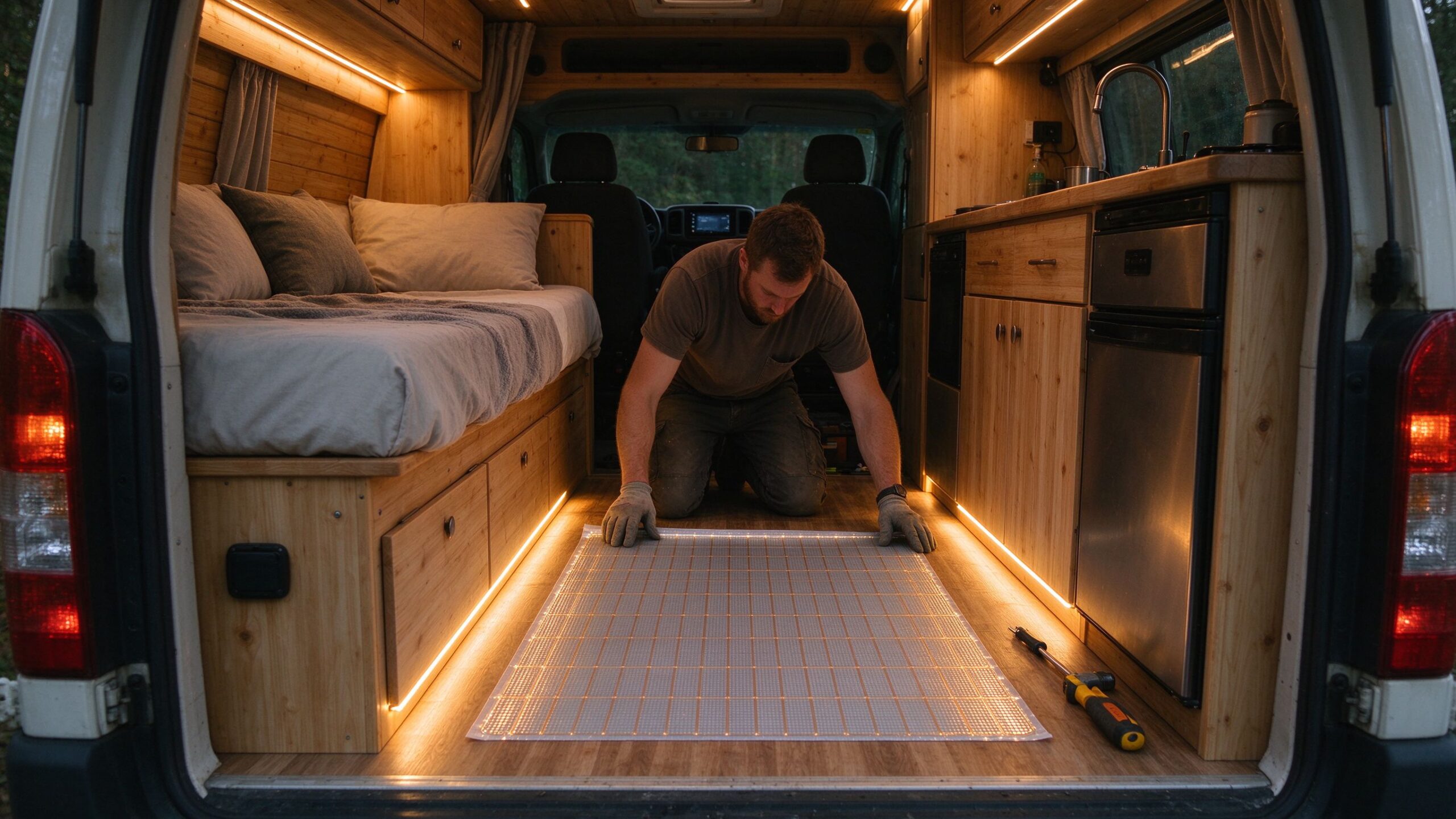
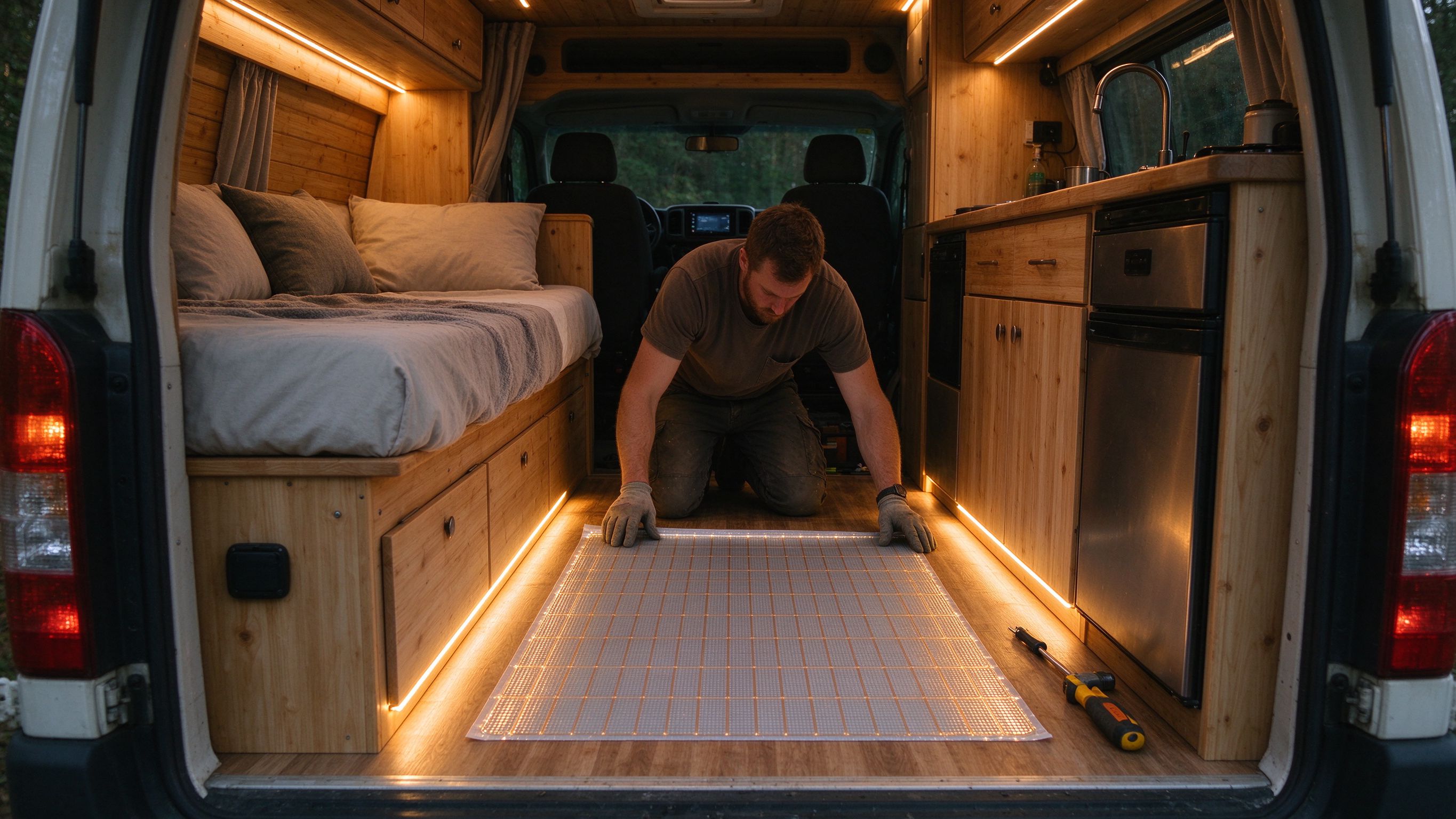
DC heating film—the 12V and 24V family—is changing the way people heat spaces that have no mains electricity: motorhomes and campervans, boat cabins, tiny houses, garden studios and off-grid retreats. Instead of a 230 V heating element wired into the grid, a 12 V or 24 V film works directly from a battery, a solar system or a vehicle’s electrical system. For builders of RVs and marine interiors, this is the difference between a heating solution that needs an electrician and a certified 230 V circuit, and one that a fitter can wire into the existing 12 V harness with a fuse and a switch.
The technology is not a scaled-down version of a mains film with a resistor squeezed onto a smaller footprint. A genuine low voltage heating film is designed from the element chemistry up for low current and high surface uniformity. The heating layer is printed at a resistance that delivers useful wattage at 12 V or 24 V, the busbars are sized for the higher current that low voltage implies, and the whole laminate is optimised for thin, non-structural substrates such as vinyl, carpet and thin wood. This article explains how low voltage heating film works, where it outperforms a mains system, how to size it for an RV or marine cabin, and what to check when buying from a heating film supplier.
1. How DC Heating Film Works: Resistance, Current and Power
The physics of low voltage heating film is the same Ohm’s law that governs a mains film, but the numbers change the design completely. Power equals voltage squared divided by resistance. At 230 V, a 100 W/m² film needs a relatively high resistance element. At 12 V, the same 100 W/m² demands an element resistance roughly 360 times lower, and the current per square metre rises by the same factor. A 1 m² 12 V film at 100 W/m² draws about 8.3 A; the same wattage at 230 V draws about 0.43 A.
That is why the busbars matter. In a mains film the busbar carries a fraction of an amp per metre and can be a thin printed trace. In a 12 V film the same busbar carries amps, so it must be wider, thicker or made of a lower-resistance conductor to avoid a voltage drop along the edge that would leave the far end of the film cooler than the near end. Manufacturers that simply reprint a 230 V design for 12 V produce film that heats unevenly, overheats at the connection or drops wattage along the strip. A properly engineered low voltage film specifies its busbar material and width for the rated current, and the datasheet states the voltage drop per metre of busbar.
2. 12V vs 24V: Which Low Voltage System Should You Choose?
Choosing between 12 V and 24 V DC heating film is a current-versus-compatibility decision. A 12 V system is the natural fit for campervans and RVs, where the vehicle’s house battery is almost always 12 V. The installation is simple: a fused feed from the battery or a DC-DC converter, a thermostat or switch, and the film. The trade-off is current. At 12 V, a 150 W/m² film draws 12.5 A per square metre, so the total load of a large living area can exceed what a single 12 V circuit should carry, and the installer must split zones across multiple fused feeds.
A 24 V system halves the current for the same wattage, which allows longer film runs and thinner cable, and it is common in marine installations and larger off-grid builds where a 24 V battery bank is standard. The rule of thumb: use 12 V for small to medium RV spaces and for anything that must drop straight into an existing 12 V harness; use 24 V for larger cabins, boats with 24 V banks, and any layout where cable runs are long. The same film family often comes in both voltages, which means a heating film supplier can supply a single product range for a whole fleet of different vehicles.
3. Where DC Heating Film Beats a Mains System
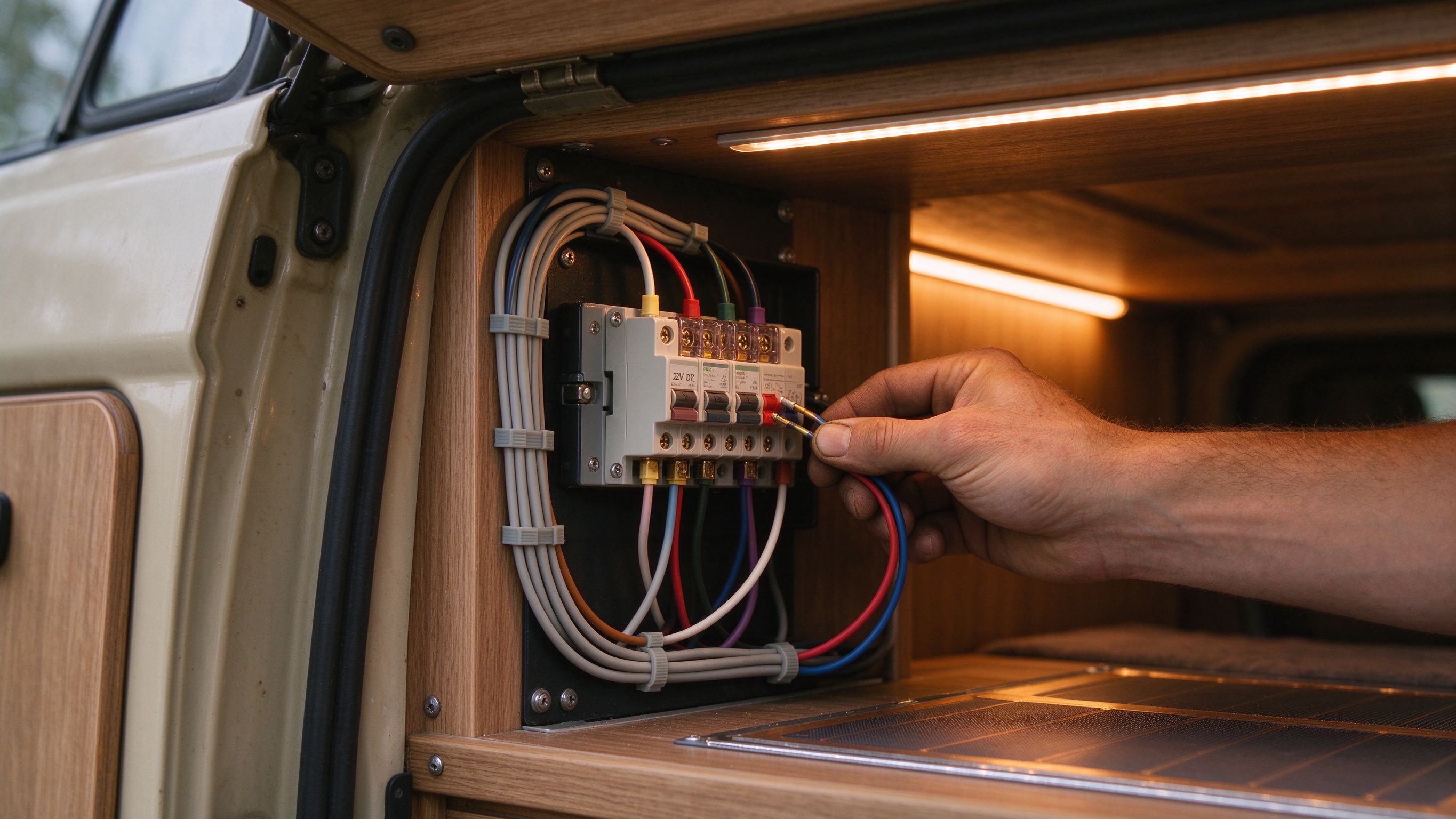
The first advantage is installation freedom. A 230 V heating element inside a thin floor layer is subject to electrical codes, certified wiring and, in many territories, professional installation. A 12 V film under vinyl in a campervan is a low-voltage DC circuit that a competent fitter can install with a fuse and a DC-rated switch, with far fewer code constraints. For conversion workshops that build many vans, that simplicity is the difference between an in-house task and a subcontracted electrician.
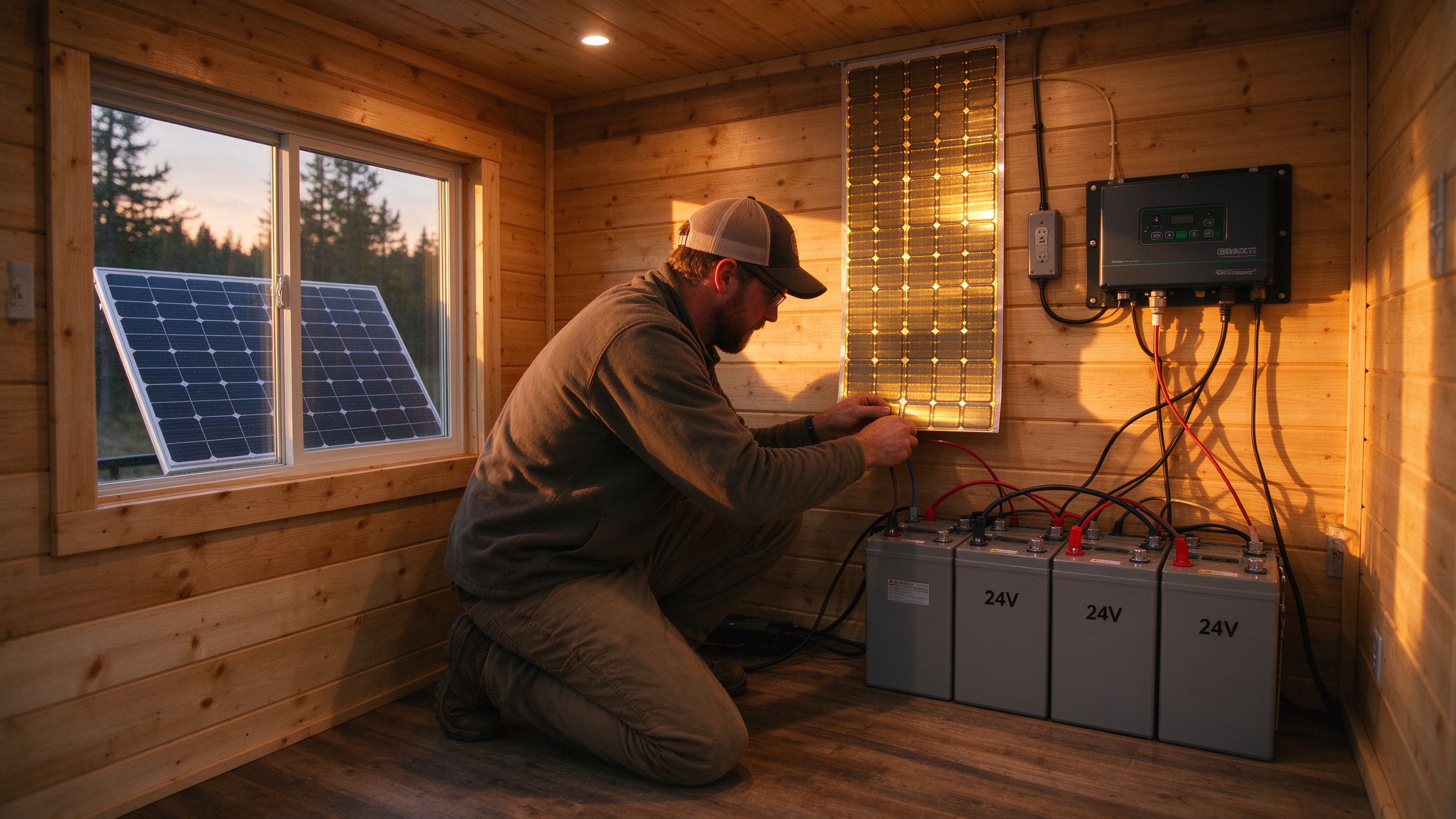
The second advantage is integration with solar and battery systems. A 12 V film fed from a solar-charged house battery heats a van floor without an inverter, avoiding the 5-10% conversion loss that a 230 V heater would incur by stepping DC up to AC. In an off-grid cabin, a 24 V film can run directly from a 24 V battery bank, and the energy accounting is simple: every watt that heats the floor is a watt that the solar array must replace. When sizing a solar system for a van or cabin, the floor heating load is now a DC load that can be budgeted precisely.
The third advantage is safety by voltage. A low voltage film cannot deliver a dangerous shock in the way a 230 V element can, which matters in damp environments such as a boat cabin or a van floor where condensation is normal. The low voltage also makes the film tolerant of imperfect insulation: a pinched wire or a damp spot creates less risk, and fault-finding is safer for the owner.
4. Sizing Low Voltage Heating Film for an RV or Marine Cabin
Start with the heat loss, not the floor area. A well-insulated van of about 8 m² of living space in a mild climate needs roughly 40-60 W/m² of floor output as a top-up heat; a poorly insulated or cold-climate van needs 80-120 W/m². The total load is floor area times output. A 6 m² living floor at 90 W/m² is 540 W, which at 12 V is 45 A—too much for one circuit—so the sensible design splits the space into two zones of 270 W each, each on its own fused 30 A feed, or moves to 24 V to halve the current.
The battery math is equally important. A 540 W floor running for 3 hours consumes 1.6 kWh, which is a large share of a typical 100 Ah (1.2 kWh usable) leisure battery. A practical rule for RV builders: design the floor as a background emitter at low output, let the air heater handle the rapid warm-up, and set the thermostat to maintain a floor surface of 22-24 °C. That keeps the daily floor-heating draw inside what a 200-400 W solar array can replace on a good day.
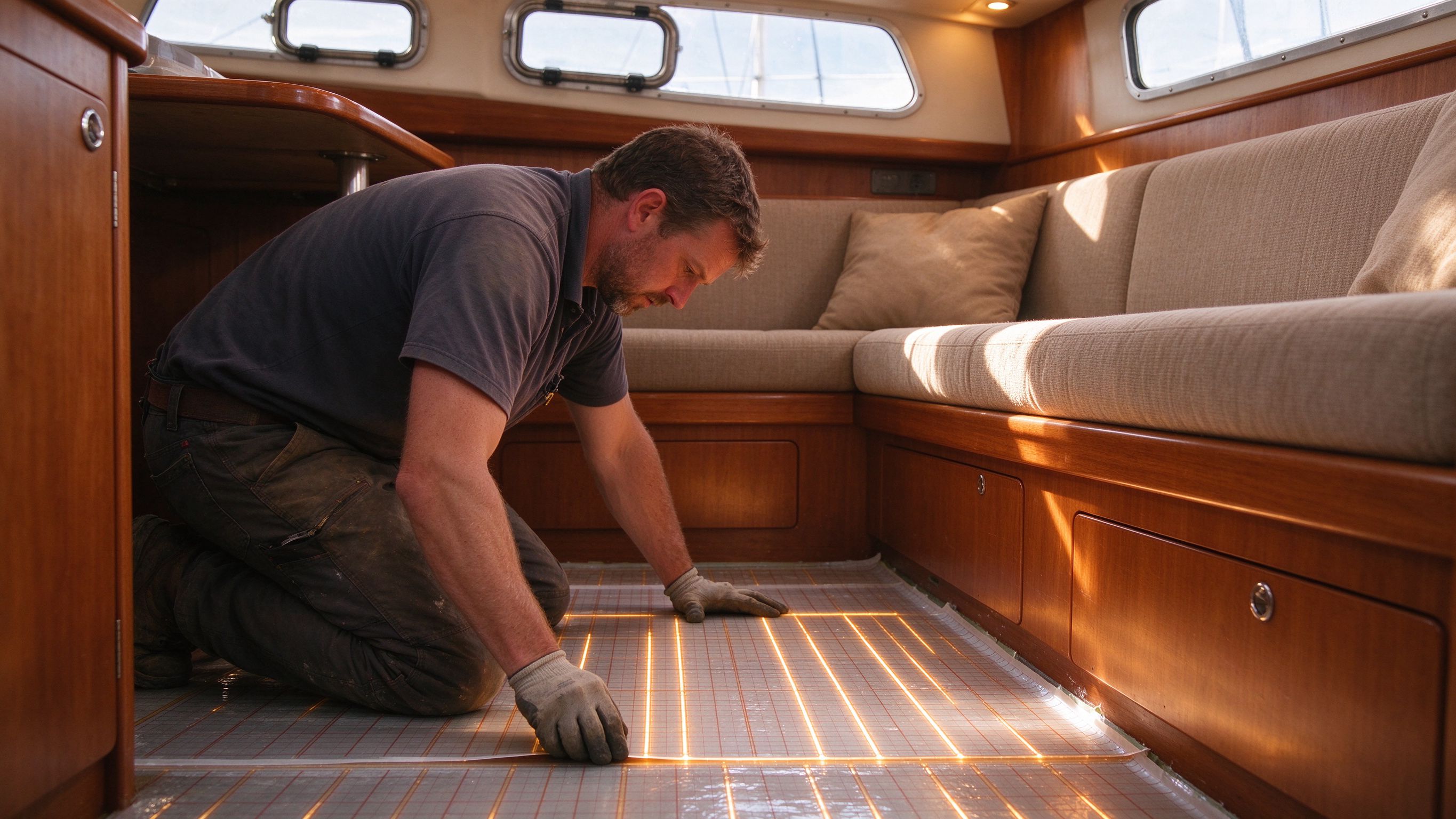
For a marine cabin the moisture story dominates. A 24 V film under the cabin sole keeps condensation off the deck, protects stored equipment and dries the cabin faster. The sizing rule is the same as on land, but the wiring must be tinned and the terminations sealed, because salt air attacks copper quickly. A marine-grade low voltage film with sealed busbars and marine-rated connectors is the correct specification, and the supplier should state the ingress protection rating of the laminate.
5. Installation: Wiring, Thermostat and Floor Build-Up
The typical RV floor build-up is: aluminium or plywood subfloor, a 3-5 mm closed-cell insulation, the low voltage heating film, a thin underlay, and vinyl or carpet as the finished surface. The film is unrolled with the printed side up, busbars at the ends, and the strips are spaced to avoid running under fixed furniture that traps heat. The supply cable is routed to a fused feed, and a surface-mounted probe or a small DC thermostat controls the zone.
The critical installation details are the connections and the coverage. Every busbar termination must be crimped, tinned and insulated, and the connection point should be accessible for service rather than buried under glue. Coverage should stay below 60-70% of the floor in most layouts, so the film does not overheat under beds, cabinets or seats, and the spacing between strips should be even so the surface temperature is uniform. Because the film is thin and flexible, it can be cut to length at the printed cutting marks and terminated at the cut edge—but only at the marked lines, never through the heating area.
6. Data and Evidence: What the Datasheet Must Show
Per SunAura factory records, a low voltage heating film is tested at rated voltage for surface temperature uniformity, insulation resistance, and current draw before it leaves the line, and the batch record is available to the buyer. The datasheet of a reputable low voltage heating film states at minimum: rated voltage (12 V or 24 V), wattage per square metre at rated voltage, the busbar material and width, the maximum surface temperature at the rated build-up, the cutting interval and the maximum series length before voltage drop exceeds the specification, and the ingress protection of the laminate.
The factory behind the film matters as much as the datasheet. SunAura Thermal has manufactured heating elements since 2008—17 years of continuous production—at its Qingdao Huangdao factory, which holds ISO 9001, ISO 14001 and ISO 45001 certification and exports heating products to more than 50 countries. The low voltage film shares the same CE, RoHS, LVD and EMC compliance framework as the mains products, and the buyer should request the test reports with the quotation. A supplier that cannot show a measurement of surface uniformity across the film width is a supplier whose film has probably never been measured.
7. Buying Low Voltage Heating Film: What to Ask the Supplier
When you compare quotations from a low voltage heating film supplier, ask four questions. First, what is the maximum series length at rated voltage before the end-to-end voltage drop exceeds 5%? Second, what is the surface temperature at the rated build-up—not at open air, which is a different number? Third, is the busbar rated for the continuous current of the full strip width? Fourth, what documentation comes with the shipment: test report, declaration of conformity, batch record?
For OEM buyers—conversion workshops, boat builders and tiny-house manufacturers that buy in volume—the supplier should also confirm custom widths, printed cutting marks to your layout, spool or sheet packaging, and a consistent batch-to-batch resistance. SunAura Thermal supplies custom low voltage heating film to OEM partners with these parameters agreed in writing before production, so the film that arrives in the container matches the film that was approved at sample stage.
8. FAQ: Low Voltage Heating Film
Can I cut low voltage heating film to any size? Only at the printed cutting marks. Cutting through the heating area breaks the circuit and voids the warranty.
Can low voltage heating film be used under laminate? Yes, with a thin underlay and the same spacing rules, but laminate conducts heat less well than vinyl, so surface temperatures run higher and the output should be derated.
Does it need an inverter? No. That is the point. A 12 V or 24 V film runs directly from the battery bank; an inverter is only needed for mains appliances.
What is the lifetime of a low voltage heating film? With correct installation and no mechanical damage, the film is rated for decades of service, and the factory batch record supports warranty claims.
9. Conclusion: Specify the Data, Not Just the Voltage
Low voltage heating film is the right answer for vehicles, boats and off-grid spaces precisely because it removes the grid from the equation. The engineering difference between a good film and a poor one is the busbar design, the resistance tolerance and the honesty of the datasheet. For RV and marine fitters, and for OEM buyers, the practical path is the same: choose 12 V for simple 12 V harnesses and 24 V for larger loads, size the wattage from the heat loss rather than the floor area, install with accessible terminations, and buy from a heating film supplier that can show its test data. If you are planning a van conversion or a boat refit, discuss the layout and battery budget with a low voltage heating film specialist before the floor goes down.
Ethan Sun, Founder & CEO, SunAura Thermal
Related Products & OEM Inquiries
Looking for low-voltage DC heating film for RV and marine use or a factory-direct OEM/ODM partner? Explore our graphene far-infrared heating film range and our OEM/ODM manufacturing program, then request a quote for your project — we supply distributors, installers and brands in 50+ countries.