
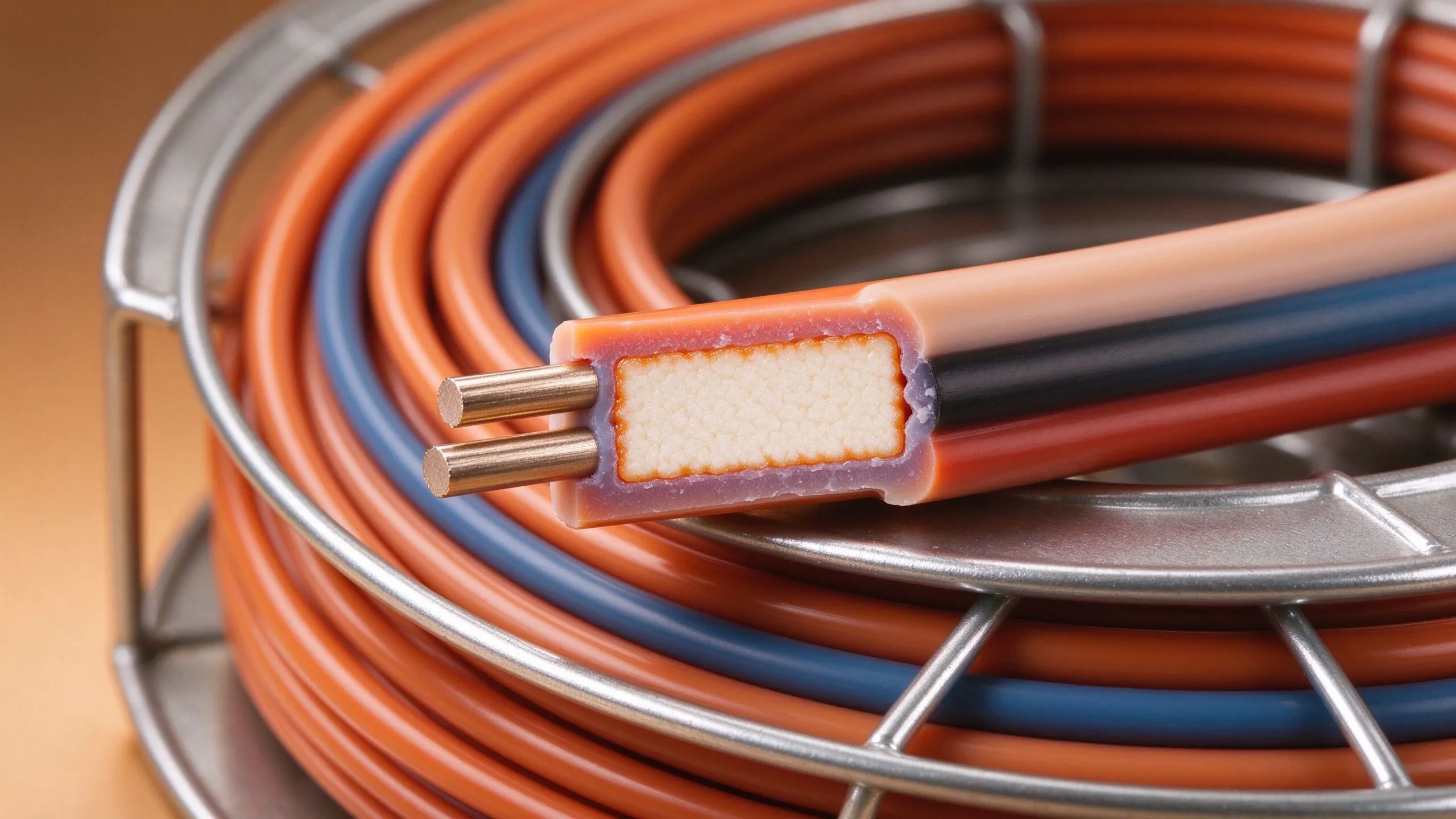
Self-regulating heating cables represent one of the most innovative and practical solutions in the electric heating industry. Unlike constant-wattage heating cables that produce the same amount of heat regardless of ambient conditions, self-regulating cables automatically adjust their heat output in response to temperature changes. This intelligent behavior is made possible by Positive Temperature Coefficient (PTC) technology.
Article by Ethan Sun, Founder & CEO, SunAura Thermal — based on 17 years of heating cable manufacturing and export experience.
Understanding PTC Technology
The core of a self-regulating heating cable is a conductive polymer matrix sandwiched between two parallel bus wires. This polymer is a blend of a base polymer and conductive carbon particles. At the microscopic level, the carbon particles form conductive pathways through the polymer. When the cable is energized, electric current flows through these pathways, generating heat through resistive heating.
The magic of PTC technology lies in what happens as the temperature changes. When the cable is cold, the polymer contracts, bringing the carbon particles closer together and creating more conductive pathways. This results in higher current flow and more heat generation. As the cable warms up, the polymer expands, pushing the carbon particles apart and reducing the number of conductive pathways. At very high temperatures, the cable effectively shuts down its heat output, preventing overheating.
This self-regulating behavior occurs at every point along the cable independently. If one section is in a colder area, that section will produce more heat. If another section is in a warmer area, it will produce less heat. This point-by-point regulation is impossible with constant-wattage cables.
Construction and Materials
A quality self-regulating heating cable consists of multiple layers. The innermost layer is the conductive PTC polymer matrix, extruded around two tin-plated copper bus wires. This is surrounded by an inner insulation layer of modified polyolefin or fluoropolymer. For hazardous environments, an additional tinned copper braid shield provides mechanical protection and grounding. The outer jacket provides protection against chemicals, UV radiation, and physical damage.
The power output is specified at a reference temperature of 10 degrees Celsius, expressed in watts per meter (W/m). Common ratings include 10W/m, 15W/m, 25W/m, and 30W/m. The actual power output varies with temperature: at lower temperatures, the output increases, and at higher temperatures, it decreases.
Applications of Self-Regulating Cables
Pipe Freeze Protection
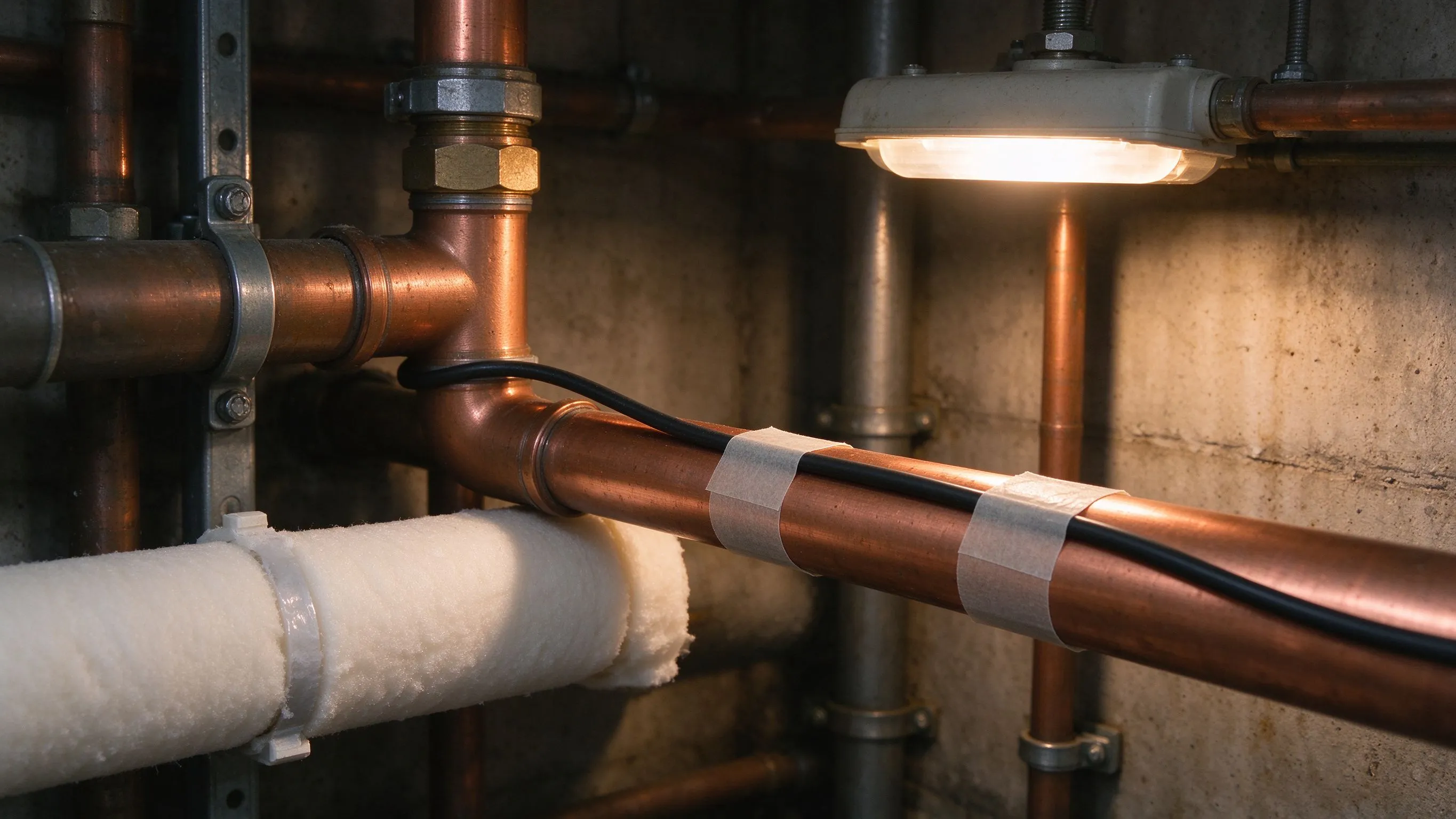
The most common application is pipe freeze protection. In cold climates, water pipes in unheated areas are at risk of freezing. Self-regulating cables are taped along the pipe, providing heat exactly where and when it is needed. The self-regulating feature ensures energy is not wasted when the ambient temperature is above freezing.
Roof and Gutter De-Icing
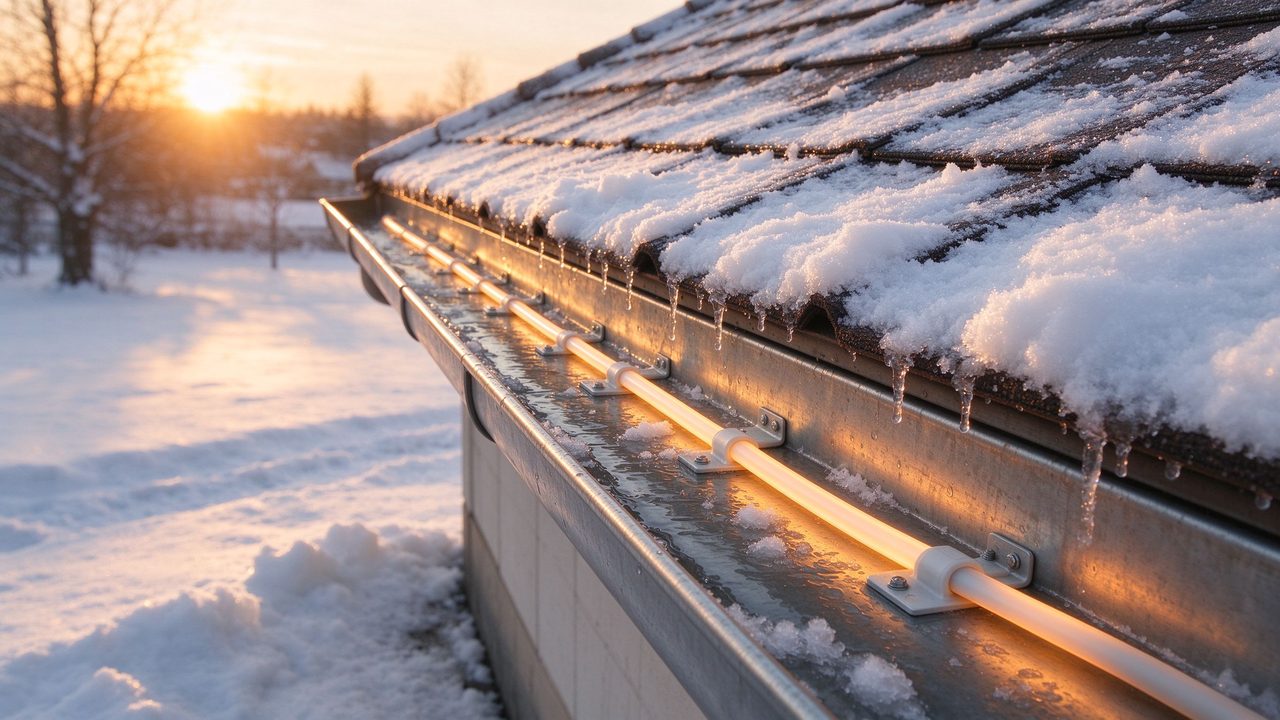
Self-regulating cables are widely used for roof and gutter de-icing. In regions prone to ice dams, heating cables are installed along roof edges and in gutters. The self-regulating feature is particularly valuable because the cable is exposed to widely varying conditions: buried under snow, exposed to air, or in running water.
Process Temperature Maintenance
In industrial settings, self-regulating cables maintain the temperature of pipes carrying viscous fluids such as heavy fuel oil, waxes, and food products. The self-regulating feature ensures the product is maintained at the correct temperature without the risk of localized overheating.
Snow Melting for Driveways and Walkways
Self-regulating cables can be embedded in concrete or asphalt for snow and ice melting. SunAura Thermal offers specialized high-output self-regulating cables (30-50W/m) designed for embedded snow melting applications, with robust construction that withstands the mechanical and chemical stresses of concrete installation.
Safety Advantages
The inherent safety of self-regulating cables is one of their most significant advantages. Because the cable reduces its heat output as temperature increases, it cannot reach dangerously high temperatures even if overlapped or insulated. This eliminates the fire risk associated with constant-wattage cables. SunAura Thermal self-regulating cables are certified to CE, RoHS, and EAC standards.
How PTC Output Changes Along the Cable
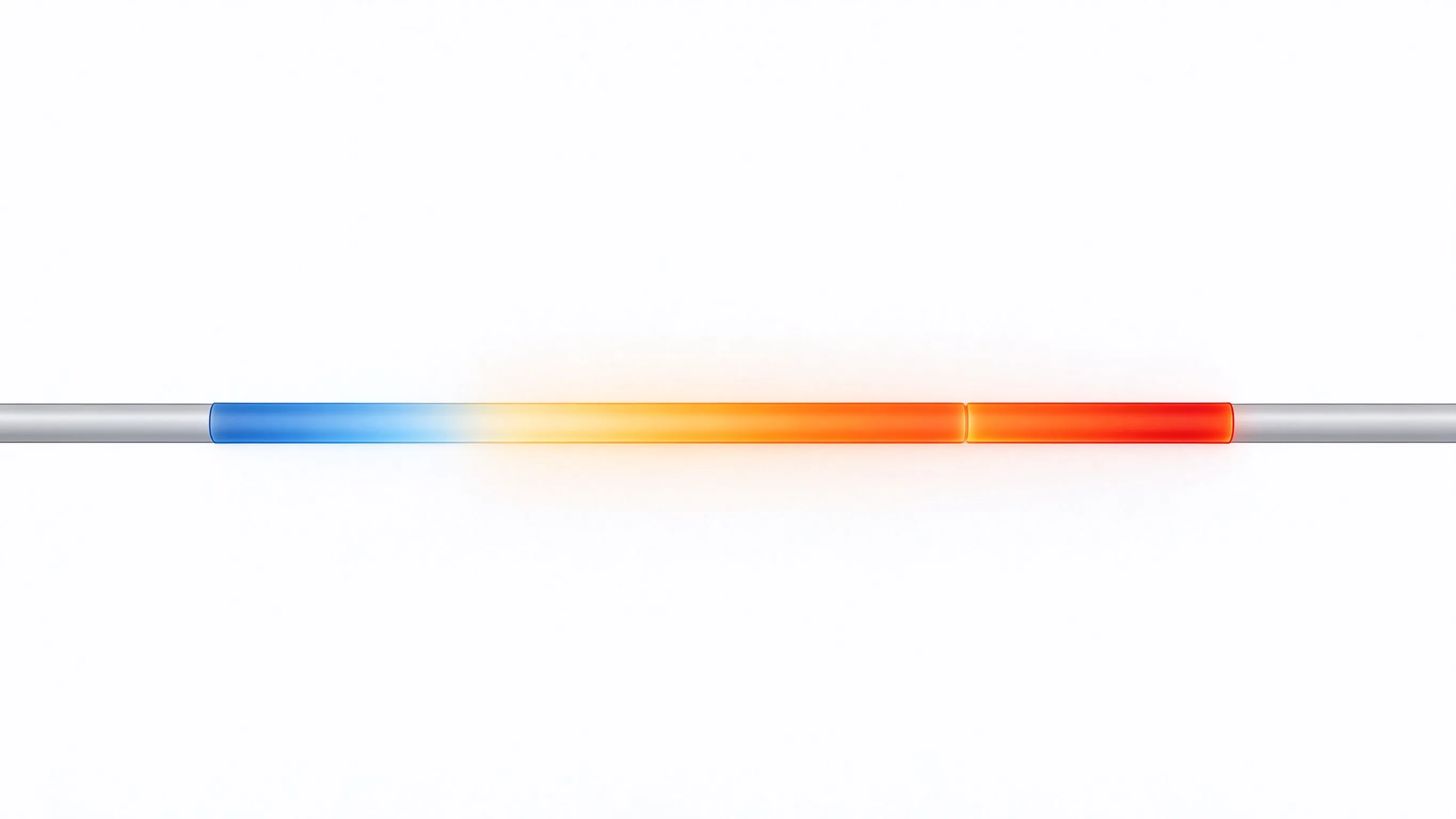
The defining behaviour of a self-regulating heating cable is that its wattage is not constant — it is a function of local temperature at every point along its length. At the rated reference temperature (usually 10 °C for pipe freeze protection) a 25 W/m cable delivers 25 W per metre. At -20 °C the same cable may output 40–45 W/m, because the polymer matrix contracts and conductive pathways multiply. At 65 °C output falls to near zero. This is why PTC cable cannot be compared on a single wattage figure; the datasheet must show the full output curve across the expected temperature range.
That curve is what makes PTC cable safe to overlap. A constant-wattage series cable folded back on itself creates a hotspot where two heating wires touch, and that hotspot is where insulation melts and faults begin. A PTC cable folded over itself simply reduces its own output in the overlapped section until temperature equalises. This single property is why PTC cable is specified for roof de-icing, where the cable must snake through valleys, gutters, overlaps and snow-drift zones without any risk of runaway temperature.
For pipe protection, the engineering calculation starts from heat loss. An insulated metal pipe in a -20 °C wind may lose 15–25 W per metre of length; choosing a 25 W/m PTC cable sized at reference temperature means the cable will actually output above 25 W/m at -20 °C, matching the heat loss. Underspecifying — for example, using 10 W/m cable on an uninsulated outdoor pipe — guarantees freezing in anything other than a mild winter. Our self-regulating heating cable for pipes product range is specified with output curves from -40 °C to +65 °C so that this calculation can be done on paper rather than guessed on site.
Designing the Circuit: Length, Power and Controls
Maximum circuit length is the second design parameter installers get wrong. Because PTC cable draws its highest inrush current at cold start — and because that inrush can last several seconds while the polymer is still cold — each circuit must be sized below the circuit-breaker’s magnetic trip threshold. A 25 W/m cable on a 16 A, 230 V circuit is typically limited to 80–100 m per run; a 10 W/m cable can reach 130–150 m. Cold-lead sizing, RCD protection (30 mA) and a dedicated circuit are mandatory; never share a PTC circuit with lighting or socket outlets.
Controls for PTC freeze protection are simpler than for underfloor heating. A simple thermostat with a capillary bulb strapped to the pipe, set to 5 °C, switches the entire circuit on and off. More advanced installations use a ambient-sensing thermostat that combines pipe temperature with outdoor temperature, which prevents the cable from running during mild weather. For snow-melting applications embedded in concrete or asphalt, a combination of moisture sensor and snow sensor activates the system only when both conditions coincide — cutting energy use by 60–80% versus continuous operation.
For wet and embedded installations, construction layers matter. A quality PTC self-regulating heating cable includes a tinned copper braid earth and an outer jacket modified polyolefin for indoor use, fluoropolymer for chemical or UV exposure, and lead-free PVC for buried concrete installations. Matching the jacket to the environment — not the price — is what separates a 5-year failure from a 20-year service life.
Power Connection and End Seals: Where Cables Actually Fail
In 30 years of trace-heating field experience, the cable itself almost never fails — the power connection and end seal do. The PTC matrix is a semiconductive polymer: if moisture reaches the cut end, it forms a conductive path across the bus wires, and over weeks the end carbonises. That is why every quality PTC cable ships with a factory-assembled power connection kit and a heat-shrink end seal, rather than expecting installers to make the joint on site. The power connection clamps onto both bus wires with crimp lugs, and a multi-layer heat-shrink boot with adhesive liner seals the transition from braid to matrix. On roof-gutter installations, the end seal must point downward so water runs off rather than into the joint.
For long circuits, a splice-in-kit mid-run is available, but it should be treated as a service joint inside a junction box — never buried in concrete, never strapped on an exposed roof edge. Inspect every termination at commissioning and again after the first winter; a small temperature rise at the end seal is normal, but visible heat marks, discolouration or a smell means the joint must be re-made immediately. This servicing discipline is why SunAura ships installation diagrams with every fire-pipe self-regulating cable order: termination drawings, not just product photos.
Buyers comparing PTC cable brands should therefore ask for three documents: the output curve across temperature, the maximum circuit length at the chosen breaker rating, and the termination kit part number used in the field. A manufacturer that cannot provide all three is selling cable, not a system.
Factory Evidence: Manufacturing, Testing and Standards
SunAura Thermal has manufactured electric heating cables at our Qingdao Huangdao facility since 2008, now in our 17th production year. Our self-regulating cables are extruded on the same line that produces our silicone heating cable applications range, under ISO 9001, ISO 14001 and ISO 45001 management systems, and carry CE, RoHS, LVD and EMC declarations. Every production lot is tested for PTC switch temperature, cold inrush current, insulation resistance at 1500 V DC, and bend-cycle performance, per SunAura factory records. The same factory supports heating cable OEM programmes, with custom wattages, cut lengths and private-label packaging for distributors across more than 50 countries.
The regulatory and energy context supports PTC specification. The US Department of Energy Energy Saver portal documents pipe-freezing protection as a standard winterisation measure, and the IEA heating report emphasises that efficient, zoned electric trace heat avoids the energy waste of leaving entire systems running to prevent a single frozen pipe. PTC’s point-by-point regulation is precisely the hardware that makes that efficiency possible — a constant-wattage cable running continuously all winter burns far more energy than a PTC cable that only outputs what the local pipe temperature demands.
Frequently Asked Questions
Can self-regulating cable be used on plastic (PEX/PPR) water pipes?Yes, with one precaution: plastic pipes have lower thermal conductivity, so the cable should be spiral-wrapped along the pipe rather than strapped straight, and an aluminium tape wrap over the cable is recommended to spread heat evenly. This prevents local hotspots against the plastic wall and speeds heat transfer to the water inside.
How much energy does freeze-protection cable actually use?Far less than most homeowners expect. A 25 W/m cable on a 10 m outdoor pipe, controlled by a 5 °C thermostat, typically runs 300–800 hours per heating season in a temperate climate — about 75–200 kWh total. That is a small fraction of the cost of one burst-pipe repair.
Can I cut self-regulating heating cable to length on site?Yes — unlike series constant-wattage cables, PTC parallel cable can be cut to any length on site, as long as the end is terminated with a proper end-seal kit. Never leave the PTC matrix exposed; moisture ingress at an unterminated end is the most common field failure.
What is the difference between self-regulating and constant-wattage cable?Self-regulating cable adjusts output point by point with temperature, cannot overheat when overlapped, and can be cut to length. Constant-wattage series cable outputs a fixed wattage per metre, must not be overlapped, and is manufactured to a specific circuit length. For freeze protection and snow melting, self-regulating is the default choice; for embedded underfloor heating where a known fixed output is needed, constant-wattage cable still has a role — see our guide on heating cable installation under screed.
How long does self-regulating heating cable last?With proper jacket selection and termination, 20+ years is typical. The PTC polymer itself does not degrade under normal thermal cycling; failures almost always start at terminations, which is why factory-potted power connections and certified end-seal kits matter.
Conclusion
Self-regulating heating cable technology, powered by PTC polymer chemistry, represents a significant advancement in electric heating safety and efficiency. The ability to automatically adjust heat output point-by-point along the cable makes these cables ideal for a wide range of applications from residential pipe protection to industrial process heating.
Related Products & OEM Inquiries
Looking for self-regulating PTC cable that guards against overheating or a factory-direct OEM/ODM partner? Explore our self-regulating PTC heat-trace cables, then request a quote for your project — we supply distributors, installers and brands in 50+ countries.