
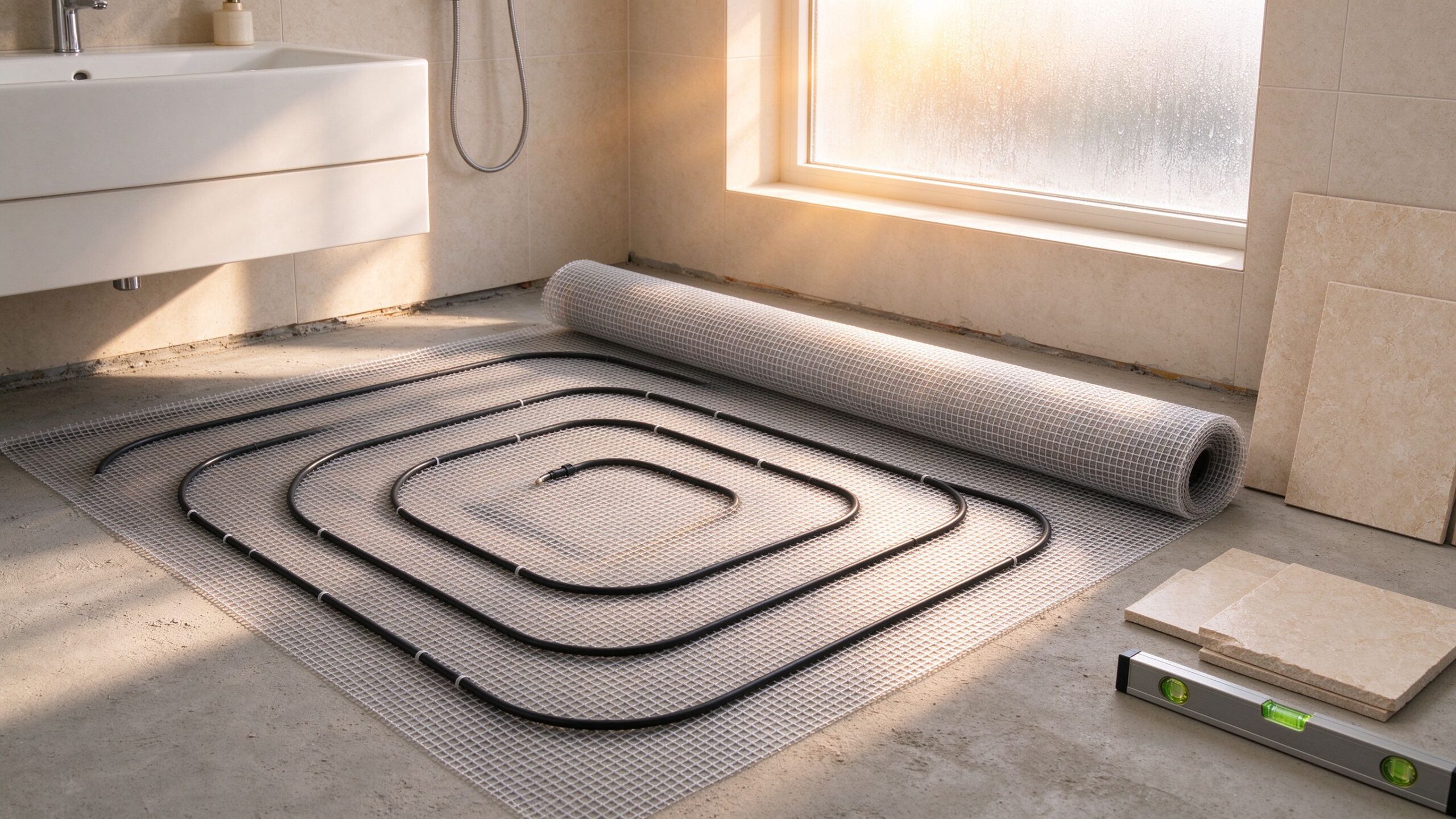
Definition. An electric underfloor heating mat is a factory-assembled, ultra-thin heating element — usually a resistance heating cable bonded to a fiberglass mesh, or a resistive foil layer encapsulated between durable polymer films — that is laid directly on the subfloor beneath tile, stone, vinyl or wood-look flooring and converts mains electricity into radiant heat to warm the floor surface. At its core the mat consists of a twin-conductor heating element, a cold power lead, and an earthed, watertight outer sheath; when powered through a floor-sensing thermostat it radiates even, low-temperature heat upward into the room. Designed for zone-by-zone comfort heating under hard floors, it is most widely used in bathrooms, kitchens, sunrooms, entryways and renovated living areas where hydronic pipework is impractical. This definition-focused guide explains how electric underfloor heating mats are built, the main types available, how they compare with heating film and loose heating cable, which floor finishes they suit, and the sizing and specification rules buyers should apply.
By Ethan Sun, Founder & CEO, SunAura Thermal — 17 years designing and manufacturing electric radiant heating elements in Qingdao, China, for brands and contractors in 50+ countries.
What Is an Electric Underfloor Heating Mat?
An electric underfloor heating mat is a self-contained, ready-to-lay electric radiant heating assembly manufactured in controlled widths — commonly 0.5 m or 1.0 m wide and rolled to order length. Unlike a loose heating cable that must be threaded and spaced by the installer on site, the mat arrives pre-spaced: the heating element is already fixed to a carrier, so the installer simply rolls it out like carpet tacking underlay, cuts it around doorways and fixtures, and connects the cold lead to a thermostat. This “mat” format is the defining difference from cable-on-clip systems and from sheet-style heating film.
The purpose of the product is supplemental or whole-room radiant comfort heating. It warms the floor covering to a typical surface temperature of 24–32 °C, which then heats people and objects in the room directly by radiation rather than blowing hot air. Because it sits beneath the wearing surface, it occupies almost no ceiling height and requires no boiler, manifold or pump — the three things that make hydronic underfloor heating heavy, expensive and unsuitable for one-room retrofits. When people ask what is an electric underfloor heating mat in a buying context, they are usually comparing it against radiators, heated towel rails, fan heaters and loose cable kits.
How It Is Made and How It Works
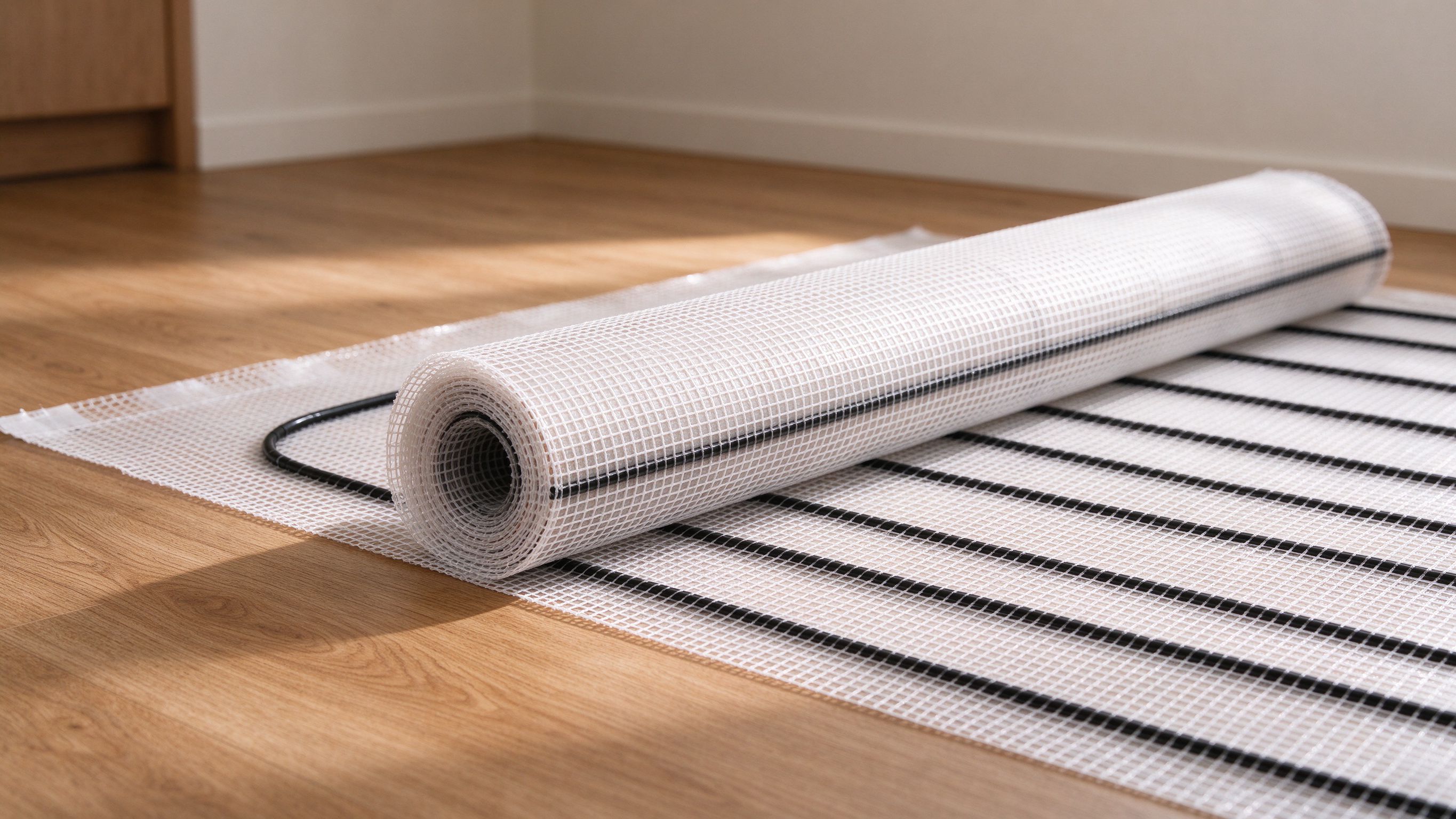
Understanding types of electric underfloor heating mats starts with how they are constructed. A standard cable-based mat is built layer by layer. First, a resistive heating alloy (usually a nickel-chromium or copper-nickel alloy wire) is drawn to a precise cross-section that sets the wattage per metre. Second, that conductor is insulated with cross-linked polyethylene (XLPE) or fluoropolymer extrusion, which withstands the 90 °C continuous conductor temperatures generated at full load. Third, a braided or laminated earthed shield is applied for safety, and finally a durable outer PVC or LLDPE sheath makes the assembly moisture-tight — essential under tile adhesive and screed.
The factory then bonds the heating cable at fixed intervals, typically 50–75 mm spacing, to a fiberglass mesh that stays flat during tiling. At one end a factory-made splice joins the hot heating cable to a cold supply lead, usually 2.5–4.0 m long, that runs cool because it has no resistance alloy inside. This splice is the most safety-critical joint in the whole system and must be made in the factory under spark-testing, never on site.
Operation is deliberately simple. When mains voltage (120 V or 230 V) is applied, current flowing through the resistive conductor dissipates power as heat along every metre of cable. That heat conducts through the tile adhesive, the tile itself, and then radiates upward. A floor temperature sensor mounted under the mat feeds actual floor temperature back to the thermostat, which switches the mat on and off to hold a set surface temperature — typically 27 °C in a bathroom. Because the system is resistive, nearly 100% of the electrical energy delivered to the mat becomes heat in the room, which is why well-controlled electric mats are efficient at the point of use, especially when paired with off-peak tariffs, rooftop PV or heat-pump-friendly low-temperature designs.
Types of Electric Underfloor Heating Mats
The market splits into four main families. Choosing among types of electric underfloor heating mats comes down to installation build-up, floor finish and renovation versus new-build status.
- Wet-install cable mats (tile-ready, thin-set). The classic format: mesh mat laid on the prepared subfloor, then bedded directly under tile adhesive or a 20–30 mm self-levelling compound. Total added height is about 4–8 mm. This is the standard underfloor heating mat for tile floors and natural stone, used in bathrooms and kitchens worldwide.
- Dry-install foil/encapsulated mats. An ultra-thin resistive foil or PTC element laminated between aluminium and polyester films, usually 0.3–0.5 mm thick. No wet adhesive: the mat sticks straight onto a flat subfloor and is covered directly with floating laminate, engineered wood, LVT or click SPC. This format exists almost entirely for retrofit where floor height cannot rise.
- Dual-voltage and low-voltage mats. Line-voltage mats run directly from 120/230 V mains. Low-voltage (12/24/36 V) mats, powered by a dedicated transformer, are used where extra shock-safety margin is required, in wet public areas, or for small shaped zones such as shower trays.
- Zoned and custom-cut mats. Manufacturers supply mats in fixed standard widths, but also cut-to-area assemblies: the mesh can be turned around alcoves, under vanities and around toilets, with the cold lead placed at the electrical entry point the designer specifies.
Across all four families, the buyer-facing specification that matters most is watts per square metre. Standard comfort output is 150 W/m² under tile; rooms with poor insulation, large glazing or cold climates may use 200 W/m²; and under low-conductivity floating floors, output is deliberately capped at 100–160 W/m² to protect the floor finish from overheating. You can review the full engineering range and request dimensions on our types of electric underfloor heating mats catalog, where each family is listed by standard wattage band.
Electric Mat vs Heating Film vs Heating Cable
Buyers frequently ask for an electric heating mat vs heating film comparison before specifying a project. The third option — loose heating cable — completes the picture. All three are resistive electric radiant products; they differ in format, installation labour, compatible floors and where they make economic sense.
| Attribute | Electric Underfloor Heating Mat | Heating Film (foil sheet) | Loose Heating Cable |
|---|---|---|---|
| Format | Cable factory-fixed to mesh, rolled to area | Continuous resistive foil sheet roll | Bulk cable, clipped on site |
| Build-up height | 4–8 mm under tile adhesive | 0.3–0.5 mm, dry-lay | 15–30 mm under screed |
| Best floor finish | Tile, stone, thin-set finishes | Laminate, engineered wood, LVT/SPC | Tile, stone, embedded screed |
| Installation labour | Low — roll out and tile | Very low — cut sheet and float floor over | High — hand-spaced on site |
| Output range | 100–200 W/m² | 100–220 W/m² | 100–220 W/m² |
| Typical use case | Bathrooms, kitchens, renovations under tile | Dry retrofits under floating floors | New-build screed, large open areas |
| Repairability if damaged | Factory splice only; local repair possible | Sheet section replacement | Easy to splice and extend |
In short: choose the electric heating mat vs heating film dry-lay roll when the floor covering is a floating laminate or LVT and you cannot raise the floor height; choose the heating mat when you are tiling and want fast, predictable installation; choose loose cable only for screed embedment in new construction. For tiled bathrooms specifically, the mat is the industry default — our step-by-step underfloor heating mat for tile floors installation guide documents exactly how the waterproofing, fixing and testing sequence works on site.
Flooring Compatibility and Where It Works
An electric underfloor heating mat is only as good as the floor finish on top of it. Thermal conductivity governs everything: heat must reach the surface, not be trapped beneath an insulator.
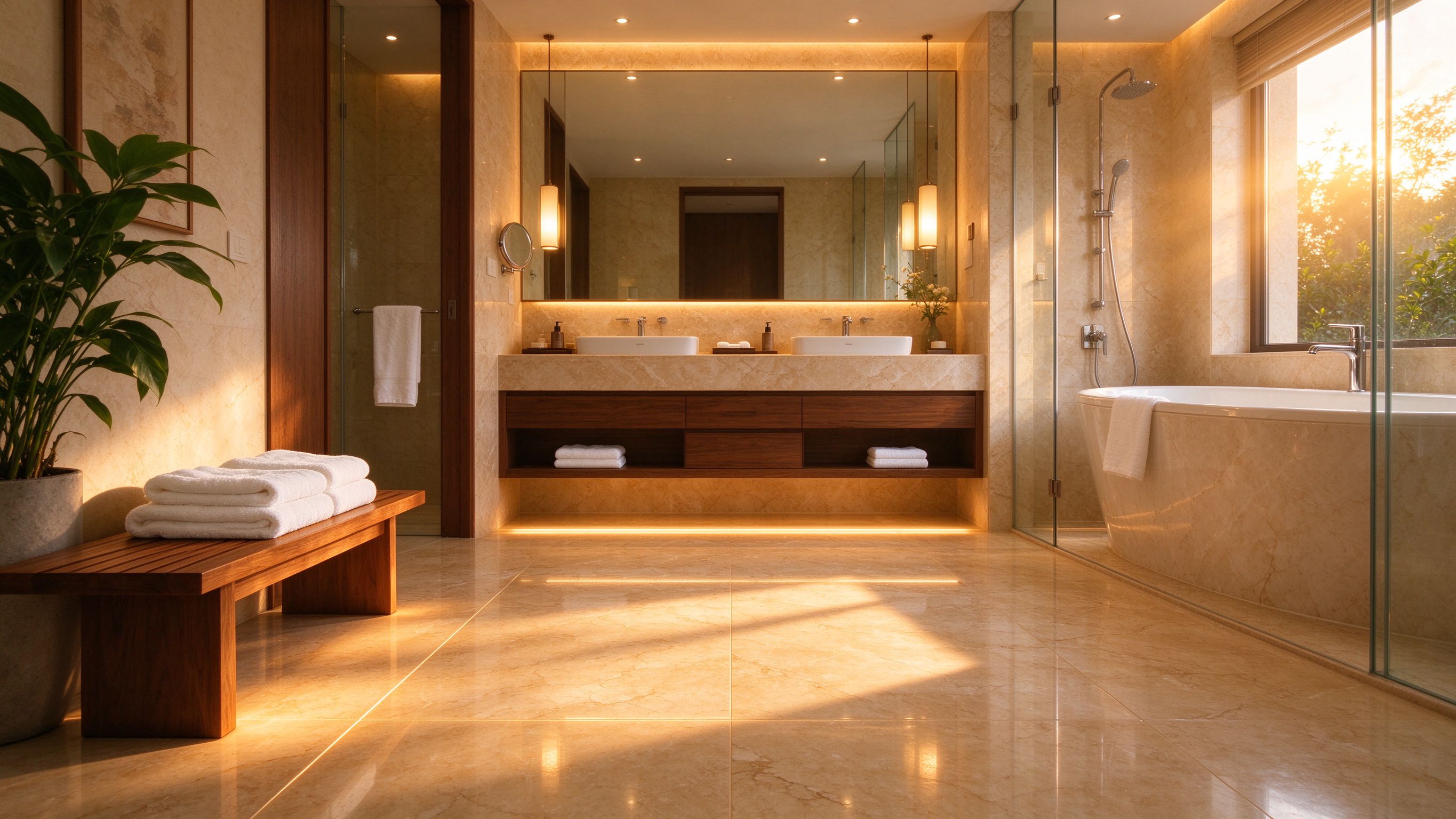
- Porcelain and ceramic tile, natural stone. Excellent. Tile and marble conduct heat well, reach comfort temperature in 30–60 minutes, and are the reason the mat format exists in the first place. This is the canonical underfloor heating mat for tile floors application.
- LVT, SPC and rigid vinyl planks. Compatible with dry-lay foil mats at capped wattage. Verify the flooring manufacturer’s maximum floor-surface temperature (usually 27–28 °C) and use a floor-probe thermostat.
- Laminate and engineered wood. Compatible with dry foil mats only. Solid wood is generally unsuitable because moisture movement under heat causes cupping and gaps.
- Carpet. Possible but poor: carpet and underlay act as insulation, raising running costs and slowing response. If carpet is unavoidable, choose low-tog underlay and derate the design.
By room, bathrooms, kitchens and entryways are the sweet spot: small zones with hard floors where stepping onto a warm surface in winter is the single biggest comfort upgrade. Sunrooms and sunlit south-facing rooms need lower design wattage; north-facing bedrooms and extensions need the higher band. Always exclude the area under fixed furniture, sanitaryware and shower trays from the heated zone — heat trapped under a cabinet or inside a shower plinth cannot dissipate and will shorten element life.
How to Choose: Sizing, Wattage, Insulation, Thermostat
Specifying a mat system correctly comes down to five decisions. Get these right and the system will heat comfortably for 20+ years; get them wrong and you pay for it in electricity bills.
- Measure the heated area, not the room area. Sketch the floor, mark fixed furniture, toilets, vanities and built-ins, then sum the free floor area in m². The mat covers only that area — do not buy mat sized to the whole room.
- Match wattage to insulation. Well-insulated modern building: 150 W/m² under tile. Older, draughty or large-glazing rooms: 200 W/m². Dry-lay under floating floors: cap at 150 W/m² and respect the flooring warranty limit.
- Never skip the insulation board. A 5–10 mm XPS or EPS thermal insulation layer under the mat stops heat disappearing into a cold concrete slab. Per SunAura factory records, projects installed with proper insulation typically reduce heat-up energy use by a third compared with direct-to-slab installs.
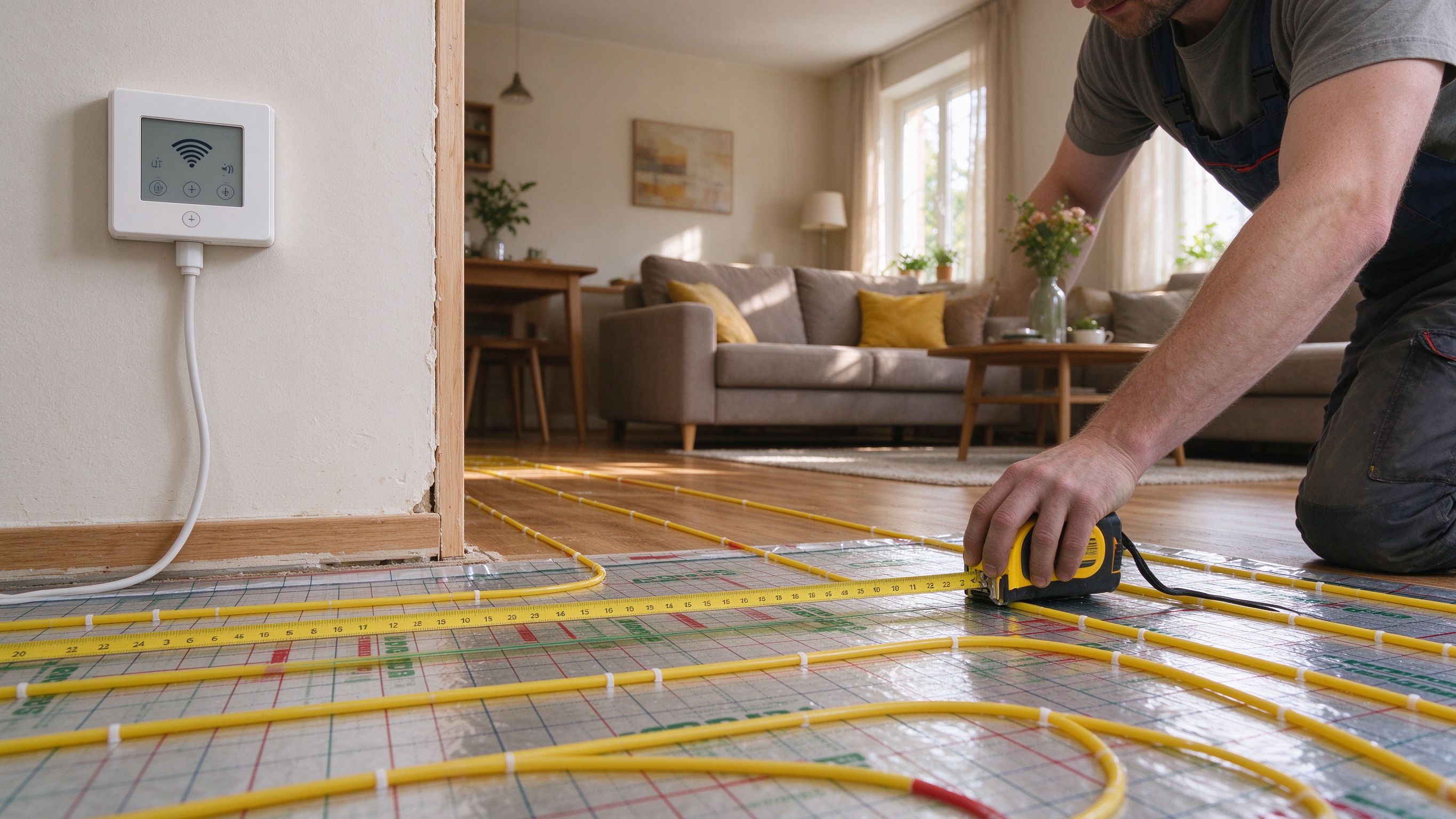
- Buy a floor-probe thermostat, not an air thermostat. The sensor must sit in the floor build-up so it measures the actual surface you feel. Programmable and WiFi models add scheduling — the biggest single lever on running cost, because mats should run ahead of occupancy, not continuously.
- Plan the cold-lead route and circuit load. Sum the total mat wattage, size the circuit and residual-current device accordingly, and keep the cold lead run as short as practical to avoid voltage drop. Large rooms may need two zones on separate thermostats.
Data and Evidence: What Backs the Specification
Independent regulation already treats electric radiant floor heating as a legitimate low-temperature comfort system. Under the EU Energy Performance of Buildings Directive (EPBD), member states are required to publish energy performance requirements and demonstrate the efficiency of building heating systems; radiant electric floor heating controlled by room- and temperature-regulating devices qualifies under the same ecodesign and energy-labelling framework as other electric heaters. The EU framework is documented on the European Commission’s official EPBD overview page. In parallel, the U.S. Energy Star programme provides the consumer-facing efficiency and qualification baseline that buyers in North America use to compare electric heating products; see the Energy Star site for the general programme definitions.
On the manufacturing side, SunAura has produced electric heating elements in our Huangdao, Qingdao factory since 2008 — more than 17 years. Our mat and film production lines operate under ISO 9001 (quality), ISO 14001 (environment) and ISO 45001 (occupational safety) management systems, and products ship under CE marking supporting the Low Voltage Directive (LVD) and EMC requirements, together with RoHS compliance. Every finished heating cable length undergoes spark testing, resistance verification and dielectric strength testing before encapsulation, and every finished mat is ohm-checked again at final packing. Export markets exceed 50 countries. All figures in this paragraph are per SunAura factory records; certificates and test reports are available to brand owners and contractors on request.
Frequently Asked Questions
What is the basic definition of an electric underfloor heating mat? It is a factory-made, thin resistive heating assembly — a heating cable pre-fixed to a mesh or a foil element sandwiched between polymer films — installed on the subfloor beneath the floor finish and powered by a thermostat to produce radiant floor heat. It is an electric, zoned alternative to radiators and hydronic underfloor heating, designed mainly for tile and stone floors in bathrooms, kitchens and renovated spaces.
Is an electric underfloor heating mat expensive to run? Running cost depends on room insulation, floor coverage, tariff and thermostat programming. A well-insulated bathroom running on a scheduled floor-probe thermostat typically uses a fraction of the energy of a 2 kW fan heater left on all day, because the thermal mass of the tile stores the heat and the mat only tops it up. Insulation board under the mat is the single most cost-effective upgrade for lowering running cost.
Can the heating mat be installed under existing floors, or is renovation required? Under tile you need to remove and re-lay the floor finish, so it is usually done during a bathroom or kitchen renovation. For floating laminate or LVT, ultra-thin dry-lay foil mats can be installed without raising floor height significantly, which is why they dominate retrofit projects. Mats are not suitable to lay under an already-finished floor.
What is the difference between a heating mat and a heating film? A mat is a cable-on-mesh product bedded under tile adhesive (wet install, 4–8 mm build-up). Heating film is a thin resistive foil sheet laid dry under floating laminate, engineered wood or LVT (0.3–0.5 mm build-up). Choose the mat for tiled wet areas; choose the film for dry-lay renovations. Both are resistive radiant systems controlled the same way by a floor-sensing thermostat.
How long does an electric underfloor heating mat last? With correct installation, correct thermostat control and flooring-compatible wattage, a properly manufactured encapsulated mat has a design life comparable to the floor itself — 20+ years — because there are no moving parts. The guarantee length varies by manufacturer and brand; always ask the factory for the actual warranty terms, not the marketing figure.
Source Electric Underfloor Heating Mats Factory-Direct
If you are a heating installer, distributor or private-label brand sourcing electric radiant heating for your market, SunAura manufactures the full mat family in Qingdao to CE, RoHS, LVD and EMC specifications under ISO 9001/14001/45001 systems, with OEM dimensions, wattage bands, voltage configurations and private-labelling support. As an experienced electric heating mat wholesale supplier exporting to 50+ countries, we support sample orders, container volume pricing and full project documentation. Request the current list, drawings and test reports via our electric underfloor heating mat factory price and OEM page, or review the standard catalog on the heating mat product page to compare formats before you specify your next project.
Ethan Sun, Founder & CEO, SunAura Thermal — electric radiant heating elements engineered in Qingdao, installed in 50+ countries.
Related Products & OEM Inquiries
Looking for an electric underfloor heating mat, properly specified or a factory-direct OEM/ODM partner? Explore our electric underfloor heating mats and complete electric underfloor heating systems, then request a quote for your project — we supply distributors, installers and brands in 50+ countries.