
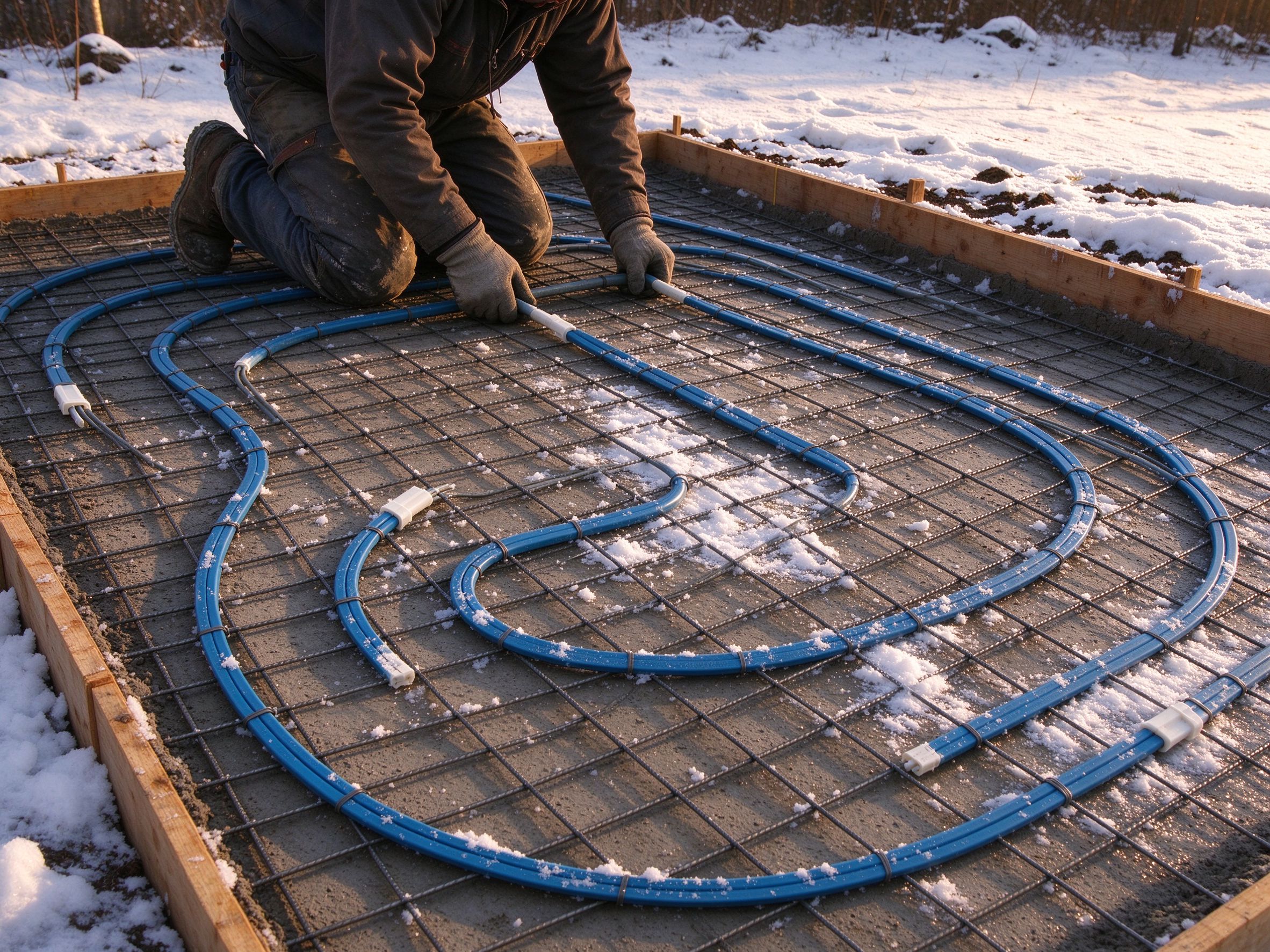
A cold garage is more than an inconvenience. A bare concrete slab stays at near-ground temperature for most of the winter, which makes the room uncomfortable to work in, slows anything stored on the floor, and raises the risk of frozen pipes and condensation. Electric underfloor heating turns that slab into a gentle, even radiator — and because a garage is a single, well-defined space with a solid floor, it is one of the most straightforward rooms to heat electrically.
This guide explains how electric garage floor heating works, how heating mats and heating cables differ, the wattage and insulation figures that matter, and the controls and safety devices a correct installation needs. It is written for homeowners, workshop owners and installers who are planning either a new build or a retrofit.
Why Heat a Garage Floor?
Concrete is dense and conducts heat well in the wrong direction: it pulls warmth out of anything touching it and holds the cold of the ground beneath. Heating the floor addresses the problem at its source rather than blowing hot air around a draughty room. The benefits are practical rather than luxurious:
- A usable workshop all winter. Warm feet and a floor that does not chill the air make a measurable difference when you are standing for long periods.
- Drier conditions. A slightly warm slab discourages surface condensation and the damp, musty environment that comes with it.
- Frost protection. Keeping the slab above freezing protects water pipes, drains and equipment kept in the garage, and stops the freeze-thaw dampness that damages stored goods.
- Even, silent heat. There is no fan, no noise, no moving air and no heater taking up wall or floor space.
For garages that double as a gym, home office or hobby room, the comfort step-up is substantial. The same logic applies to underfloor heating systems used in other solid-floor rooms.
What Makes Garage Heating Different From Living Spaces
It is tempting to copy a living-room specification straight into a garage, but the rooms behave differently. A garage usually has:
- Higher heat loss. A large, poorly insulated roller door, little or no wall insulation and frequent air changes mean heat escapes quickly.
- A thick concrete slab in contact with the ground. Without insulation under it, much of the energy simply drains downward.
- Intermittent use. Most garages are not occupied all day, so the system is often run on a timer or frost setting rather than continuously.
- Heavier loads. The floor carries vehicles, tool chests and workshop equipment, so the heating element must be fully embedded and protected.
These points push the design toward adequate power density, proper sub-slab insulation, and a control strategy that distinguishes between comfort heating and simple frost protection.
Electric Mat vs Heating Cable: Two Ways to Heat a Garage Slab
Both approaches use an electric resistance element embedded in or under the floor, controlled by a thermostat. The difference is how the element is supplied and laid.
Heating mats
A heating mat holds the cable at a fixed spacing on a mesh or foil backing. You roll it out across the floor, make simple turns at the edges, and the spacing — and therefore the power density — is already set. Mats are fast to fit, reduce the risk of uneven spacing, and suit rectangular floors with few obstructions. The ultra-thin variants add very little build-up height, which is useful in retrofit work.
Loose heating cable
Loose cable comes on a reel and is laid by hand, fixed to strapping, mesh or the slab. You choose the spacing to hit a target wattage and weave around pillars, drains, parked-car positions and irregular shapes. Cable is the more flexible option for a garage with lots of obstacles or an uneven layout, and it often works out more economical over larger areas.
Self-regulating cable for frost and pipes
If the primary goal is freeze protection rather than comfort, self-regulating (PTC) heating cable changes its output with temperature — producing more heat when cold and less when warm, which reduces the risk of overheating. It is widely used on pipes and for frost duty, and is closely related to the heat trace cable used on tanks, pipes and roofs. For full comfort warmth across the whole floor, a fixed-output mat or cable with a thermostat is the more common choice.
Power Density: How Many Watts per Square Metre
Power density is expressed in watts per square metre (W/m²) and is the single most important sizing figure. The right value depends on insulation, heat loss and whether you want full comfort or just frost protection. As a general guide for planning:
- Frost protection / background keep-warm: a relatively low density is enough to hold the slab above freezing.
- Comfort heating in an insulated garage: a moderate density is typical for a well-built room with a door seal and some insulation.
- Comfort heating in a draughty or uninsulated garage: a higher density is needed to overcome the heat loss through the door and slab.
Exact figures should be confirmed against the room’s insulation and heat loss rather than guessed, and the total must fit within a dedicated circuit. The step-by-step method for converting room area and element output into W/m² is covered in the underfloor heating wattage calculation and the watts per square metre guides. Note that garage comfort heating is specified well below the much higher densities used for outdoor snow melting — the two applications should not be confused.
Insulation, Damp-Proofing and the Concrete Slab
Insulation is where many garage projects waste energy. A slab poured directly onto cold ground will conduct a large share of the heat downward regardless of how powerful the element is. A well-built floor includes:
- Rigid insulation below the element to direct heat upward into the room rather than into the earth.
- A damp-proof membrane to stop ground moisture rising through the slab — important both for comfort and for protecting the cable and floor finishes.
- Edge insulation around the slab perimeter, where the floor meets cold external walls and the door.
The effect of insulation on heat-up time and running cost is explained in the insulation R-value guide. In a retrofit where lifting the slab is not practical, adding door seals, wall insulation and an insulated door gives a useful return even if the floor build-up stays thin.
New Build vs Existing Garage: Installation Methods
New build or full re-screed. The cleanest approach is to place insulation and a damp-proof membrane, lay the cable or mat, and then pour the screed or concrete over it. The element is fully protected, which suits the heavy loads of a garage floor. Cable spacing can be planned around the vehicle and workbench positions.
Existing floor (retrofit). Where the slab must stay, a thin mat or cable can be laid in a thin layer of self-levelling compound or tile adhesive, adding minimal height. The main practical issue is the threshold at the garage door — even a few extra millimetres can affect clearance, so ultra-thin elements and careful build-up planning matter. A separate article covers the choice between tile adhesive and self-levelling compound.
Whichever route is used, the element must never be cut or shortened, and the floor should not be drilled or anchored into after the cable is laid without reference to the layout drawing.
Controls: Thermostats, Floor Sensors and Frost Protection
A garage benefits from a thermostat that can do more than hold a single temperature. Useful features include:
- A floor sensor embedded in the slab, so the controller reads the actual floor temperature rather than just the air.
- A frost/anti-freeze setting that holds the slab at a safe minimum when the room is unused.
- A timer or schedule that brings the floor up to comfort temperature before the room is used, since a slab takes time to heat.
- Smart or remote control for switching the heating on from a phone, particularly handy in a workshop used at weekends.
Because the slab is slow to respond, pre-heating ahead of use is far more effective than turning the system to maximum when you walk in. Running the system on cheaper off-peak tariffs can also lower the cost of a timed warm-up. The full range of smart thermostats covers floor-sensor, programmable and remote options.
Circuit, Load and Electrical Safety
Electric floor heating is a fixed load and should be treated as a dedicated circuit. Key points for a safe install:
- Dedicated circuit sized for the total load, with headroom rather than running at the limit. The way load and current are calculated is covered in the circuit sizing guide.
- RCD/GFCI protection. A residual-current device is essential for an embedded element; the differences between device ratings are explained in the RCD protection guide.
- Insulation and continuity testing of the element before and after laying, and again before the floor is closed up.
- Correct voltage for the region. North American garages commonly use 120 V or 240 V; the choice is explained in the 120 V vs 240 V guide, while European installations generally run at 230 V.
Wiring and connection work should be carried out by a qualified electrician and signed off to local regulations. Commissioning and thermostat wiring are covered in the thermostat installation guide.
Running Costs and Energy Strategy
The running cost of garage floor heating is driven by three things: how well the slab and door are insulated, the power density installed, and how the system is scheduled. A well-insulated, timer-controlled system used mainly for comfort periods and left on a frost setting otherwise is inexpensive to run, because it is not heating empty space at full power. An uninsulated slab under a draughty door, run continuously, is a different and much costlier story.
The honest way to estimate a budget is to multiply the installed load by the expected hours of use and the local electricity price, then allow for the savings from insulation and off-peak scheduling. The factors that move a quoted price are set out in the price per square metre guide. If the garage shares a roof with solar panels or a battery, the timed warm-up can be shifted toward self-generated power.
Heating Mat vs Cable: Comparison Table
| Factor | Heating mat | Loose heating cable |
|---|---|---|
| Installation speed | Fast — roll out, fixed spacing | Slower — hand-laid and spaced |
| Layout flexibility | Best on simple rectangular floors | Best around obstacles and irregular shapes |
| Power density control | Pre-set by the mat | Adjustable via spacing |
| Build-up height | Very low on thin variants | Low, depends on fixing method |
| Cost on large areas | Often higher per m² | Often more economical |
| Best fit | Retrofit, simple rooms, quick fit | New builds, complex or large garages |
Garage Heating Decision Checklist
- Decide the goal: full comfort, frost protection, or both with a switchable thermostat.
- Measure the heated area and calculate the required W/m² against insulation and heat loss.
- Plan insulation and a damp-proof membrane under the element, especially on a new slab.
- Choose mat for a simple layout or loose cable for obstacles and large areas.
- Confirm the dedicated circuit, RCD/GFCI protection and voltage before ordering.
- Specify a floor-sensor thermostat with a frost setting and a scheduled pre-heat.
- Keep the layout drawing so the finished floor is never drilled into the cable.
Common Mistakes to Avoid
- Under-specifying power in a draughty garage — the system runs constantly yet never reaches comfort temperature.
- Skipping sub-slab insulation — a large share of the energy drains into the ground.
- No floor sensor or frost setting — relying on air temperature alone gives poor slab control.
- Sharing a circuit — an embedded heater needs its own protected supply.
- Drilling or fixing into a finished heated floor without the cable layout — a common cause of damage.
- Expecting instant heat — a concrete slab needs a scheduled pre-heat, not last-minute maximum output.
Frequently Asked Questions
Can I heat an existing garage floor without digging it up? Yes. Thin mats or cable can be laid in a thin layer of self-levelling compound or adhesive over the existing slab, adding minimal height. Door clearance is the main thing to check.
Is it cheaper to run frost protection or full heating? Frost protection uses far less energy because it only holds the slab above freezing. Most owners combine the two: frost duty when the room is idle and scheduled comfort heating before use.
Do I need a separate circuit? Yes. A fixed floor-heating load should have a dedicated, RCD/GFCI-protected circuit sized by a qualified electrician.
Can the heating element be damaged by a car? Once fully embedded in screed or concrete, the element is protected against normal vehicle loads. It must not be exposed or subjected to point loads before the floor is finished.
How does this differ from outdoor snow melting? Snow melting systems use far higher power densities and moisture-sensing controls. Indoor garage comfort heating is a separate, lower-density specification.
Related Products & OEM Inquiries
SunAura Thermal manufactures electric heating mats, heating cables, self-regulating cable and matching smart thermostats at our own factory, with installation kits for complete projects. As a manufacturer with 17 years of production across automated lines, we supply distributors and brands with custom wattage, sizing and private-label options, supported by CE, RoHS and ISO documentation. Tell us your garage dimensions, floor build-up and voltage, and we can help size the system.