
When people describe a wall panel as “radiant” heating, they are referring to the way it transfers warmth rather than to a different fuel or a new kind of element. Understanding the balance between radiation and convection in a graphene panel explains why these heaters feel the way they do — silent, still and evenly warm — and why that comfort is not the same as the heat from a fan or a traditional radiator. This guide breaks down the two mechanisms, how a graphene panel produces them, and what the mix means for comfort and efficiency.
It is a technical companion to our product pages for graphene heating panels and graphene wall heating film. The construction of the element itself is covered in the material science and emissivity guide; here we focus on how heat actually moves into the room.
The Three Modes of Heat Transfer
There are three fundamental ways heat moves: conduction, convection and radiation. A wall panel uses all three in different measures. Conduction is the transfer of heat through direct contact — it is how energy travels from the printed element through the panel surface. Convection moves heat by warming the air next to the panel, which then rises and circulates. Radiation transfers energy as infrared waves that travel through the air and are absorbed by cooler surfaces and people. The element heats the panel by conduction; the room is then warmed by a combination of convection from its surface and radiation from it.
What Far-Infrared Radiation Is
Infrared radiation is the same form of energy as visible light, just at a longer wavelength the eye cannot see. It does not need a medium to travel through and does not primarily heat the air — it travels in straight lines until it strikes a surface, which absorbs the energy and warms up. The band used in comfort heating is generally described as far-infrared, the same gentle radiant warmth people feel from sunshine or a warm stone wall. Because the energy is delivered to surfaces and occupants directly rather than to the air, radiant warmth can be felt quickly even while the overall room air is still warming.
How a Graphene Panel Emits Radiation
Inside the panel, a printed graphene-based element is laminated behind the flat face. When current passes through it, the resistive element heats the whole surface evenly, and that warm surface becomes the radiator. A large, flat, uniformly warm face is well suited to emitting radiation across the room, which is why panel design emphasises surface area and even temperature rather than concentrated hot spots. The emissivity of the surface — how effectively it radiates — and the material properties behind this are detailed in the material science guide. The practical point is that the panel’s broad, even surface is what allows a strong radiant component.
The Convection Component
No wall panel is purely radiant. As the surface warms, it also heats the thin layer of air in contact with it. That warm air is less dense and rises, drawing cooler air across the panel in a gentle natural cycle — convection, but without a fan. The proportion of heat delivered by convection depends partly on panel temperature and mounting: a hotter, freely exposed surface drives more natural convection, while a well-distributed, moderately warm panel favours radiation. The convection is silent and produces only very gentle air movement, which is why these panels do not create the draughts associated with fan heaters.
The Typical Radiation–Convection Balance
Flat infrared panels are often described as predominantly radiant, with a meaningful but smaller convection share, whereas conventional “radiators” in practice deliver a large part of their warmth through convection as air passes over their fins. The exact split varies with surface temperature, design and room conditions, so any single figure should be treated as a general indication rather than a fixed property. What matters for the buyer is the qualitative difference: a flat panel radiates a large share of its warmth directly onto surfaces and occupants, while a finned radiator relies more on heating and moving the air.
Why the Mix Matters for Comfort
The radiant character of a panel shapes the experience of the room. Because warmth is delivered to surfaces and people rather than carried by moving air, there is no fan noise, no blown dust and no strong temperature stratification with hot air pooling at the ceiling. The surfaces in the room gently warm, which helps reduce the feeling of cold radiating from walls and reduces the rate at which the body loses heat to them. The human comfort side of this is explained in the far-infrared thermal comfort guide. It is important to keep the claims factual: the benefit is comfort and stillness, not any medical effect.
Surface Temperature and Thermal Uniformity
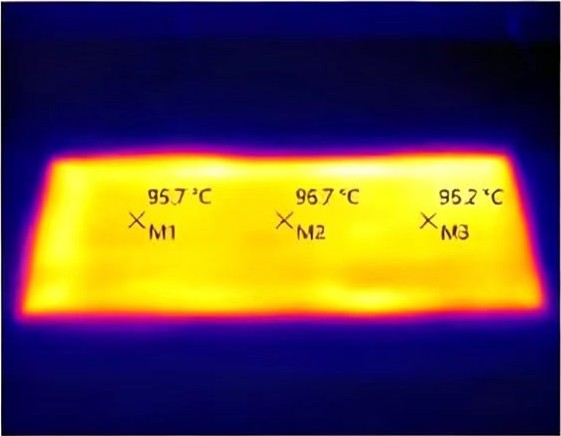
How evenly the panel heats is central to both safety and performance. A well-made panel holds a fairly uniform surface temperature across its face rather than running hot in one area and cool in another, which gives consistent radiation and avoids local overheating. Thermal imaging is used during quality control to check this uniformity and to confirm the surface stays within its designed range. The same evenness supports predictable output: the panel radiates steadily rather than cycling around a single hot element. Because the surface is warm rather than scorching, it is safe to touch briefly in normal operation, though the exact temperature should be checked against the product specification.
How This Differs from Fan and Radiator Heating
A fan heater works almost entirely by convection, forcing a high volume of warmed air across a hot element; it heats the air fast but is noisy, draughty and creates strong temperature differences. A conventional finned radiator also relies heavily on convection, relying on air to circulate over its surface. A flat panel, by contrast, radiates a large share of its output directly and adds only gentle natural convection. The fuller comparison across heater types is set out in the wall panel vs other heaters guide, and the comparison with heat pumps and air conditioning in the heat pump comparison.
Absorption and Re-Radiation in the Room
Radiant energy does not disappear when it reaches a surface. Walls, the floor, ceiling and furniture absorb the infrared and warm slightly, then re-radiate and release some of that warmth gradually. This is why a radiant system tends to warm the whole envelope of a room over time rather than just the column of air, and why the surfaces feel less cold to the touch. It also means the room can hold a comfortable feel with less continuous input, once the surfaces have warmed — a behaviour that works well with a thermostatically controlled schedule and good insulation, since the warmed surfaces act as gentle thermal storage.
Wavelength and Surface Temperature: The Physics in Plain Terms
The amount a warm surface radiates is closely tied to its temperature: radiant output rises with the surface temperature rather than increasing in a straight line, which is why even a modest rise in panel temperature can produce a noticeably stronger radiant feel. The wavelength of the emitted infrared also shifts with temperature, and comfort panels are designed to run at a moderate, even surface temperature that keeps the output in the gentle far-infrared band rather than concentrating heat at a high-temperature element. This is the same reason the panels favour a broad, uniformly warm face over a small, very hot one — spreading the same total wattage across more area keeps each point cooler and safer while still delivering the required radiant energy.
In practical terms, this is why panel wattage and physical size are linked: a higher-wattage panel is generally larger, not simply hotter, so that its surface temperature stays within a comfortable, even range. Running the element at extreme local temperatures would shorten its life, create safety risks and produce uneven radiation, so the design deliberately trades concentrated heat for distributed warmth. These are general physical relationships rather than product-specific figures; the exact surface temperatures are given on the individual panel specification.
How Room Geometry Affects the Radiant Path
Radiation travels in straight lines, so the layout of the room decides how much of the panel’s output actually reaches the occupants. A panel with a clear view of the seating or working area delivers its warmth directly, while one hidden behind tall furniture or heavy curtains radiates mostly into the objects immediately in front of it. The angle and distance matter too: panels positioned to face the main occupied zone, at the mounting height recommended for the product, give the best personal warmth, while a panel mounted too high or angled away sends more of its energy to the ceiling or an empty corner.
For this reason, even a correctly wattaged panel underperforms in a badly planned room, and distributing several panels to cover different zones is often more effective than fitting one large unit in a single spot. The geometry works together with the convection component: leaving some space around the panel allows the gentle natural air cycle to form, while sealing it tightly behind obstructions blocks both the radiant path and the free movement of warmed air. Mounting heights and clearances are covered in the installation guidance, and the aim is simply to give the radiant warmth an unobstructed route into the occupied space.
Efficiency Considerations
All electric heaters convert essentially all the electricity they draw into heat within the room, so the meaningful efficiency differences come from how that heat is distributed and controlled, not from a magical element. A radiant panel’s comfort advantage is that it warms occupants and surfaces directly, which can reduce the need to heat the entire volume of air to a high temperature. Pairing the panel with a good thermostat, adequate insulation and sensible zoning — rather than running it continuously at full power — is where genuine running-cost savings appear. The way controls and setback reduce energy use is covered in the thermostat and sizing guidance.
EMF and Safety
Buyers sometimes ask about electromagnetic fields from electric panels. A correctly designed panel keeps the heating element and its connections arranged to limit fields, and the measured values in normal operation are well within the relevant safety standards. The way such measurements are interpreted is explained in the EMF measurement guide and the EMF safety guide. As with any fixed appliance, proper installation, appropriate electrical protection and use within the specified rating are the practical safety requirements.
Radiant vs Convection Heating: Summary Table
| Factor | Flat infrared panel | Fan / finned convection heater |
|---|---|---|
| Primary transfer | Large radiant share, gentle convection | Mainly convection via moving air |
| Noise and draught | Silent, still air | Fan noise and air movement |
| Warmth target | Surfaces and occupants directly | Room air first |
| Temperature stratification | Low | Often hot air at ceiling |
| Surface feel | Warm, even face | Hot element or fins |
| Best fit | Quiet rooms, retrofit, comfort | Fast temporary air heating |
Frequently Asked Questions
Are graphene wall panels purely radiant? No. They radiate a large share of their warmth but also add some natural convection as air passes over the warm surface; there is no fan.
Does infrared heat the air? It primarily heats surfaces and occupants directly, though the warmed surfaces and the convection component also raise the room air over time.
Why does radiant heat feel warm even before the room air is hot? Because the infrared energy is absorbed directly by people and surfaces, its warmth is felt immediately rather than waiting for the whole air volume to heat.
Is far-infrared radiation safe? The far-infrared band used in comfort heating is a benign form of radiant warmth, and the panels operate within normal electrical and thermal safety requirements.
Do radiant panels use less energy than fan heaters? Electric heaters convert electricity to heat equally at the element; savings come from controls, insulation and warming occupants directly rather than heating large volumes of moving air.
Related Products & OEM Inquiries
SunAura Thermal manufactures graphene heating panels, wall heating film and matching smart thermostats at our own factory, with thermal-imaging and electrical checks used in quality control. With 17 years of production across automated lines and CE, RoHS and ISO documentation, we support distributors and brands with standard and custom panels, private-label options and technical sizing. Contact us with your room details and we can help specify the right radiant solution.